Key takeaways
- Stand versus straps: A steel stand buys you independence from trees and walls but claims a permanent nine-foot rectangle. Tree straps cost you flexibility in placement and gain you a hammock that stores in a shoebox — decide which constraint you can actually live with before comparing anything else.
- Collapse behavior: Ask how the frame breaks down, not merely whether it does. Stands that separate into four or five sections slide behind a wardrobe; welded single-piece frames become furniture you cannot move alone.
- Weight capacity as durability signal: A 450lb or 660lb rating rarely reflects intended load. It tells you the fabric weave and hardware were engineered with margin, which is what keeps a hammock from sagging into the floor after two seasons.
- Fabric versus climate: Woven cotton breathes beautifully indoors and holds moisture badly outdoors. Parachute nylon dries in minutes and packs smaller, but reads as camping gear rather than furniture in a styled room.
- Spreader bars and stability: Spreader bars create a flat, bed-like surface that suits reading and daytime naps. Gathered-end hammocks cocoon more securely and pack tighter, which matters when storage is the scarce resource.
What's inside
Square footage is the quiet villain in most hammock purchases. A nine-foot cotton bed looks weightless in a product photo, then arrives at a third-floor walkup and swallows the only clear wall in the living room. The frustration compounds when the stand turns out to be a permanent installation in disguise — too heavy to shift for vacuuming, too wide to tuck behind a sofa, too committed for a lease that ends in fourteen months. Buyers in small homes are not shopping for relaxation gear so much as negotiating with their floor plan.
This guide approaches hammocks the way I approach any object entering a tight footprint: what does it cost you in space when it is not in use? I have grouped the strongest 2026 options by how they resolve that question — freestanding frames that collapse honestly, strap-based hangs that store in a drawer, and the weight capacities that determine whether a single purchase serves one person or two. Assembly time, carry-bag quality, and the specific dimensions that matter in apartments are all covered below.
As an Amazon Associate we earn from qualifying purchases.




How to Choose a Hammock for a Small Space (2026)
- Stand versus straps: A steel stand buys you independence from trees and walls but claims a permanent nine-foot rectangle. Tree straps cost you flexibility in placement and gain you a hammock that stores in a shoebox — decide which constraint you can actually live with before comparing anything else.
- Collapse behavior: Ask how the frame breaks down, not merely whether it does. Stands that separate into four or five sections slide behind a wardrobe; welded single-piece frames become furniture you cannot move alone.
- Weight capacity as durability signal: A 450lb or 660lb rating rarely reflects intended load. It tells you the fabric weave and hardware were engineered with margin, which is what keeps a hammock from sagging into the floor after two seasons.
- Fabric versus climate: Woven cotton breathes beautifully indoors and holds moisture badly outdoors. Parachute nylon dries in minutes and packs smaller, but reads as camping gear rather than furniture in a styled room.
- Spreader bars and stability: Spreader bars create a flat, bed-like surface that suits reading and daytime naps. Gathered-end hammocks cocoon more securely and pack tighter, which matters when storage is the scarce resource.
The Best Hammocks of 2026, Reviewed
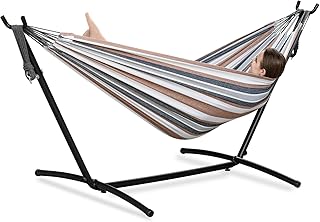
Best Choice Products Double Hammock with Steel Stand (Desert Stripes)
The most complete answer for renters with no trees and no anchor points — Brazilian-style cotton on a sectional steel frame that disassembles into the included carrying bag when guests need the floor. The striped weave is soft enough to double as a daybed, which justifies the footprint in a way plainer models do not.
Best Choice Products 2-Person Woven Cotton Rope Hammock
A classic rope build with spreader bars and a 450lb capacity, which makes it the flattest and most genuinely two-person option here. Buy it if you already have a stand or solid anchor points, since the hammock alone stores in a cupboard and adds nothing to your room when it is down.
Double Hammock with Stand, Heavy-Duty Portable (Coffee)
Marketed as space-saving and, unusually, earning the claim — the 9FT frame is proportioned for balconies and narrow patios rather than open yards, and assembly runs under fifteen minutes without tools drama. The coffee colorway keeps it visually quiet in a small living room.
Kootek Camping Hammock, 500lb Capacity
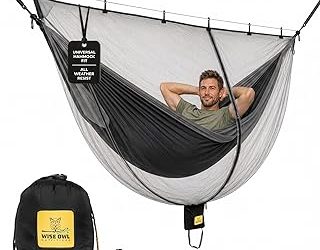
The strongest choice for anyone whose storage is measured in drawers. The 210T parachute nylon and D-shaped carabiners pack to roughly the size of a water bottle, and the tree-friendly straps let you hang it on a porch beam one weekend and a campsite the next.
ANYOO Cotton Camping Hammock, 660lb Capacity
Cotton comfort in a strap-based format, which is a rare combination — you get a breathable weave that feels like furniture with the storage profile of camping gear. The 660lb rating is the highest here and shows in the density of the weave.
Frequently Asked Questions
How much floor space does a hammock stand actually need?
Plan for the stated length plus roughly a foot of clearance at each end, so a 9FT model wants about eleven feet of usable wall. Verify against your longest uninterrupted wall before ordering, not after.
Can I use these indoors year-round?
Cotton and rope models are well suited to indoor use and last longer for it. Nylon hammocks work indoors too, though they read more casually in a furnished room.
Are stands worth it if I have trees?
If you have two sound trees at the right distance, straps are cheaper, lighter, and store almost invisibly. A stand earns its keep only when your hanging options are unreliable or seasonal.
How long does assembly take?
Most sectional steel stands go together in ten to twenty minutes with no tools. Strap-based hammocks are ready in under two.
Final Thoughts
For small homes without anchor points, the Best Choice Products Double Hammock with Steel Stand remains the most versatile purchase of 2026 — it disassembles genuinely rather than nominally. If your storage is the tighter constraint, the Kootek Camping Hammock packs down to nothing while holding 500lbs, and the ANYOO Cotton Hammock delivers the same portability with a far more comfortable weave.