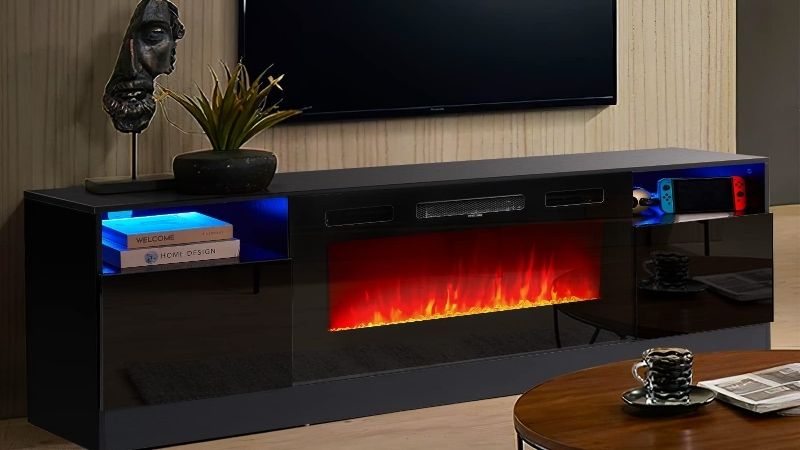
Some electric fireplace TV stands contain internal protective devices, but a replaceable fuse is not guaranteed. If you are wondering are there fuses in a tv stand fireplace, the practical answer depends on the exact fireplace insert. A resettable overheat cutoff, a household breaker, and a one-time thermal fuse are different components. Identify the model before you try to reset or repair anything.
As an Amazon Associate we earn from qualifying purchases.
By KK Home Furnishings Editorial Team
What Protects the Electrical System in a Fireplace TV Stand?
The wooden console normally houses an electrically powered fireplace insert, and the protection described in its manual usually concerns that insert or the household circuit feeding it. A symptom such as “no heat” does not identify a failed fuse on its own. Use the table to distinguish possible causes before checking the exact operating instructions.
| Protection or Part | What It Does | What the Owner May Notice | Appropriate Next Step |
|---|---|---|---|
| Resettable temperature cutoff | Interrupts heater operation after abnormal temperature conditions | Heat stops, sometimes while flame effects still operate | Follow the model’s cooling and reset instructions |
| One-time thermal fuse, if fitted | Opens a circuit after a specified temperature condition | Function may remain unavailable after cooling | Ask the maker or qualified service professional to identify it |
| Household circuit breaker or panel fuse | Protects the home’s electrical circuit | Other receptacles or devices on that circuit may lose power | Check the electrical panel safely; investigate repeated trips |
| Thermostat or temperature sensor | Regulates heat or reports temperature conditions | No heat, intermittent heating, or a model-specific error code | Check settings and the manual’s error-code guidance |
| Control board, switch, or power connection | Controls and distributes electrical power in the appliance | Unit does not respond, or only some functions respond | Check external power; contact support for internal faults |
| Remote-control battery | Supplies power to the handheld transmitter, not the heater | Remote fails while manual controls may still work | Replace the specified battery and try the unit’s controls |
A Fuse Is Not the Same as a Resettable Thermal Cutoff
A conventional fuse opens an electrical path when its rated condition is exceeded; a one-time thermal fuse is not restored merely by waiting for the appliance to cool. By contrast, some fireplace inserts have a temperature cutoff that the user can reset through an approved power-off or unplug procedure. The component type must come from the specific model’s documentation.
For example, the Dimplex DF3015 owner’s manual describes a temperature cutoff switch that can be reset after unplugging the fireplace for five minutes. That is evidence for the DF3015’s reset procedure, not evidence that every console fireplace has an accessible fuse or the same waiting period [Dimplex, DF3015 Owner’s Manual].
The Fuse in Your Electrical Panel Is a Separate Issue
When a manual says a “fuse blows,” it may mean the fuse protecting the home’s wiring rather than a replaceable component inside the fireplace. The Dimplex DF3015 manual discusses a 120-volt, 15-amp circuit and warns that other devices on the same branch circuit can contribute to repeated breaker trips or blown household fuses [Dimplex, DF3015 Owner’s Manual].
A heater marked 1,500 watts at 120 volts can demand about 12.5 amps under its rated conditions, which leaves limited capacity on a typical 15-amp household circuit for other loads. Do not assume a larger fuse or breaker is the solution: circuit protection must match the wiring, and electrical upgrades are a job for a qualified electrician.
Start With the Fireplace Insert’s Exact Model Number
Look for the manufacturer and model on the fireplace insert’s rating label, purchase documentation, or supplied manual. A furniture brand and an insert brand may differ. Search the specific manual for “temperature cutoff,” “overheat,” “fuse,” “thermal switch,” “reset,” and “troubleshooting” before deciding what the protective device actually is.
Two Dimplex documents show why model matching matters. The DF3015 owner’s manual describes a five-minute unplug reset, while the Optimyst Linear service manual describes a 30-minute cool-down after its thermal cutoff engages. Those instructions must not be swapped between products [Dimplex, DF3015 Owner’s Manual; Optimyst Linear Service Manual].
Six Common Symptoms and the Safest Next Check
Determine exactly what stopped working: the entire unit, the heat, the lights, the remote, or household power. That distinction helps separate a settings problem from an overheat event and a possible circuit fault. The checks here stop at user-accessible controls, visible cords, ventilation, and manufacturer-authorized reset procedures.
The Fireplace Will Not Power On at All
First confirm that the power button is on and that the plug is securely connected to a suitable wall receptacle. If it is safe to do so, check whether that outlet supplies power to a different low-power device. A dead receptacle, switched outlet, or tripped household breaker can make the fireplace appear to have blown an internal fuse.
If power is present but both heat and flame effects remain off, consult the model’s troubleshooting chart instead of guessing at an internal component. Stop using the fireplace if the plug is hot, discolored, melted, loose, or damaged. The maker or a qualified technician should assess faults that require opening the enclosure.
The Flames Work but the Heater Does Not
When the display and flame effect still operate, incoming power is reaching at least part of the insert. Verify that the heat function is enabled and that the temperature setting calls for heat. Some models provide an independent flame-only mode; its operation does not establish that a heater’s protective device is intact.
A thermal cutoff or sensor fault is one possible explanation, but not the only one. Dimplex technical support identifies overheat protection and obstructed ventilation among the causes of heaters turning off. Follow the exact model’s reset advice only after checking visible vents, and seek service if heat does not return [Dimplex, Technical Support].
Heat Stops After Several Minutes of Operation
Repeated shutdown during heating may indicate overheating, restricted airflow, an automatic temperature control, or another fault. First distinguish normal thermostat cycling from an unexpected shutdown accompanied by an error display. Check that the insert’s air inlet and outlet have the clearances required by its own installation guide.
Dimplex explains that blocked air-intake slots can trip an overheat cutoff on some of its fireplaces. If your manual permits a cool-down and restart, follow that instruction once the obstruction is corrected. If the condition returns, disconnect power and contact support rather than repeatedly resetting the heater [Dimplex, Technical Support].
The Circuit Breaker Trips When the Heat Turns On
Heating draws substantially more power than a decorative flame effect in many electric fireplace inserts. A breaker that trips only when heat starts may signal an overloaded branch circuit or a fault requiring diagnosis. The Optimyst Linear service manual lists an inappropriate circuit current rating as a possible cause of breaker trips or blown panel fuses [Dimplex, Optimyst Linear Service Manual].
Unplug the fireplace and other high-demand devices on the affected circuit. Do not repeatedly reset a tripping breaker, substitute a higher-rated fuse, or bypass a safety device. If the breaker trips again when the fireplace is connected, stop testing and have an electrician and the manufacturer’s service team determine whether the problem lies in the wiring or appliance.
The Remote Stops Working but the Manual Controls Respond
A dead remote battery or failed transmitter is more plausible than a heater fuse when buttons on the fireplace itself still work. Check the remote’s battery type and orientation against the manual, and remove any shipping insulation tab if the remote is new. Recheck whether the fireplace’s main power or control switch must be enabled for remote operation.
Do not disassemble the heater to address an isolated remote-control issue. Test the manual controls without engaging the heat if you need to see whether the user interface is responsive. Some fireplace manuals describe remote faults separately from heater and circuit faults, so following those categories can prevent unnecessary service work.
You Suspect a Fuse Has Failed Inside the Insert
Stop at the model documentation. Some appliance designs contain internal fusing or thermal protection, but that does not mean there is a user-accessible fuse drawer or an approved do-it-yourself replacement. An internal part that has opened may reflect a more serious underlying problem, and replacing it without diagnosis can leave the cause unresolved.
Photograph the product label and note the precise symptom, any error code, and whether the failure happened during heating. Give that information to the manufacturer’s support team or an appropriately qualified repair professional. Never bridge a fuse, defeat a thermal cutoff, or install a component with a guessed current or temperature rating.
Frequently Asked Questions About Electric Fireplace Fuses
The questions below address component location, replacement, and the difference between an approved reset and a repair. Exact instructions vary by fireplace insert, even when two TV consoles look similar. Treat the product manual as the controlling document and use professional service where internal electrical components are involved.
Where Is the Fuse Located in a TV Stand Fireplace?
There is no universal fuse location. Some manuals specify a temperature cutoff but do not identify any owner-replaceable internal fuse. Others refer to a household circuit fuse rather than a part inside the appliance. The furniture’s access panel, an apparent rear cover, or a control-board compartment is not proof that the owner should open it.
If your manual lists a serviceable fuse, follow its exact instructions and restrictions. If the manual does not describe a fuse location or owner replacement, do not search inside a plugged-in or recently heated fireplace. Ask the manufacturer to identify the relevant component and whether an authorized technician must service it.
Can I Replace an Electric Fireplace Fuse Myself?
Only if the specific manufacturer expressly provides an owner-service procedure for that exact part and model. Many apparent “fuse problems” can instead involve a resettable overheat switch, a household breaker, a failed sensor, or an electronic control fault. Replacing a guessed part will not reliably identify the underlying cause.
Do not substitute a different fuse type, current rating, or thermal cutoff specification, and do not bypass the protective device for testing. If an appliance has suffered overheating or recurring electrical faults, contact its manufacturer or an appropriately qualified repair technician before putting it back in service.
How Long Should I Leave the Fireplace Unplugged?
Use the waiting period in your exact manual, not a generic online rule. Dimplex’s DF3015 documentation specifies five minutes for its temperature cutoff reset. A different Dimplex service manual, for Optimyst Linear, describes allowing 30 minutes for its heater to cool after the thermal cutoff engages [Dimplex, DF3015 Owner’s Manual; Optimyst Linear Service Manual].
Always turn the appliance off first and keep combustibles and obstructions away from its vents as directed. If the model requires a different sequence or advises service instead of resetting, follow that instruction. Repeated protective trips are a reason to stop using the heater, not to keep extending or shortening the cooling interval.
Can a Fireplace Keep Working After Its Heater Shuts Down?
Yes, depending on its control design. A fireplace insert may operate decorative lighting while heat is switched off or limited by temperature protection. That behavior means only that some electronics still receive power; it does not prove the heater is undamaged, the wiring is sound, or an internal safety component has reset successfully.
Use the display and the exact manual to identify whether the unit is in a normal flame-only setting, a thermostat-controlled idle state, or an error condition. Never use continuing flame operation as permission to ignore a burning smell, abnormal noise, damaged cord, or recurrent shutdown. Disconnect power and seek qualified help if such symptoms appear.
Final Thoughts
So, are there fuses in a tv stand fireplace? There may be internal protection, but an accessible replaceable fuse is not a feature you can assume. Identify the fireplace insert’s model, distinguish a household breaker from a thermal cutoff, and follow only the documented owner checks. Persistent trips, overheating, and suspected internal faults belong with qualified service rather than improvised repairs.
More from Amazon
Programs that pair well with the guide above. Offers and eligibility are set by Amazon and may change.
Collect the home and kitchen items you want in one registry that guests can shop from.
Create a wedding registrySet up recurring deliveries of everyday items on eligible products. Terms and savings are set by Amazon.
Explore Subscribe & SaveFree shipping on eligible items, Prime Video and more. Eligible new members can start with a free trial.
Start a Prime free trialAudiobooks and podcasts to listen to on the go. Eligible new members can start with a free trial.
Try Audible freeAs an Amazon Associate we earn from qualifying purchases.