Key takeaways
- Above a sofa: Install the bottom of the shelf 8-12 inches above the top of the sofa back. For a standard 32-36 inch high sofa, this puts the shelf at 48-60 inches from the floor. Leave at least 4-6 inches of horizontal clearance from the sofa ends so the shelf appears centered and not crowded.
- Above a TV or console: Mount 6-10 inches above a 28-34 inch high media console. Keep the shelf narrower than the console below it by at least 6 inches on each side (for example, a 60-inch console pairs well with a 36- to 48-inch shelf).
- Standalone display wall: In a typical 10×12 ft living room with 8-foot ceilings, hang the primary shelf at 52-58 inches from the floor (eye level) and leave 16-20 inches of vertical space between stacked shelves to accommodate books (10-12 inches tall), vases, and framed art without crowding.
- Clearance for traffic: If the shelf is along a hallway or beside a doorway, keep the shelf depth to 8-10 inches max and maintain at least 36 inches of clear floor space for walkways.
For most living rooms and bathrooms, the best floating shelves for wall storage and display are solid wood with hidden steel brackets if you need 30-50 lbs per shelf for books and decor, powder-coated metal with integrated brackets if you need maximum strength and moisture resistance, and MDF with hollow-core construction if you want a lightweight, affordable display shelf for under 15 lbs.
Wood vs. MDF vs. Metal: The Core Trade-Offs
All three materials can look like a true floating shelf, but they differ significantly in how much they hold, how they mount, and where they last. Your choice should be driven by what you plan to put on the shelf, not just the finish.

Ikea LACK Rack Wall Shelf Unit, White 402.821.87
Included for 'Best Floating Shelves for Wall Storage and Display' because the listing specifies White 402.821.87, details this guide uses to compare options.
View on Amazon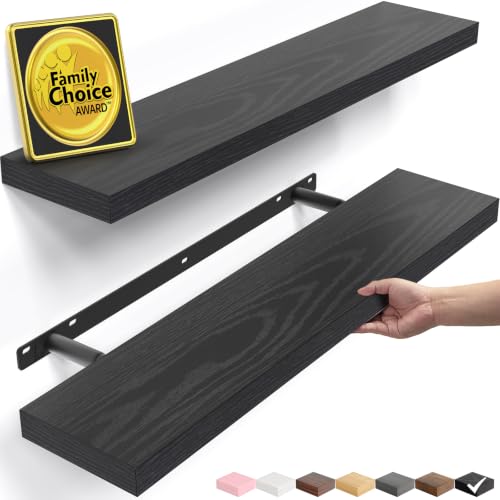
BAYKA Black Floating Shelves 22.5in, Set of 2, Wall Mounted for Wall Decor
Included for 'Best Floating Shelves for Wall Storage and Display' because the listing specifies Set of 2 and Wall Mounted for Wall Decor, details this guide uses to compare options.
View on Amazon
BAYKA Black Floating Shelves 15.7in, Set of 3, Wall Mount Rustic Wood Shelf
Included for 'Best Floating Shelves for Wall Storage and Display' because the listing specifies Set of 3 and Wall Mount Rustic Wood Shelf, details this guide uses to compare options.
View on Amazon
Amada 15.7" Floating Shelves for Wall Decor & Storage, Set of 3, White
Included for 'Best Floating Shelves for Wall Storage and Display' because the listing specifies Set of 3 and White, details this guide uses to compare options.
View on Amazon| Feature | Solid Wood / Butcher Block | MDF / Engineered Wood (Hollow-Core) | Metal (Steel / Aluminum) |
|---|---|---|---|
| Typical Weight Capacity (per 24-36″ shelf, into studs) | 30-50 lbs | 10-20 lbs | 40-75 lbs |
| Weight Capacity (drywall anchors only) | 15-25 lbs | 5-10 lbs | 20-35 lbs |
| Common Bracket Type | Concealed steel bar / French cleat | Plastic or thin metal sleeve + dowel | Welded integrated bracket or heavy-duty cantilever |
| Shelf Thickness | 1.5″ – 2″ | 1″ – 1.5″ | 0.25″ – 1″ |
| Moisture Resistance | Moderate – needs sealed finish for bathrooms | Low – swells with humidity if not sealed | High – powder-coated steel resists rust |
| Sag Resistance Over Time | Excellent | Prone to sag on spans over 30″ | Excellent, no sag |
| Typical Price Per Shelf (2026) | Usually $45–$120 | Usually $15–$45 | Usually $35–$90 |
| Best For | Books, plants, heavy decor | Light decor, photos, small plants | Bathrooms, kitchens, heavy storage |
Solid wood shelves are typically made from pine, oak, or acacia and use a solid slab. They resist warping and hold screws firmly, which is why they handle heavier loads. MDF shelves are usually a hollow-core box wrapped in veneer or laminate to mimic wood at a lower weight and cost. They look clean but rely on the outer skin for strength, so they sag and chip more easily. Metal shelves are bent or welded steel with a powder-coated finish – thinner profile, much higher strength-to-weight ratio, and the best option for humid environments.
Bracket Type Determines Real-World Strength
A floating shelf is only as strong as its mounting hardware and what it is anchored into. Always anchor at least one bracket point into a wall stud for anything over 10 lbs. For drywall-only installs, use heavy-duty toggle bolts, not the small plastic anchors included in most kits.
1. Concealed Steel Bar (Most Common for Wood)
A solid steel rod or flat bar is screwed horizontally into studs, then the shelf slides over it. The bar must be at least 1/2 to 2/3 the depth of the shelf to prevent tilting. For a 10-inch deep shelf, look for a 6- to 7-inch long bracket bar. This type holds 30-50 lbs when hit into two studs, but will tilt forward if overloaded at the front edge.
2. French Cleat / Interlocking Bracket
A wall-mounted cleat interlocks with a groove in the back of the shelf. Easier to level than a bar system and distributes weight across a wider area. Common on MDF and lighter wood shelves. Capacity is usually 15-30 lbs into studs. Ideal for renters who want easier removal because the cleat leaves only a few screw holes.
3. Hollow-Core Sleeve with Dowel Pins
Found on most low-cost MDF floating shelves. A thin bracket with small dowels slides into a hollow cavity. It creates a clean look but provides the least support. Even into studs, limit these to 10-15 lbs per 24-inch shelf and avoid spans over 36 inches to prevent visible sag within 6-12 months.
4. Welded Integrated Metal Bracket
The bracket is welded directly to the metal shelf as one piece. This eliminates the slide-and-sag problem entirely. When lag-bolted into studs, these routinely hold 50-75 lbs for a 24-inch wide shelf. This is the correct choice for bathroom storage with folded towels, mason jars, or small appliances.
Ideal Install Height and Clearance by Room
Incorrect height is the most common reason floating shelves look awkward or become unusable. Use these measurements rather than eye-balling it.
Living Room Guidelines
- Above a sofa: Install the bottom of the shelf 8-12 inches above the top of the sofa back. For a standard 32-36 inch high sofa, this puts the shelf at 48-60 inches from the floor. Leave at least 4-6 inches of horizontal clearance from the sofa ends so the shelf appears centered and not crowded.
- Above a TV or console: Mount 6-10 inches above a 28-34 inch high media console. Keep the shelf narrower than the console below it by at least 6 inches on each side (for example, a 60-inch console pairs well with a 36- to 48-inch shelf).
- Standalone display wall: In a typical 10×12 ft living room with 8-foot ceilings, hang the primary shelf at 52-58 inches from the floor (eye level) and leave 16-20 inches of vertical space between stacked shelves to accommodate books (10-12 inches tall), vases, and framed art without crowding.
- Clearance for traffic: If the shelf is along a hallway or beside a doorway, keep the shelf depth to 8-10 inches max and maintain at least 36 inches of clear floor space for walkways.
Bathroom Guidelines
- Above the toilet: Mount the bottom shelf 24-30 inches above the tank lid (typically 56-64 inches from the floor) to allow easy access and prevent head contact when standing. Depth of 6-8 inches is ideal to avoid bumping.
- Above a vanity: Install 18-22 inches above the vanity countertop or 12-16 inches above the top of the backsplash. Keep depth to 6 inches if near a medicine cabinet to avoid interfering with the door swing.
- In a shower or wet zone: Only use powder-coated metal or sealed teak/acacia wood. Mount with stainless steel hardware and maintain at least 2 inches of gap between the shelf end and the shower glass or tile corner for ventilation.
- Humidity note: MDF will swell at exposed edges in a bathroom with no exhaust fan. If you must use MDF there, seal all edges with polyurethane and expect a shorter lifespan of 2-3 years versus 7-10+ years for sealed wood or metal.
Decision Matrix: Which Floating Shelf Should You Choose?
Match your situation to the right material and bracket system instead of shopping by look alone.
| Your Situation | Best Choice | Why It Works |
|---|---|---|
| Small apartment, need to display books and heavy plants | Solid wood, 1.5″ thick, concealed steel bar into studs | Highest capacity for weight without visual bulk; resists sag over time |
| Renter, light decor only (photos, candles), drywall walls | MDF or lightweight engineered wood, French cleat with toggle bolts | Low cost, few holes, adequate for under 10 lbs; easy to patch on move-out |
| Family with kids and pets, things will be bumped | Solid wood or metal with integrated bracket, lag bolts into studs | Most resistant to pull-out and tilt from accidental impact |
| Bathroom storage for towels, toiletries, humid air | Powder-coated metal or sealed solid acacia/teak | Will not swell, rust, or sag in moisture; easy to clean |
| Need a thin, modern look for minimal decor | Metal, 0.5″ – 0.75″ profile | Slimmest sightline while still holding 30+ lbs |
| Budget makeover for a large wall, multiple shelves | MDF hollow-core, 24-30″ wide max per shelf | Keeps total cost usually $60–$150 for a set of 3-4; keep spans short to avoid sag |
Assembly, Moving, and Durability Realities
Floating shelves ship flat and seem simple, but installation determines durability.
- Box weight and handling: A 36-inch solid wood shelf weighs 8-14 lbs per shelf; a comparable MDF shelf weighs 4-7 lbs; a metal shelf weighs 6-9 lbs. Two-person lifting is recommended for shelves over 36 inches to keep the bracket level while marking studs.
- Doorway and wall fit: Most shelves ship in 24-, 36-, and 48-inch lengths. Measure stud spacing (typically 16 inches on center in US homes) before buying. A 36-inch shelf will span two studs reliably; a 48-inch shelf will span three, which is ideal for heavy loads.
- What wears first: On MDF, the laminate edge and screw holes strip first, especially after one or two moves. On solid wood, the finish around the bracket entry point can crack if overtightened. On metal, the powder coating can chip at corners if hit – touch-up paint prevents rust.
- Reusability after moving: Wood and metal shelves with solid steel bars can be reinstalled 3-4 times if you fill old holes. Hollow-core MDF rarely survives a second install with the same holding strength because the internal dowel channels loosen.
- Leveling tip: Use a 24-inch or longer level across the bracket, not just the shelf top. A 1/8-inch tilt at the wall becomes a 1/2-inch drop at the front edge of a 10-inch deep shelf and will cause items to slide.
How to Choose Size and Depth
For living room display, an 8- to 10-inch deep shelf accommodates most books, 6-inch plant pots, and framed 8×10 photos without overhang. For bathrooms, 6- to 8-inch depth is more functional and keeps the profile from overwhelming a narrow room. Avoid depths over 12 inches for any true floating design – the leverage greatly reduces weight capacity and increases the risk of wall damage.
Length matters for sag. For MDF, do not exceed 30 inches without center support if you plan to place books. For solid wood and metal, 36-48 inches is safe when anchored into studs. If you need a 60-inch run, use two 30-inch shelves with a small 1-2 inch gap rather than one long span.
Frequently Asked Questions
How much weight can floating shelves for wall actually hold?
Into studs with proper brackets: MDF 10-20 lbs, solid wood 30-50 lbs, metal 40-75 lbs per 24-36 inch shelf. Into drywall anchors only, reduce those numbers by about 50%. Always check the bracket’s listed capacity and stud requirement in the product specifications.
Can I install floating shelves on drywall without studs?
Yes for light display under 10-15 lbs using toggle bolts rated for 50 lbs per anchor in 1/2-inch drywall. For books, kitchen items, or bathroom storage, you must hit at least one stud. Use a stud finder and confirm with a small pilot hole.
Are floating shelves strong enough for books?
Solid wood and metal shelves are. A single linear foot of hardcover books weighs about 10-12 lbs, so a 36-inch shelf full of books can approach 30-36 lbs. Use solid wood or metal with concealed steel or integrated brackets and avoid hollow-core MDF for book storage.
What is the best floating shelf for a bathroom?
Powder-coated steel or sealed solid wood like teak or acacia. Both resist humidity, support towels and toiletry weight, and clean easily. Avoid raw pine or unsealed MDF in bathrooms.