Key takeaways
- Total length vs. your anchor gap: Measure the distance between your two anchor points before buying. A 10ft pair covers most balconies and backyard trees; 20ft sets exist for wide gaps or thick trunks that swallow several feet of webbing on the wrap alone.
- Loop count and spacing: More loops means finer control over the 30-degree hang angle that makes a hammock comfortable. Sets with 30-plus loops let you shift seat height by an inch or two, which matters when you’re clearing a coffee table or radiator.
- Stated capacity and stretch: Look for polyester webbing rated well above your body weight. Nylon stretches under load and keeps sagging as the evening goes on, so you end up re-adjusting mid-nap.
- Tree and wall friendliness: Wide webbing, typically 0.75 inch or more, spreads pressure instead of cutting into bark. On indoor mounts, wider straps also reduce point stress on the hardware.
- Packed footprint: If storage is the whole reason you chose a hammock, check that the set includes a stuff sack and folds down small enough to live in a closet bin or under a bed.
What's inside
A hammock takes up almost no room when it’s not in use, which is exactly why it works so well in apartments, dorms, narrow balconies, and bedrooms where a lounge chair would eat the entire floor plan. The catch is the suspension. Most people buy the hammock, hang it from whatever’s nearby, and discover the hard way that rope knots slip, distance between anchor points is never what you guessed, and a strap that’s too short leaves you either sitting on the ground or hanging so tight the fabric loses its curve. In tight quarters that margin of error is brutal, because you rarely get to choose your anchor spacing — you work with the two trees, posts, or wall studs you already have.
Adjustable daisy-chain straps solve this by giving you dozens of pre-sewn loops instead of one fixed length, so you can dial in sag and seat height without re-rigging anything. Below I’ve broken down the straps worth owning in 2026, what separates a genuinely load-rated set from a lightweight bundle of webbing, and how to match strap length to the space you actually have rather than the campsite you’re imagining.
As an Amazon Associate we earn from qualifying purchases.


How to Choose a/an Hammock Strap (2026)
- Total length vs. your anchor gap: Measure the distance between your two anchor points before buying. A 10ft pair covers most balconies and backyard trees; 20ft sets exist for wide gaps or thick trunks that swallow several feet of webbing on the wrap alone.
- Loop count and spacing: More loops means finer control over the 30-degree hang angle that makes a hammock comfortable. Sets with 30-plus loops let you shift seat height by an inch or two, which matters when you’re clearing a coffee table or radiator.
- Stated capacity and stretch: Look for polyester webbing rated well above your body weight. Nylon stretches under load and keeps sagging as the evening goes on, so you end up re-adjusting mid-nap.
- Tree and wall friendliness: Wide webbing, typically 0.75 inch or more, spreads pressure instead of cutting into bark. On indoor mounts, wider straps also reduce point stress on the hardware.
- Packed footprint: If storage is the whole reason you chose a hammock, check that the set includes a stuff sack and folds down small enough to live in a closet bin or under a bed.
The Best Hammock Strap (2026)s Reviewed
Foxelli XL Hammock Straps
At 20ft per strap with 40-plus loops and a 2,000 lb rating, this is the set to buy when your anchor points are frustratingly far apart or wrapped in wide trunks. The no-stretch polyester holds its adjustment all afternoon, and the included carry bag keeps the whole rig compact between uses.
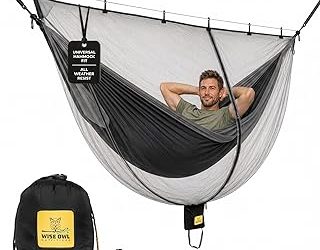
Wise Owl Outfitters Hammock Straps
A well-built 10ft kit with 38 loops, carabiners, and hooks that covers the majority of standard setups without excess webbing to manage. Wise Owl’s stitching quality is consistently good, making this a reliable default for anyone hanging in the same two spots regularly.
MalloMe Hammock Straps for Trees
MalloMe’s multi-purpose kit is the versatile pick, working equally well across two trees or over a single sturdy branch. Useful if you rotate the hammock between a balcony rail and a backyard tree depending on the day.
SZHLUX Hammock Straps
Two 10ft straps, 38 loops, and two carabiners at a price that makes this an easy first upgrade from knotted rope. Adjustment is fast and repeatable, which is what you want if you’re taking the hammock down every morning.
Heavy Duty Long Extender Webbing Kit
This 10ft set with 32 loops and a 1,000 lb per-strap rating leans toward the extender role, adding reach when your hammock’s built-in suspension falls short. Fewer loops than the leaders, but plenty of adjustment for a fixed installation.
Frequently Asked Questions
How far apart should my anchor points be?
Roughly 12 to 15 feet is ideal for a standard hammock. Closer than that and you’ll need to hang the ends higher; further apart calls for a longer strap set like a 20ft pair.
Can I use these indoors?
Yes, but the straps are only as strong as what they’re attached to. Anchor into wall studs or ceiling joists with rated hardware, never drywall alone.
Do straps damage trees?
Wide webbing straps are the tree-safe option and are required at most parks precisely because they don’t bite into bark the way rope does. Choose 0.75 inch or wider and wrap around trunks at least 6 inches thick.
Why does my hammock keep sagging lower over time?
That’s nylon stretch. Polyester webbing marketed as no-stretch holds its set length far better, so pick that if you’re annoyed by constant readjustment.
Final Thoughts
For most compact spaces, the Wise Owl Outfitters 10ft kit hits the right balance of loop count, build quality, and packed size. Step up to the Foxelli XL set if your anchors are far apart or you want maximum adjustment range, and consider the MalloMe kit if you need one set that adapts to several different hanging spots.