Key takeaways
- Heat output: Match BTU capacity to the area and exposure. A small, sheltered seating nook needs far less output than an open deck or restaurant-style patio.
- Fuel connection: Confirm that you have a properly installed natural gas line, compatible fittings, and enough reach for the intended placement. Never substitute an improvised hose or connector.
- Clearance and footprint: Measure vertically and horizontally around tables, umbrellas, railings, and overhangs. In a small space, a narrow wheeled tower is often more practical than a large fixed unit.
- Safety controls: Look for anti-tilt protection, automatic shutoff, sturdy bases, guarded burners, and clear manufacturer clearance requirements.
- Installation category: Check whether the product is a true outdoor radiant heater or a pool-and-spa heating system. Pool heaters are not interchangeable with patio heaters and usually need professional installation.
What's inside
Choosing a natural gas patio heater is less straightforward than comparing wattage on a shelf label. Buyers must balance fixed gas-line requirements, clearance around furniture, heat coverage, ignition controls, and the realities of a compact outdoor space. A powerful unit can be wasteful—or simply unsuitable—if it overwhelms a small terrace or cannot be positioned safely.
This guide focuses on the details that matter in real homes: footprint, installation, output, portability, safety features, and whether a product is designed for people or for pool and spa water. The shortlist includes patio heaters alongside several high-output natural gas heaters that may appear in related searches but require very different installation and use.
As an Amazon Associate we earn from qualifying purchases.


How to Choose a Natural Gas Patio Heater (2026)
- Heat output: Match BTU capacity to the area and exposure. A small, sheltered seating nook needs far less output than an open deck or restaurant-style patio.
- Fuel connection: Confirm that you have a properly installed natural gas line, compatible fittings, and enough reach for the intended placement. Never substitute an improvised hose or connector.
- Clearance and footprint: Measure vertically and horizontally around tables, umbrellas, railings, and overhangs. In a small space, a narrow wheeled tower is often more practical than a large fixed unit.
- Safety controls: Look for anti-tilt protection, automatic shutoff, sturdy bases, guarded burners, and clear manufacturer clearance requirements.
- Installation category: Check whether the product is a true outdoor radiant heater or a pool-and-spa heating system. Pool heaters are not interchangeable with patio heaters and usually need professional installation.
The Best Natural Gas Patio Heaters (2026) Reviewed
Golden Flame XL-Series Natural Gas Patio Heater
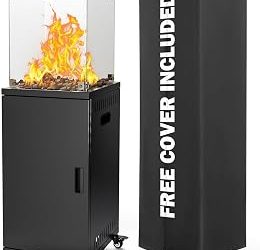
The Golden Flame XL-Series is the most natural fit here for a conventional outdoor seating area. Its 45,000 BTU output, tall profile, wheels, push-button ignition, and anti-tilt safety feature suit patios where furniture needs to be rearranged frequently. The hammered silver or pewter finish also blends more easily with outdoor furniture than many utilitarian commercial units.
Adjustable-Height Natural Gas Patio Heater with 24-Foot Hose
This adjustable model is appealing for flexible layouts, particularly when a small patio serves several purposes across the seasons. Its 55-to-78-inch height range and included 24-foot hose may simplify positioning, but buyers should verify local gas, CSA, and installation requirements rather than relying on certification claims alone.
JXiQ Natural Gas Heater, 400K BTU, Copper Exchanger
The JXiQ400NK is a very high-output heater with a copper exchanger, making it more relevant to pool or spa heating than to a compact patio seating zone. Its 400,000 BTU capacity is excessive for most residential outdoor comfort applications, so it belongs on a pool-equipment shortlist—not beside a dining table or lounge chair.
Pentair EC-462024 Natural Gas 125K Heater
The Pentair EC-462024 is another pool-focused natural gas heater rather than a patio radiant heater. Its 125,000 BTU rating may suit a properly sized pool or spa system, but it requires the correct plumbing, venting, gas supply, and installation approach; it should not be used as a freestanding outdoor space heater.
Raypak 014784 PR156AENC 150,000 BTU Natural Gas Heater
The Raypak PR156AENC is designed for heating pool or spa water and is best considered by homeowners planning a dedicated mechanical-room or equipment-pad installation. Its substantial output can be useful in that setting, but it offers none of the direct radiant warmth, mobility, or furniture-friendly footprint expected from a patio heater.
Frequently Asked Questions
Is natural gas better than propane for a patio heater?
Natural gas is convenient when a permanent line is already available, since there are no cylinders to refill or store. Propane is generally easier for renters and movable layouts because the heater can operate away from a fixed utility connection.
How much area can a natural gas patio heater warm?
Coverage depends on the BTU output, reflector design, wind, temperature, and whether walls or screens retain warmth. Treat published coverage as a starting point, then position the heater close enough to the seating area without violating required clearances.
Can a pool heater be used as a patio heater?
No. Pool and spa heaters transfer heat into water and require plumbing, combustion ventilation, and safety systems intended for that application. They are not substitutes for radiant outdoor heaters and should not be adapted for people-warming use.
Where should a patio heater go in a small outdoor space?
Place it beside—not directly behind—the primary seating cluster, with clear space above and around the reflector. Keep it away from curtains, cushions, branches, railings, and low ceilings, and preserve a clear path so the unit cannot become a trip hazard.
Final Thoughts
For most compact patios, the Golden Flame XL-Series is the strongest all-around choice, while the adjustable-height heater is worth considering when reach and repositioning matter most. The JXiQ, Pentair, and Raypak models are capable pool and spa systems, but they should be selected only for that purpose and installed according to professional requirements.