
Key takeaways
- The best squat rack for a home gym should suit the intended lifter, bar and squat setup within its documented configuration. Compare the support and...
What's inside
- Bring a specific squat requirement to the comparison
- Check the support positions
- Understand the specified safety system
- Product listings to compare
- Choose the format through its requirements
- Make the walk-in and return paths clear
- Compare complete purchase terms
- Keep the setup specific as it evolves
- Additional product links
- Related reading
The best squat rack for a home gym should suit the intended lifter, bar and squat setup within its documented configuration. Compare the support and safety arrangements before optional storage or cosmetic details. A full cage, half rack and another rack format may have different requirements; none should be treated as automatically suitable because its footprint fits the room.
This guide provides practical selection and use considerations. It does not report hands-on product testing.
Bring a specific squat requirement to the comparison
Use qualified instruction to establish the movement and appropriate setup. Identify the bar and any other required equipment. The rack should support that understood task rather than determine a new technique through whichever positions happen to be available. Keep personal load selection separate from product capacity claims.
If the exercise is unfamiliar, learn it through an appropriate process before planning heavy home use. A shopping article cannot assess a lifter’s movement or assistance needs. The useful outcome is a clear setup requirement that can be checked against the manufacturer’s instructions.
Check the support positions
Read how the bar supports adjust and how their position is secured. Ask whether the available range and configuration suit the intended user and bar. Do not infer compatibility from a photograph of another lifter. An appropriate demonstration with guidance can help clarify the question without turning it into a demanding lifting test.
Check access for placing and removing the bar as instructed. Include the space beside the rack for handling plates. A frame can be narrow enough for a room while the bar and ordinary loading process are not. Measure the complete arrangement using the actual equipment, not a generic rack outline.
Understand the specified safety system
Identify the safety components supplied or required for the chosen configuration. Learn their correct positioning for the task with qualified guidance. Do not assume that any pair of arms or straps can be fitted to any rack, or that the mere presence of a safety accessory makes every setup appropriate.
Read the maker’s limits and installation requirements for those components. Keep the exact compatibility information available. Do not deliberately fail an unfamiliar loaded squat to evaluate the product. Appropriate setup checks and instruction should precede use, with unresolved questions addressed before increasing demands.
Product listings to compare
As an Amazon Associate we earn from qualifying purchases at no extra cost to you. Product prices and availability are accurate as of the date shown and are subject to change. Compare the selected variant and its current description with the requirements above.
As an Amazon Associate we earn from qualifying purchases at no extra cost to you. Product prices and availability are accurate as of the date shown and are subject to change.


Choose the format through its requirements
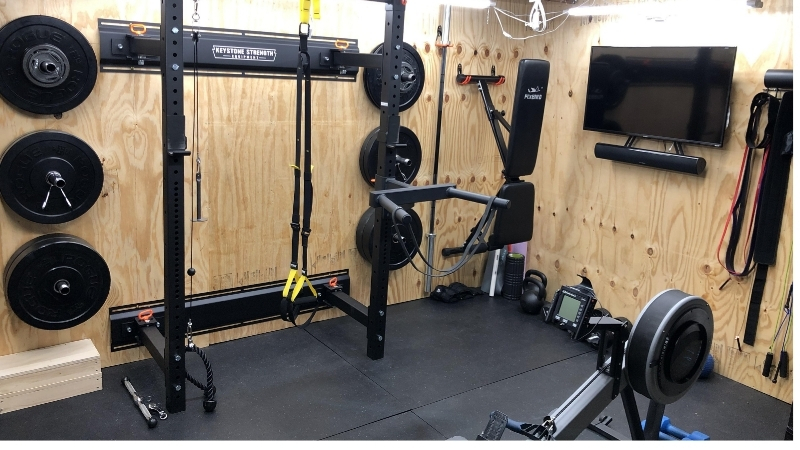
Compare the complete installation for each candidate. A folding wall-mounted rack requires a suitable documented mounting arrangement and a workable deployment process. Another design may need a different anchoring or floor setup. Ask appropriate professionals about the actual structure when necessary.
Do not assume that adding plates to storage pegs replaces a specified fixing method. Likewise, a floor covering does not establish structural capacity. Keep installation questions distinct from room styling. An attractive compact rack remains unsuitable if the required installation cannot be completed correctly.
Make the walk-in and return paths clear
Draw the user approach, equipment handling and required movement space. Keep doors, other occupants and stored objects outside those areas. Do not use spare space inside the rack as general storage while expecting it to remain immediately ready for exercise.
If the room changes function between sessions, describe exactly what is moved and where it goes. Follow handling instructions for the equipment. A rack that can be folded may restore floor space, but that benefit depends on the actual process being practical for the household.
Compare complete purchase terms
Confirm which supports, safety components and installation hardware are included. Check whether delivery reaches the intended location and what assembly remains. Read return conditions before relying on sending back a fully assembled system if the room assessment was incomplete.
Ask how replacement components and support are obtained. Keep model details and manuals together, including any instructions specific to the installed format. A long frame warranty is not a substitute for knowing how an essential worn or damaged part will be addressed.
Keep the setup specific as it evolves
When changing the bar, adding an attachment or introducing another activity, review compatibility and placement again. An appropriate squat setup does not automatically certify every possible use of the frame. Inspect and maintain the system according to its instructions.
Choose the rack that supports the actual squat arrangement with understood requirements and enough working space. Once those questions are answered, optional features can help distinguish suitable candidates. The strongest reason to buy is a complete, appropriate setup, not a headline capacity or the largest accessory bundle.
Additional product links
- Start 30-Day Prime Free Trial →
- See Today’s Amazon Deals
- ▸ Try Amazon Prime — free 30-day trial
- ▸ Start an Audible Premium Plus free trial
- ▸ Read free with Kindle Unlimited
Related reading
- Best squat rack home gym
- Chris Parker
- Best Gym Mat for Home: Rubber vs Foam Picks for Any Floor
- Best Rowers for Home Gym: Air, Magnetic and Water Compared
- Best Weight Home Gym: 6 All-in-One Machines for Small Rooms
- Best Home Gym Equipment for Beginners: The Starter Setup
- Best Treadmills for Home Gym: 5 Picks by Deck and Motor
- Best gym bench for home
- Best weight benches home gym
- Best at home full body workout equipment
- Best resistance bands workout
- Best resistance bands leggings
- Best Home Gym Power Cage Options Rated for Small Spaces
- Best Home Smith Machine Gym Options for Real Room Sizes
- Best at Home Gym Machine: 6 Options Ranked by Footprint
- Best Workout Dumbbells: 7 Picks for Small Home Gym Spaces
Write Your Review
No reviews yet. Be the first to share your experience!