Key takeaways
- Temperature. Cool and steady, roughly 50 to 70°F. Avoid spots near furnaces, water heaters, or uninsulated garages and attics.
- Light. Darkness slows color and flavor loss. Open shelves in a bright room benefit from a curtain or door.
- Rings off. Food-safety guidance from extension services recommends removing screw bands after jars seal, so a failed seal is obvious and the rings do not rust onto the jar.
- Single layer is safest. Stacking jars directly can mask a failed seal and puts weight on the lids below. If you must stack, limit it to two layers with cardboard or a thin board between them.
- Rotation. Write the date on each lid and put new jars at the back. Most home-canned food is best used within about a year.
The best canning jar storage keeps filled jars in a single layer on shelves 10 to 12 inches deep, in a cool dark spot between 50 and 70°F, with rings removed, while empty jars go in their original cardboard flats or divided crates somewhere less valuable, like a garage loft or basement. Filled and empty jars have different needs, so plan for them separately.
Know Your Jar Sizes First
Shelf spacing is easier when you know what you are storing. The dimensions below are typical for standard US home-canning jars from makers such as Ball and Kerr; exact sizes vary slightly between regular-mouth and wide-mouth versions.

Seville Classics UltraDurable Heavy Duty NSF Solid Steel Wire Rack Storage Unit Organizer for Garage, Warehouse, Office, Restaurant, Classroom, Kitchen, 5-Tier Shelving, 48" W x 18" D
Included for 'Canning Jar Storage Ideas: Shelf Depths, Weight Loads and Where Empties Go' because the listing specifies Warehouse and Office, details this guide uses to compare options.
View on Amazon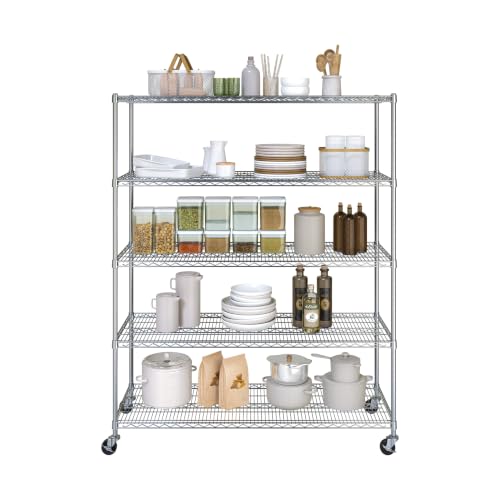
Seville Classics UltraDurable Heavy Duty NSF Solid Steel Wire Rack Storage Unit Wheels, 5-Tier Shelving, 60" W x 24" D
Included for 'Canning Jar Storage Ideas: Shelf Depths, Weight Loads and Where Empties Go' because the listing specifies 5-Tier Shelving and 60" W x 24" D, details this guide uses to compare options.
View on Amazon
Seville Classics UltraDurable Heavy Duty NSF Solid Steel Wire Rack Storage Unit Organizer for Garage, Warehouse, Office, Restaurant, Classroom, Kitchen, 5-Tier Shelving, 60" W x 18" D
Included for 'Canning Jar Storage Ideas: Shelf Depths, Weight Loads and Where Empties Go' because the listing specifies Warehouse and Office, details this guide uses to compare options.
View on Amazon| Jar size | Approx. height | Approx. diameter | Approx. filled weight | Jars per foot of shelf (one row) |
|---|---|---|---|---|
| 4 oz (quarter pint) | 2.5 in | 2.5 in | 0.5 lb | 4-5 |
| Half pint (8 oz) | 3.5-4 in | 2.75-3 in | 0.9-1 lb | 4 |
| Pint (16 oz) | 5-5.5 in | 3-3.4 in | 1.5-1.8 lb | 3-4 |
| Quart (32 oz) | 6.75-7 in | 3.5-4 in | 2.8-3.2 lb | 3 |
| Half gallon (64 oz) | 9-9.5 in | 4.5 in | 5-6 lb | 2 |
A 36-inch shelf holding three rows of quart jars carries roughly 27 jars and 80 or more pounds. That is the number to check against any shelf’s weight rating.
Storage Ideas for Filled Jars
Shallow open shelving
Shelves 10 to 12 inches deep hold three rows of pints or quarts, so nothing gets lost behind other jars. Deeper shelves (18 to 24 inches) hold more, but jars at the back tend to be forgotten and outlast their best-quality window. Space shelves 8 inches apart for quarts and 6 to 7 inches for pints so you can lift jars without tipping them.
Steel wire shelving units
Freestanding steel wire units, often rated 250 to 600 pounds per shelf when weight is evenly distributed, are the workhorse of basement pantries. Add a solid shelf liner so smaller jars do not tip between wires, and set a lip or rail on the front edge if the unit is in a high-traffic spot.
Built-in wall shelves between studs
The cavity between wall studs is about 14.5 inches wide and 3.5 inches deep in a standard 2×4 wall. That fits a single row of half pints and smaller jars. It is a good use of a stairwell or a pantry wall, but check for wiring and plumbing before cutting.
Under-stair and closet pantries
Closets often hold the most jars in the least space, since doors keep light out. A 24-inch-deep closet works well with two sets of 12-inch shelving, one on each side wall, leaving a center aisle.
Rolling carts and drawer systems
Deep drawers with dividers hold jars upright and keep them in the dark. Label the lids from above so you can read them when the drawer is open.
Shelf Material Trade-Offs
| Shelf type | Load capacity | Moisture tolerance | Typical cost | Watch for |
|---|---|---|---|---|
| Steel wire unit | High (250-600 lb per shelf) | Good; chrome can rust in damp basements | $60-$200 | Small jars tipping between wires |
| Solid wood (pine, plywood) | High if span under 32 in | Good when sealed | $50-$250 DIY | Sag on long spans with quarts |
| Particleboard or MDF | Low-moderate | Poor; swells if damp | $40-$150 | Bowing under heavy jars |
| Plastic utility shelving | Low-moderate (50-150 lb per shelf) | Excellent | $40-$100 | Flex and wobble when fully loaded |
| Metal boltless/rivet shelving | Very high | Good | $80-$250 | Particleboard decks in damp areas |
For wood shelves loaded with quarts, keep unsupported spans to 30 to 32 inches with 3/4-inch plywood, or add a center support.
Storage Conditions That Protect Home-Canned Food
- Temperature. Cool and steady, roughly 50 to 70°F. Avoid spots near furnaces, water heaters, or uninsulated garages and attics.
- Light. Darkness slows color and flavor loss. Open shelves in a bright room benefit from a curtain or door.
- Rings off. Food-safety guidance from extension services recommends removing screw bands after jars seal, so a failed seal is obvious and the rings do not rust onto the jar.
- Single layer is safest. Stacking jars directly can mask a failed seal and puts weight on the lids below. If you must stack, limit it to two layers with cardboard or a thin board between them.
- Rotation. Write the date on each lid and put new jars at the back. Most home-canned food is best used within about a year.
Empty Mason Jar Storage Ideas
Empty jars are light but fragile and bulky. A case of 12 empty quart jars takes about a 14 x 11 x 7.5 inch footprint.
- Keep the original cardboard flats. They are sized for the jars, protect against chips, and stack reasonably well when empty.
- Store jars upside down on shelves to keep dust and insects out, or right side up with a lid set loosely on top.
- Divided plastic crates or bottle crates work better than cardboard in damp basements.
- Separate lids and rings. Flat lids go in a labeled bin by size (regular or wide mouth); rings go on a wooden dowel or a hanging strap so they stay dry and do not rust.
- High, out-of-the-way shelves are fine for empties since they are light. Save easy-reach shelves for filled jars.
Which Setup Fits Your Situation
| Situation | Recommended setup |
|---|---|
| Small apartment, under 50 jars | A closet or cabinet with 2-3 shallow shelves; empties in their flats under a bed |
| Basement pantry, 100-300 jars | Steel wire or rivet shelving, 12-14 in deep, with liners |
| Damp basement | Plastic or coated metal shelving; no particleboard |
| Kitchen display | Short open shelf away from stove heat and window light |
| Earthquake-prone area | Shelves with front rails or bungee cords; anchor units to studs |
| Kids or pets around | Heaviest jars on low shelves, anchored units, no top-heavy loading |
Common Mistakes
- Overloading a budget shelf rated for 50 pounds with three rows of quart jars.
- Storing jars in a garage that swings from freezing to 90°F across the year.
- Leaving rings on, which hides a failed seal and rusts in humidity.
- Using deep shelves without a rotation system, so older jars stay buried.