Key takeaways
- Depth (front to back): usually 18 to 22 inches inside. Subtract half an inch for clearance.
- Width: roughly 3 to 4 inches less than the cabinet width. An 18-inch cabinet often gives a 14 to 15 inch interior; a 24-inch cabinet gives about 20 inches.
- Height: top drawers commonly have 3 to 4.5 inches inside; deep pot drawers 9 to 11 inches.
A kitchen drawer organizer for large utensils needs compartments at least 14 inches long and a drawer with 3.5 inches or more of interior height; most standard cutlery trays have 10-inch slots, which is why ladles, spatulas and tongs end up jammed in sideways. Measure your longest tool and your drawer’s inside dimensions before buying anything, then pick the organizer style that fits both.
Step 1: Measure the Tools, Not Just the Drawer
Large cooking utensils vary more than people expect. Here are typical lengths and the widest part of each tool, which together determine the compartment you need.

OXO Good Grips Drawer, Large Expandable Kitchen Tool Organizer
Included for 'Kitchen Drawer Organizer for Large Utensils: Sizing Slots for Ladles, Spatulas and Tongs' because the listing specifies Large Expandable Kitchen Tool Organizer, details this guide uses to compare options.
View on Amazon
OXO Good Grips Expandable Long Tool Organizer
Included for 'Kitchen Drawer Organizer for Large Utensils: Sizing Slots for Ladles, Spatulas and Tongs' as a relevant option in this category; details come from the product listing.
View on Amazon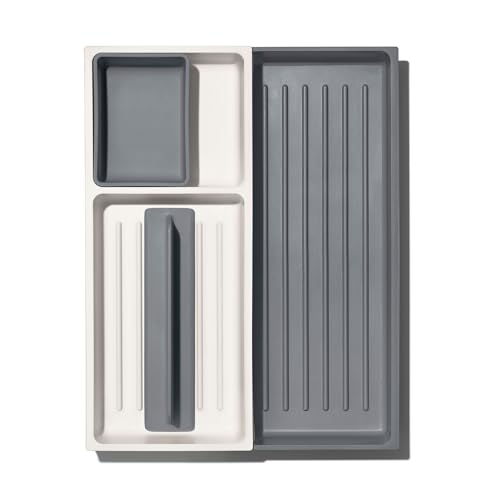
OXO Good Grips Expandable Kitchen Tool Drawer Organizer
Included for 'Kitchen Drawer Organizer for Large Utensils: Sizing Slots for Ladles, Spatulas and Tongs' as a relevant option in this category; details come from the product listing.
View on Amazon
OXO Good Grips Adjustable Deep Drawer Organizer, Utensil Holder Drawer
Included for 'Kitchen Drawer Organizer for Large Utensils: Sizing Slots for Ladles, Spatulas and Tongs' because the listing specifies Utensil Holder Drawer, details this guide uses to compare options.
View on Amazon| Utensil | Typical length | Widest point | Needs compartment of |
|---|---|---|---|
| Ladle | 12-14 in | 3-4 in bowl, 2-3 in deep | 14-15 in long, 3.5 in tall drawer |
| Solid/slotted serving spoon | 12-13 in | 2.5-3 in | 13-14 in long |
| Turner/spatula | 12-14 in | 3-4 in head | 14-15 in long |
| 12-inch locking tongs | 12 in | 1.5-2 in closed | 13 in long |
| 16-inch grill tongs | 16 in | 2 in closed | 17 in long |
| Balloon whisk | 10-12 in | 2.5-3.5 in head | 12-13 in long, 3.5 in tall drawer |
| Spider strainer | 14-16 in | 5-6 in basket | 16-17 in long, wide slot |
| Potato masher | 10-11 in | 3-4 in head, 3 in tall | 11-12 in long, 3.5 in tall drawer |
| French rolling pin | 18-20 in | 1.75-2 in | Full drawer depth |
The tools that cause most problems are the tall ones: ladles, mashers and whisks. If your drawer has less than 3.5 inches of clear height, these will catch on the cabinet frame every time you close it. That is a drawer problem, not an organizer problem, and it usually means those tools belong in a deeper drawer or a countertop crock.
Step 2: Measure the Drawer Interior
Standard U.S. base cabinets are 24 inches deep, but the usable drawer box is shorter. Measure the inside of the drawer itself, at the bottom, because sides often taper slightly.
- Depth (front to back): usually 18 to 22 inches inside. Subtract half an inch for clearance.
- Width: roughly 3 to 4 inches less than the cabinet width. An 18-inch cabinet often gives a 14 to 15 inch interior; a 24-inch cabinet gives about 20 inches.
- Height: top drawers commonly have 3 to 4.5 inches inside; deep pot drawers 9 to 11 inches.
Also check the opening above the drawer when it is closed. Some frameless cabinets have a lip that reduces usable height by half an inch.
Step 3: Choose the Organizer Style
Expandable long-compartment trays
Expandable bamboo or plastic trays slide open to fill the drawer width, typically from about 13 to 20 inches, and have long center slots of 14 to 17 inches. They suit drawers 18 inches deep or more. Make sure the long slots are at least 3 inches wide; many expandable trays are designed for flatware and only the outer side compartments are wide enough for a spatula head. The OXO Good Grips expandable utensil organizer is a well-known example of this type.
Adjustable divider strips
Spring-loaded bamboo dividers tension between the drawer front and back, creating lanes of any width. They are the most flexible option for odd-shaped tools: give the ladle a 4-inch lane, the tongs 2 inches, the spider 6 inches. They need straight drawer sides to grip, and they work best in drawers 17 to 22 inches deep since that is the common adjustment range.
Angled or stacked utensil holders
Compact organizers that hold utensils at an angle or on two levels, such as the Joseph Joseph DrawerStore line, fit more tools in a narrower drawer. The trade-off is height: angled holders need about 3.5 to 4 inches of clearance, and the longest ladles may overhang.
Custom-cut or modular bins
Modular bins in 3, 6 and 9 inch widths combine like tiles. They suit unusual drawer sizes but rarely come longer than 15 inches, so they are better for whisks, mashers and scoops than for 16-inch tongs.
Deep drawer upright inserts
In a 9 to 11 inch deep drawer, a row of upright canisters or a pegboard-style insert holds large tools standing up. Cabinet-insert specialists like Rev-A-Shelf make inserts designed for deep drawers. This is the best answer when your top drawers are too shallow.
Material Trade-Offs
| Material | Strengths | Weaknesses | Typical price |
|---|---|---|---|
| Bamboo | Rigid, looks warm, does not dent from metal tools | Can warp if put away wet; hand-wash only | $25-$60 |
| Plastic (polypropylene) | Dishwasher-safe on top rack, light, cheap | Slides around without non-slip feet; cracks over time | $12-$35 |
| Acrylic | Clear, easy to see contents | Scratches quickly; brittle if dropped | $20-$50 |
| Metal mesh/steel | Durable, handles heavy tools | Noisy; can scratch nonstick-safe utensils | $20-$45 |
| Solid hardwood custom insert | Exact fit, very durable | Costly; fixed layout | $80-$250 |
Decision Matrix: Which Organizer Fits Your Drawer
| Your situation | Best choice |
|---|---|
| Drawer 18-22 in deep, 3.5 in+ tall, 15-24 in wide | Expandable long-compartment tray |
| Mixed tool sizes including spider and grill tongs | Adjustable divider strips |
| Narrow drawer, 12-15 in wide | Angled two-tier holder |
| Top drawer under 3 in tall | Flat tools only; move ladles/whisks to deep drawer or crock |
| Deep pot drawer you can spare | Upright canister or pegboard insert |
| Renting and frequently moving | Plastic or bamboo tray (no installation) |
Layout Tips That Make It Work
- Alternate head direction. Placing a ladle head-front next to a spatula head-back lets bulky ends nest and saves an inch or more per pair.
- Put daily tools at the front of the drawer. Pull-out drawers rarely open fully; most people reach only the front two-thirds.
- Cap the count. A 20-inch-wide drawer comfortably holds 10 to 14 large utensils. If you own more, move duplicates or seasonal tools elsewhere.
- Add non-slip liner. Even good trays shift; a rubber liner stops rattling and keeps the tray from sliding forward when the drawer closes.
- Check the drawer slide rating. Basic side-mount slides are often rated around 50 to 75 pounds; a full load of steel tools, a bamboo tray and cast-iron accessories rarely exceeds that, but sagging drawers are a sign to lighten the load.
When a Drawer Is the Wrong Place
If you cannot find a drawer with enough height or length, store the tallest tools upright in a countertop crock at least 6 inches across and 7 inches tall, or on a wall rail with hooks. Keep the drawer for flat items such as spatulas, tongs and serving spoons. Splitting tools between a drawer and a crock is often the most practical answer in kitchens with shallow top drawers.