Key takeaways
- A reclining sofa earns its keep in a small room only if it fits the wall and still has room to lean back. A good compact reclining sofa publishes an overall width and the clearance it needs behind it, so…
A reclining sofa earns its keep in a small room only if it fits the wall and still has room to lean back. A good compact reclining sofa publishes an overall width and the clearance it needs behind it, so you can map the footprint before it arrives rather than discovering the wall is too close.
As an Amazon Associate we earn from qualifying purchases.
By KK Home Furnishings Editorial Team
How to Choose a Compact Reclining Sofa
For a small room, two numbers rule: how wide the sofa is and how much space it needs behind to recline. The criteria below start with overall width and wall clearance, then cover seat depth and capacity and the frame and upholstery details that decide how a recliner holds up through years of daily leaning back.
Overall Width for the Room
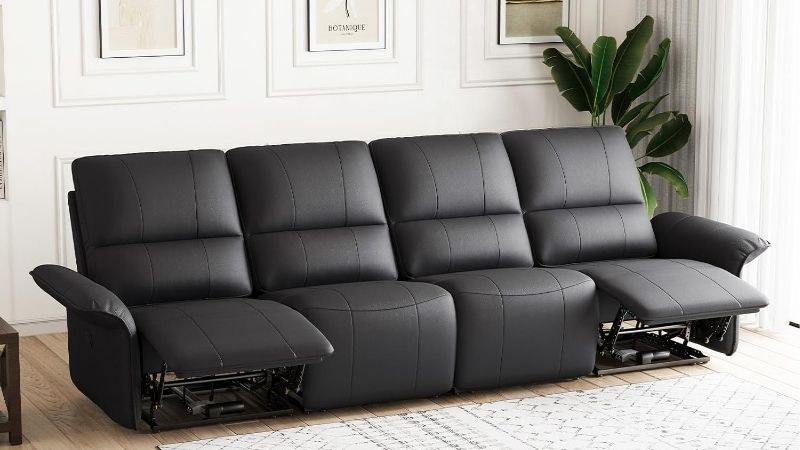
Compact means width above all, so compare overall widths against your wall. These range from the 78-inch Lazzara Greeley and 80-inch Emma Grey to the 84-inch Flexsteel Catalina, a six-inch spread that decides whether a sofa leaves room for a side table or crowds a doorway. Measure your wall and subtract clearance before choosing.
Width is not the only footprint number, so plan the whole layout. Leave a walkway past the sofa, map any door swing, and confirm the piece fits through your entry, hallway, and any stair turn, since a sofa that fits the wall perfectly can still be impossible to carry into the room it was bought for.
A narrower sofa frees floor space but seats fewer people comfortably, so balance width against how many need to sit. For a tight room a 78-to-80-inch two-seater often beats squeezing in a wider three-seater, which leaves the recliners cramped and the walkway blocked whenever someone actually leans back in them.
Wall Clearance to Recline
A wall-hugger does not mean zero clearance; it means less. The Emma Grey needs about three inches behind it, the Lazzara Greeley at least three, and the Flexsteel Catalina around five, so even a compact recliner must sit off the wall to lean back. Measure from the wall and leave the stated gap before pushing it flush.
Closed depth, open depth, and wall clearance are three different numbers, so do not confuse them. The sofa’s closed depth is its footprint parked, the open depth is how far the footrest extends forward, and the clearance is the space behind for the back to tilt. A compact room has to accommodate all three at once.
Confirm the clearance against your actual wall, including baseboards, radiators, and trim that eat into the gap. A wall-hugger mechanism reduces the space needed but never removes it, so a sofa pushed too close simply will not recline fully, which defeats the point of buying a reclining sofa for the room at all.
Seat Depth, Count and Capacity
Seat comfort comes from depth and support, and capacity sets who can use it. The Emma Grey, for instance, lists a 300-pound per-seat rating, a useful figure for heavier sitters. Check the per-seat capacity rather than a single total, since the number that matters is what each reclining seat holds, not the sofa as a whole.
Match seat count to the room and the people. A compact two-seater reclines fully without blocking a walkway, while a three-seater needs more width and more open floor in front for the footrests. Count how many recline at once, since two extended footrests claim far more space than the closed sofa suggests on the floor plan.
Seat depth affects who sits comfortably: a deep seat suits taller people but leaves shorter sitters unsupported at the knee. If the sofa serves a mixed household, a mid-depth seat with firm support is the safer choice, and confirm the reclined length so a tall user is not left with feet hanging off the footrest.
Frame, Upholstery and Durability
The recliner mechanism works hardest, so its quality decides lifespan. Flexsteel, for example, is an established maker whose figures are first-party, while smaller brands’ specs are manufacturer-stated without testing. Favor a proven mechanism, since a reclining joint that loosens is the usual first failure on a recliner.
Upholstery is the daily-wear surface, so match it to your household. Performance fabric resists stains in a home with kids or pets, while leather wears differently and shows scratches; either way, check whether the maker sells replacement parts for the mechanism and whether the cover can be cleaned without a specialist.
Warranty terms usually split the frame from the mechanism and the upholstery, so read which part is covered and for how long. A long frame warranty means little if the reclining mechanism, the part most likely to fail, carries a short one, so weigh the mechanism coverage most heavily before you commit to a sofa.
Top Picks
Each pick leads with the two numbers that define a compact reclining sofa for a small room, overall width and wall clearance, plus the trade-off worth knowing. Three are built for standard living rooms; the etrailer model is made for RVs, so it is included for that use rather than compared one-to-one with the rest.
| Product | Best For | Key Spec | Watch Out For |
|---|---|---|---|
| Emma Grey | Best for small rooms | 80 in wide; 3 in clearance; 300 lb/seat | Specs are manufacturer-stated |
| Lazzara Greeley | Best value | 78 in wide; ≥3 in clearance | Clearance listed as a minimum |
| Flexsteel Catalina | Best for build quality | 84 in wide; 5 in clearance; 67 in open | Widest here; needs more floor and wall |
| etrailer e59TV | Best for RVs | 80 in wide; 4–5 in clearance | RV-specialized; confirm fit for home use |
Emma Grey: Best for Small Rooms
The Emma Grey is the small-room pick, at 80 inches wide with about three inches of wall clearance and a 300-pound per-seat rating, opening to roughly 62.5 inches deep. It suits a tight living room that still wants two full recliners. It sits in the mid tier, so confirm the current price before ordering.
Its advantage is a slim three-inch clearance and a solid per-seat capacity, so it hugs the wall more closely than most while supporting heavier sitters. Measure your wall, the open depth in front, and the path into the room, since even a compact sofa needs clearance behind to recline and space ahead for the footrests.
The honest caveat is that its figures are manufacturer-stated without independent testing, so treat the capacity and clearance as the maker’s numbers to verify against your space. Check the reclining mechanism’s warranty, since that joint is the usual first failure, and confirm replacement parts are available before relying on it for years.
Lazzara Greeley: Best Value
The Lazzara Greeley is the value pick, the narrowest here at 78 inches wide with at least three inches of wall clearance. It suits a small room on a tighter budget that still wants to recline. It sits in the budget-to-mid tier, so verify today’s price before choosing it over the slightly wider options.
Its strength is footprint: at 78 inches it frees the most floor space of the standard picks, leaving room for a side table or a clearer walkway. Measure your wall and leave at least the stated clearance behind, and confirm the open depth in front, since the narrow width still needs room for the footrests to extend.
The trade-off is that the clearance is listed as a minimum rather than an exact figure, so give it a little extra behind to be safe, and its specs are manufacturer-stated. Check the mechanism warranty and parts availability, and sit-test the seat depth if you can, since a narrow sofa can still feel shallow to a tall user.
Flexsteel Catalina: Best for Build Quality
The Flexsteel Catalina is the build-quality pick, from an established maker, at 84 inches wide with about five inches of clearance and a 67-inch open depth. It suits a room with space to spare that prioritizes a proven frame. It sits in the premium tier, so confirm the current price before ordering it.
Its advantage is a trusted mechanism and first-party specs rather than manufacturer-stated figures without testing, which matters most on the reclining joint. Measure carefully, though, since at 84 inches wide with five inches of clearance and a deep 67-inch open footprint, it needs more wall and floor than the compact picks.
The caveat is size: it is the widest and deepest option here, so it is the least compact and needs genuine room to recline. If your space is truly tight, the Emma Grey or Lazzara fits better; choose the Catalina when build quality outweighs the extra footprint and you have measured the wall, the walkway, and the open depth.
etrailer e59TV: Best for RVs
The etrailer e59TV is the RV pick, at 80 inches wide with four to five inches of clearance, built for the dimensions and mounting of a recreational vehicle rather than a living room. It suits an RV or camper upgrade. It sits in the mid tier, so confirm the live price and the fit for your coach first.
Its advantage is that it is designed for RV use, where standard sofas often do not fit the wall runs or securement needs. If you are outfitting a camper, that purpose-built fit is exactly what you want, so measure your RV’s wall and confirm the mounting and clearance match the coach before ordering this over a household sofa.
The honest caveat is use case: this is an RV-specialized piece, so it is included for that purpose and not compared one-to-one with the home sofas here. For a standard living room, choose one of the household picks instead, and only pick the e59TV when an RV’s specific dimensions and securement are the actual requirement.
Frequently Asked Questions
Shoppers fitting a recliner into a small space ask the same questions about clearance, depth, and fit. Each answer below opens with the short version, then the measurement that changes it, so you can match a compact reclining sofa to your room rather than discovering after delivery that the wall is an inch too close.
How much wall clearance does a wall-hugger need?
Less than a standard recliner, but never zero. Wall-hugger designs here need roughly three to five inches behind them to lean back, so the Emma Grey’s three inches and the Flexsteel’s five are the gaps to leave. Measure from the wall, including baseboards and trim, before pushing any reclining sofa flush against it.
The exact figure is set by the mechanism, so use the maker’s clearance number rather than a general rule. A sofa pushed closer than its stated gap simply will not recline fully, which defeats the purpose, so give it at least the listed clearance and a touch more if a radiator or thick molding is in the way.
Remember clearance is only one of three depth figures. The closed depth is the parked footprint and the open depth is how far the footrest extends forward, so a wall-hugger that saves space behind still needs room in front. Map all three against your room before deciding a compact sofa truly fits the spot.
Will a compact reclining sofa fit my small living room?
It can, if you measure the full footprint, not just the width. Check the wall length against the overall width, leave the stated clearance behind, and allow the open depth in front for the footrests. A 78-to-80-inch sofa suits many small rooms, but two extended footrests claim more floor than the closed sofa suggests.
The path in matters as much as the spot. Measure doorways, hallways, and any stair turn, since a sofa that fits the wall can still be impossible to carry in. Confirm the delivery route and whether the piece comes in sections, because a one-piece reclining sofa is heavy and awkward around tight corners.
If the room is very tight, favor the narrowest option and a wall-hugger mechanism, and consider a two-seater over a three. Map the layout on paper or with tape on the floor first, including the reclined position, so you can see whether a walkway survives once someone actually leans back in the finished setup.
What is the difference between closed and reclined depth?
Closed depth is the sofa’s footprint when upright and parked; reclined, or open, depth is how far it extends once the footrest comes up and the back tilts. The Flexsteel Catalina, for example, opens to about 67 inches deep, well beyond its parked footprint, so the open figure is what you plan the floor around.
Both numbers matter for a small room. The closed depth sets how far the sofa juts from the wall day to day, while the open depth decides whether a reclined footrest hits a coffee table or a walkway. Leave room in front for the open depth, or the sofa reclines into whatever is parked ahead of it.
Add wall clearance to complete the picture, since the back needs space behind as the seat tilts. Together, closed depth, open depth, and clearance describe the full space a recliner occupies, so measuring only the parked footprint is the classic mistake that leaves a compact sofa unable to recline once it is in place.
Should I choose power or manual recline?
It depends on use and placement. A manual recliner is simpler and has fewer parts to fail, while a power recliner adjusts smoothly and suits anyone who finds a manual lever hard to work, though it needs an outlet nearby and adds electronics that can eventually fail. Match the type to who uses it and where.
Placement affects the choice, since a power sofa must reach a power outlet and route a cord without crossing a walkway. A manual sofa goes anywhere but requires the strength and reach to push back against the mechanism, which can be awkward for some users in a tight spot against a wall.
Either way, the mechanism is the part most likely to fail, so weigh the warranty on it heavily and confirm replacement parts are sold. Power adds convenience at the cost of complexity; manual keeps it simple at the cost of effort, so pick the trade-off that fits the household rather than defaulting to the fancier option.
Final Thoughts
The right compact reclining sofa is the one whose overall width fits your wall and whose clearance still lets it recline once baseboards and a walkway are counted. Before ordering, tape out the closed footprint, open depth, and clearance on your floor, and measure the path in, since a sofa that fits the wall can still fail at the doorway.