Key takeaways
- Most gazebos are open on at least one side, so the first spec is the location listing rather than the blade span. A damp-rated unit belongs under a sealed roof, a gazebo fan that can catch blown rain needs a…
Most gazebos are open on at least one side, so the first spec is the location listing rather than the blade span. A damp-rated unit belongs under a sealed roof, a gazebo fan that can catch blown rain needs a wet listing, and some low roofs rule out a ceiling fan before any model gets compared.
As an Amazon Associate we earn from qualifying purchases.
By KK Home Furnishings Editorial Team
How to Choose a Gazebo Fan
Work in this order: the location listing the model carries, the measured area under the roof, then blade span and published airflow, then the clearances the installation instructions call for. Two of the four fans here publish a high-speed airflow figure and the other two publish none at all.
Start With Wet Versus Damp Location Rating
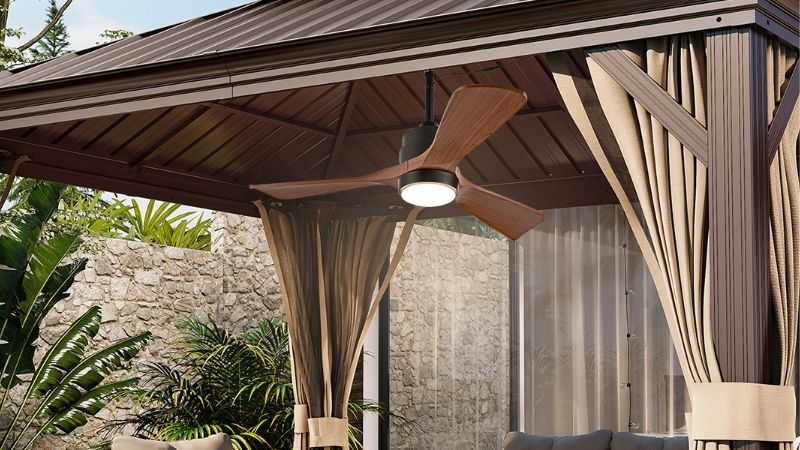
A gazebo open at the sides takes blown rain directly, and that exposure is what a wet listing covers. Both Hunter models here carry a wet rating with the brand’s WeatherMax construction, and the Hampton Bay Gazebo III is wet-rated with five weather-resistant reversible blades fitted as standard.
A damp listing covers humid or sheltered conditions rather than direct water, so an outdoor label on its own settles nothing; read the listing the exact model carries. None of these should be called weatherproof either, since wet-rated is an installation category and not a promise about service life.
Match Blade Span to the Gazebo Footprint
Measure the roofed area before shopping. The ENERGY STAR reference puts rooms up to 75 square feet near 29 to 36 inches of span, 76 to 144 square feet near 36 to 42 inches, 144 to 225 square feet near 44 inches, and 225 to 400 square feet near 50 to 54 inches [ENERGY STAR], all for enclosed rooms.
A 10 by 15-foot gazebo is 150 square feet, which lands close to the 44-inch band, while 12 by 20 feet is 240 square feet and points toward 50 to 54 inches. Treat that as a planning range rather than a rule, since an open-sided structure loses moving air at the perimeter that a room keeps.
Check Mounting Height and Wall Clearance
Blades should typically sit at least 7 feet above the floor and roughly 18 inches clear of any wall or post [ENERGY STAR]. In a gazebo those two figures often pull against each other, because the roof slopes and the only sound mounting point is the peak rather than the spot over the seating.
Measure from the finished deck to the underside of the mount you would actually use, then subtract the downrod and the depth of the fan body itself. If what remains is under about 7 feet, a wall-mounted or portable outdoor fan is the better answer than forcing a ceiling fan into the space.
Compare Airflow Only on the Same Basis
Hunter publishes 4,125 CFM on high for the Seawall 44 and 5,907 CFM on high for the Seawave 52, so the Seawave moves roughly 43 percent more air than the Seawall at that one setting. Both of those are high-speed figures, and both are manufacturer-stated rather than verified by any independent test house.
What cannot be compared is a CFM figure against a marketed coverage area in square feet, because those are different measurements and brands derive coverage in different ways. Where a maker publishes no airflow at all, the honest comparison stops at span, motor type and the location listing.
Top Picks
No single fan here suits every gazebo, because the location listing and the roof height decide eligibility before preference gets a say. Spans run from 44 to 52 inches across these four, and only the two Hunter models publish a high-speed airflow figure you can actually hold them to afterwards.
| Product | Best For | Key Spec | Watch Out For |
|---|---|---|---|
| Minka-Aire Simple 44 F786-BNW | Best Overall | 44 in span; wet listing covering uncovered outdoor use | Premium tier; no airflow figure quoted, so it cannot be compared on CFM |
| Hampton Bay Gazebo III 52 | Best Value | 52 in span; wet-rated; 5 weather-resistant reversible blades | Budget tier; 52 inches needs lateral clearance a small gazebo may not have |
| Hunter Seawall 44 | Best for Compact Gazebos | 44 in span; 4,125 CFM on high; wet-rated WeatherMax build | Upper-mid tier; the manufacturer’s own store currently shows it out of stock |
| Hunter Seawave 52 | Best for Higher Airflow | 52 in span; 5,907 CFM on high at 41 W; wet-rated | Mid tier; manufacturer-direct stock is also currently unavailable |
Minka-Aire Simple 44: Best Overall
The Simple 44 in the Brushed Nickel Wet variant is listed for wet locations including uncovered outdoor use, which is the broadest permission in this group, on a 44-inch span that matches the reference band for a gazebo of roughly 150 square feet. A remote is included, so no separate wall control is needed.
It is the premium tier of this sample, and comparability is the drawback: no high-speed airflow figure is quoted for it, so it cannot be placed against the Hunter fans on CFM. Confirm the exact variant code before ordering, because the wet listing belongs to specific finishes rather than the line.
Hampton Bay Gazebo III 52: Best Value
At a 52-inch span with a wet rating and five weather-resistant reversible blades, the Gazebo III is the budget tier here by a wide margin. Reversible blades let you change the finish between seasons without buying a second fan or sourcing a separate blade kit, which few fans at this tier allow.
Fifty-two inches is the catch. That span sweeps 26 inches from the centre in every direction and wants roughly 18 inches of clearance to each post, so a compact gazebo runs out of room before the reference table says it should. Measure the shortest run from the mount to a post, never the diagonal across the floor.
Hunter Seawall 44: Best for Compact Gazebos
The Seawall 44 pairs a compact span with a published 4,125 CFM on high and Hunter’s wet-rated WeatherMax construction, which makes it the most measurable option for a smaller roofed area where a 52-inch fan would crowd the posts and the seating. It sits in the upper-mid tier of this group.
Availability is the real drawback, since the manufacturer’s own store currently shows it out of stock and retailer inventory moves with the season. Outdoor fans also want the blades and housing wiped down between seasons, because pollen and dust bind to an exterior finish far faster than indoors.
Hunter Seawave 52: Best for Higher Airflow
The Seawave 52 publishes 5,907 CFM on high, the strongest figure in this group, drawing 41 watts at that speed, on the same wet-rated WeatherMax construction as the Seawall. For a larger gazebo sitting in the 225 to 400-square-foot band, the span and the airflow finally line up with each other.
It is mid tier on price and shares the Seawall’s manufacturer-direct stock problem. Airflow only helps if the mount is high enough to spread it across the seating rather than straight down onto one chair, so confirm the 7-foot blade height first before treating a CFM figure as the deciding reason to buy it.
Frequently Asked Questions
These questions come from two decisions that routinely get made in the wrong order: buyers settle on a span before measuring the roofed area, and they buy an outdoor fan before reading which location listing it carries. Each answer below uses a published figure rather than a general rule.
What Size Fan Works for a 10 by 15-Foot Gazebo?
That is 150 square feet, which falls in the band ENERGY STAR associates with a span of roughly 44 inches [ENERGY STAR]. Both the Minka-Aire Simple and the Hunter Seawall measure exactly 44 inches, which makes either one a reasonable starting point for that particular footprint before clearance is checked.
The reference assumes an enclosed room with an eight-foot ceiling, and a gazebo is neither of those, so read it as a planning range. Open sides let moving air escape at the perimeter instead of recirculating, which usually argues for choosing the upper end of a band rather than settling in the middle of it.
Is a 52-Inch Fan Too Large for a Gazebo?
Not by default. The same reference puts 225 to 400 square feet near 50 to 54 inches, so a larger gazebo takes 52 inches comfortably [ENERGY STAR]. The limiting factor is lateral clearance rather than the number itself, and clearance is something you measure rather than something you judge by eye.
Check the shortest run from the proposed mounting point to the nearest post, rail or hanging basket, then compare it against the roughly 18 inches of clearance the same guidance suggests. A 52-inch fan sweeps 26 inches out from its centre in every direction, which is considerably more than most buyers picture.
How Low Can a Gazebo Ceiling Fan Hang?
Keep the blades at least 7 feet above the floor, and ENERGY STAR describes 8 to 9 feet as the better mounting zone where the structure allows it [ENERGY STAR]. Gazebo roofs peak in the middle and slope away, so usable height at the actual mount is often well below what the ridge measurement suggests.
If the peak cannot deliver that clearance once the downrod and fan body are counted, the honest conclusion is that this structure does not want a ceiling fan at all. A wall-mounted outdoor fan or a pedestal unit moves air without putting spinning blades near standing head height.
What Does a Gazebo Fan Cost?
The four wet-rated models here span a budget tier through to a premium tier, with the widest gap sitting between the 52-inch Hampton Bay and the 44-inch Minka-Aire. Price in this category tracks the finish, the motor type and whether a remote is bundled far more closely than it tracks blade span.
Count the installation alongside the fan itself. An outdoor ceiling fan needs an electrical box rated for fan support and a circuit run out to the structure, and that is licensed-electrician work in most jurisdictions, which routinely costs more than the fan does on an unwired gazebo.
Final Thoughts
Before comparing any of this, stand in the structure and measure from the deck to the mounting point at the peak. If that figure will not leave 7 feet under the blades once a downrod is counted, no gazebo fan on this list is the right purchase, and a wall-mounted or pedestal outdoor unit is.