Key takeaways
- Electric blankets turn electrical resistance in insulated heating elements into warmth. So how do electric blankets work from outlet to fabric? A controller supplies and regulates power while model-specific circuits may monitor heat or end a session. The blanket warms…
Electric blankets turn electrical resistance in insulated heating elements into warmth. So how do electric blankets work from outlet to fabric? A controller supplies and regulates power while model-specific circuits may monitor heat or end a session. The blanket warms the person and nearby bedding, not the whole room.
As an Amazon Associate we earn from qualifying purchases.
By KK Home Furnishings Editorial Team
Inside an Electric Blanket: How Heat Is Produced
An electric blanket is not simply ordinary fabric with a plug. It combines flexible electrical heating elements, insulation, and a compatible control system. In a conventional plug-in design, resistance in the heater converts electrical energy into warmth. Some models can also monitor operating conditions and interrupt heating [UL Solutions, Electric Blankets Are Cozy, accessed October 2026].
| Part or Stage | Role in Heating | What Can Differ | Important Limit |
|---|---|---|---|
| Power cord | Connects the blanket to its specified power supply | 120 V AC models or purpose-built low-voltage systems | A matching plug does not prove power-source compatibility |
| Controller | Switches heating on and adjusts the selected level | Dial, buttons, digital display, or connected control | Setting number is not a universal temperature |
| Heating element | Converts electrical input into heat through resistance | Wire layout, conductor material, number of zones | Do not cut, bend sharply, or expose the element |
| Element insulation | Separates conductive parts from the user and fabric | Cable construction and protective layers | External softness cannot reveal internal condition |
| Control feedback | May cycle heat or respond to measured conditions | Timed cycling, sensors, electronic monitoring | Not every blanket uses the same sensing method |
| Protective shutdown | May interrupt heat in specified abnormal conditions | Thermal protection, error detection, design limits | It cannot make damaged bedding safe |
| Automatic timer | Ends a heating session after a defined interval | Present, absent, fixed, or adjustable by model | Auto-off is not approval for sleeping with it on |
The Flexible Heating Elements Inside the Fabric
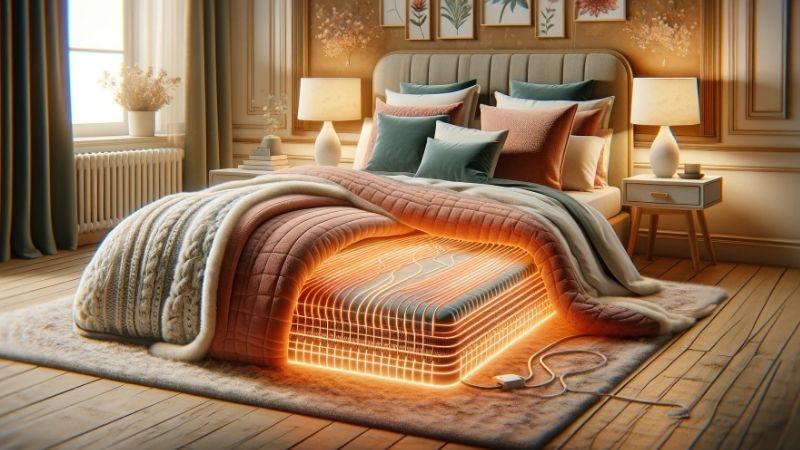
The internal heater is usually a flexible, insulated electrical conductor distributed across the blanket rather than a single hot pad at the center. As current flows, the element’s resistance produces heat that spreads into the surrounding textile. The layout is designed to cover the intended warming area, not to function as an exposed heating coil.
Insulation helps keep live conductive material separated from the fabric surface and the person using it. The arrangement must also tolerate ordinary movement within the limits of the product’s instructions. This is why an intact-looking cover cannot prove the wiring is undamaged and why cutting or modifying a heated blanket is unsafe.
What the Controller Does With the Electrical Supply
The controller lets the user request more or less warmth without accessing the electrical elements. It may vary how long power is supplied, change the power delivered through an electronic circuit, or use a different regulation method. Sunbeam states that its warming-product heat control cycles on and off according to the selected level [Sunbeam, Heating & Performance FAQ].
That means a number such as Level 5 is a control setting, not necessarily a promise that the fabric will reach a particular temperature in degrees Fahrenheit. Ambient conditions, bedding layers, the user’s position, and the specific control design influence how warmth feels. Compare settings within one product, not as if every brand used the same scale.
How Temperature Feedback and Protection Differ
Some designs incorporate temperature-responsive components or electronic monitoring to detect conditions that call for reduced heating or shutdown. A patented electric-blanket control, for example, describes monitoring the resistance of a heating element to help regulate current [U.S. Patent 6,222,162, 2001]. A patent illustrates a possible mechanism, not a feature confirmed in every product.
Protection may respond to abnormal heat or an electrical fault, while an ordinary timer simply stops a session after its preset duration. Those are separate functions. UL 964 is a safety standard covering electrically heated bedding, but its scope alone does not certify a particular blanket [UL Standards & Engagement, UL 964, revised 2020].
How an Electric Blanket Works in Everyday Situations
After the basic heating path is understood, the real differences appear in the controller’s behavior. Six common situations show why two products can feel different even though both use electrical resistance. These are explanations of features, not instructions to defeat a timer, test exposed wiring, or ignore the safety requirements in an owner’s manual.
When You Switch a Cold Blanket On
Switching on a compatible, correctly connected blanket allows its control system to energize the heating elements. Warmth gradually spreads through the fabric and into the immediate covered area. The blanket may feel only mildly warm to a hand resting on uncovered fabric, even when it is operating normally [Sunbeam, Heating & Performance FAQ].
The speed at which warmth becomes noticeable depends on the approved operating setting, how the blanket is positioned, and the product’s construction. Do not invent a fixed warm-up time for every blanket. If the device has a manufacturer-defined startup procedure, use that procedure rather than piling other bedding onto the heater to force a hotter feeling.
When You Move From a Low Setting to High
Increasing the setting tells the controller to request greater heating output or a different heating cycle. On some products, a controller cycles its power on and off to maintain a comfortable level [Sunbeam, Heating & Performance FAQ]. A higher setting usually increases the heating request, but it does not necessarily mean the element remains fully energized every second.
Heat settings also do not map reliably across brands. Ten levels on one controller cannot be converted into ten equal temperature increments without manufacturer data. If you are sensitive to heat or cannot reliably feel a hot spot, obtain appropriate individualized advice before using electrically heated bedding rather than trusting the setting number alone.
When a Model Has a Preheat Mode
Preheat is a programmed period of stronger initial warming, followed by another operating level on models designed that way. For example, a Sunbeam connected-heated-bedding manual describes a 30-minute preheat cycle that returns to the previous setting afterward [Sunbeam, Connected Heated Bedding manual, model dependent]. The example is not a timing rule for other brands.
This feature changes the controller’s sequence; it does not add a second heating technology to the textile. Users should check whether the exact product permits preheating under their intended bedding arrangement. A preheat feature is not permission to leave the appliance operating unattended, and it does not replace the manufacturer-specific instructions for shutoff.
When a Queen or King Blanket Has Two Zones
Some larger heated blankets divide their warming area into independently adjustable sections. A connected Sunbeam queen or king product manual, for example, identifies Side A and Side B as separate temperature-control zones [Sunbeam, Connected Heated Bedding manual]. One side can request a different setting without asking the other side to use that same level.
Separate zones can involve independent controls or a shared interface controlling more than one circuit. The manufacturer’s layout determines which cord or button operates each side; it is not safe to guess from a picture of a different model. Dual control describes independent temperature choices, not a guarantee of identical heating or a particular total wattage.
When a Sensor or Protection Circuit Detects a Problem
A monitored blanket may stop or reduce heat if its protective logic detects an abnormal condition. The exact event that triggers a fault code varies by model; it may concern the control connection, internal circuitry, or temperature protection. This is a protective response, not a feature that a user should bypass to restore warmth.
Do not open the fabric, splice heating wires, substitute an unapproved controller, or defeat an error display. If a blanket has damaged insulation, charred marks, a loose connector, or an unusual odor, turn it off and stop using it. ESFI advises replacing worn heated bedding; the specific manufacturer’s service instructions determine any further action [ESFI, Heating Pads and Electric Blankets Safety].
When the Automatic Shutoff Timer Expires
A timer counts down a permitted operating period and then ends the heating session. Depending on the product, that interval may be fixed or user-adjustable. Sunbeam’s manuals show that auto-off durations differ between product styles and generations, so the timer on one heated throw should never be assumed to match the timer on a bed blanket.
Automatic shutoff limits scheduled operation; it does not monitor every possible misuse, damaged component, or trapped-heat condition. ESFI generally advises against leaving electric blankets operating unattended or while sleeping [ESFI, Heating Pads and Electric Blankets Safety]. Follow the instructions for your exact model, and never treat auto-off as a safety guarantee.
Frequently Asked Questions
These questions clarify what the heating system can and cannot do, including how heat moves away from the element and what electrical supply different designs require. They add practical context without repeating the separate guides on energy cost, faults, or heated-blanket storage.
Does an Electric Blanket Heat the Air or the Person?
Primarily the person and nearby bedding. Heat begins in the insulated element, moves through surrounding fabric, and reaches the covered user’s immediate environment. Some warmth also escapes into the air, but the device does not circulate or condition room air the way a dedicated space heater is intended to do.
This distinction explains why the surrounding bedroom may remain cool even when the blanket feels comfortable. The amount of warmth that stays near the user depends on the permitted textile layers and the room environment. Do not add tightly trapped layers simply to make the element work harder; follow the product’s restrictions on coverings and folding.
Do Electric Blankets Keep Producing Heat After Unplugging?
No. Once disconnected from its electrical supply, a conventional plug-in blanket can no longer create new heat through its wiring. Its fabric and any nearby bedding can hold some residual warmth for a while, but that is retained heat, not continued electrical heating. The cooling time varies with materials and surroundings.
Some battery-powered personal warming products use a different power source and must be considered separately. Their existence does not make a wall-powered blanket portable or safe on an inverter. Check the electrical rating and approved supply in the original manual instead of assuming any adapter or battery pack will operate the controller correctly.
Do All Electric Blankets Have Built-In Temperature Sensors?
No. Temperature-control and protective methods vary. Some controllers cycle output based on their design, while other systems incorporate temperature-responsive components or monitoring circuits. An advertised setting scale or auto-off timer alone does not establish which temperature sensors, if any, are embedded in the textile.
Look for the exact product’s technical documentation if sensor design matters to your decision. Do not infer continuous skin-temperature measurement from phrases such as smart heat or automatic comfort. UL Solutions describes sophisticated sensing in some blankets, not as a characteristic shared by all models [UL Solutions, Electric Blankets Are Cozy].
Are Heating Wires and Low-Voltage Blankets the Same Thing?
No. A heating wire or other resistive element describes how electrical energy becomes warmth; low voltage describes the supply arrangement delivering electricity to that element. UL 964 identifies conventional North American electrically heated bedding within its specified 110 to 120 V AC scope, while other supply designs require separate evaluation [UL 964, Section 1].
A product marketed as low voltage may use electronics to transform the supply before it reaches its heating circuit, but its exact architecture cannot be deduced from the marketing label. Use only the intended power unit and controls. Low-voltage claims should not be interpreted as freedom from overheating, damaged-cord, or misuse risks.
Final Thoughts
Electric blankets work by passing current through insulated resistance elements, while controllers adjust warmth and model-specific circuits may limit operation. Understanding how these parts interact is more useful than assuming that every blanket uses identical sensors or timers. Use the product unfolded and follow its own safety instructions.