
Key takeaways
- A low cabinet preserves visual space above the screen in small apartments.
- Measuring front-to-wall depth prevents unexpected obstruction of the main walkway.
- A simple floor-standing format avoids designing an entire media wall.
The most useful living room tv stand ideas solve a layout problem before adding decoration. A low console can protect a narrow walkway, drawers can hide family clutter, and open bays can make devices easier to use. Start with the wall, your main viewing seat, and the equipment you own; then choose among six distinct room setups.
As an Amazon Associate we earn from qualifying purchases.
By KK Home Furnishings Editorial Team
Living Room TV Stand Ideas for Everyday Spaces
Choose the stand arrangement around the room’s hardest constraint: a narrow passage, a busy household, or several devices needing easy access. Cabinet shape alone cannot fix a blocked drawer or a television set at the wrong wall. These first three concepts solve different daily problems before introducing decorative elements.
| Idea | Space or Size Needed | Cost Tier | Effort and Time |
|---|---|---|---|
| Low, long console | Single uninterrupted wall; cabinet depth fits circulation | Low to medium | Position and route cables; check top capacity |
| Family drawers | Clear floor area for full drawer extension | Medium | Assign compartments; anchor furniture |
| Open-bay setup | Ventilated device bays and reachable outlets | Low to medium | Organize ports and equipment |
| Modular media wall | Wide wall plus secure attachment locations | Medium to high | Assemble and fasten multiple units |
| Sectional offset | Main seat location and clear side paths | Low to medium | Test sightlines and shift console |
| Glare-aware placement | Wall outside direct screen reflections | Low to medium | Compare positions at viewing hours |
Low, Long Console on One Wall – Best for Compact Apartments
Best For: Apartment dwellers with a short viewing distance and a busy walkway beside the main television wall.
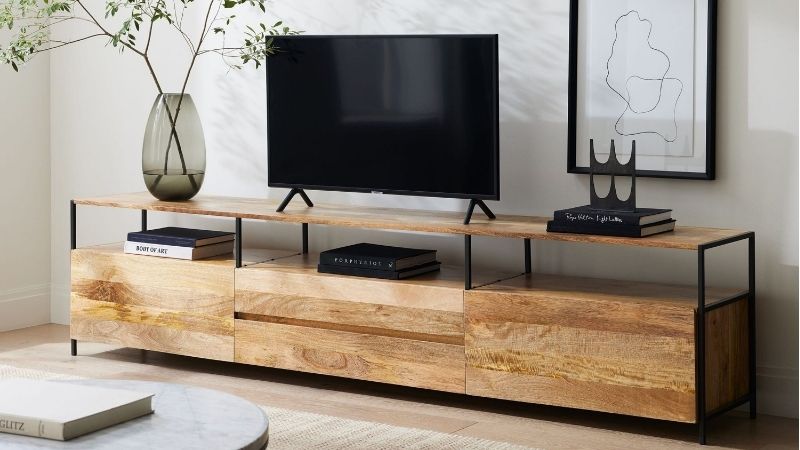
A long, low stand makes the television wall feel calmer without requiring a deep cabinet or a full built-in installation. Keep the unit against the uninterrupted wall and let the sofa face it directly. This layout leaves a more predictable path around a coffee table than bulky corner furniture, but shallow storage may not fit tall equipment.
Measure cabinet depth from the wall to the front edge before buying, then compare it with your actual traffic route. As one real-size reference, the IKEA BESTÅ unit 395.664.98 is 47 1/4 inches wide and 15 3/4 inches deep, with a 35-pound maximum TV load on top [IKEA, 2026]. Those are model-specific figures, not room-layout standards.
If the television rests on the cabinet, check that both factory feet sit completely on the rated top. Organize power cords at the rear rather than dragging a power strip across a walking route. Closed backs can hide wires but restrict larger equipment; use the device maker’s ventilation instructions, and secure the television against tipping.
Pros:
- A low cabinet preserves visual space above the screen in small apartments.
- Measuring front-to-wall depth prevents unexpected obstruction of the main walkway.
- A simple floor-standing format avoids designing an entire media wall.
Cons:
- Short cabinets can leave little room for a center speaker or game system.
- Shallow tops may not fit wide-spaced television feet or deep accessories.
Who Should Skip It: Use the modular media-wall approach if the living room has a long wall and substantial extra storage needs.
Drawer-Front Family Media Hub – Best for Everyday Clutter
Best For: Families sharing the living room for movies, toys, remotes, and chargers who need simple daily cleanup.
Drawers give the TV area an everyday job beyond supporting a screen. Assign one to controllers, one to family accessories, and one to backup cables; leave frequently used remotes in a reachable but child-safe location. The result is a seating area that can switch from playtime to movie night, although drawers require clearance in front.
An IKEA BESTÅ TV bench with drawers combines cable openings and enclosed compartments [IKEA, 2026]. Before choosing a similar unit, measure the full drawer extension and confirm that the coffee table does not stop it. Also verify the rated top load rather than assuming every drawer cabinet holds any television.
Heavy items belong low in the cabinet, with cords routed away from moving drawer parts. The U.S. CPSC specifically recommends securing TVs and furniture and removing objects that tempt children to climb [CPSC, 2026]. Anchoring does not replace correct assembly, and drawer fronts and hinges still need occasional adjustment as the cabinet is used.
Pros:
- Separate drawers keep controllers and accessories from occupying the stand top.
- Closed fronts reduce the visible jumble around shared living-room seating.
- A dedicated storage assignment makes evening cleanup repeatable without new bins.
Cons:
- Deep drawers need empty floor space in front to open fully.
- Closed sections may be unsuitable for powered consoles that require ventilation.
Who Should Skip It: Choose the ventilated open-bay layout if connected devices are used constantly and must stay accessible.
Ventilated Open-Bay Setup – Best for Gaming and Streaming
Best For: Households using a game console, streaming box, router, and sound system that need reachable connections and airflow.
Open compartments make a media setup easier to change: devices are visible, cables remain reachable, and airflow is less likely to be blocked by a solid door. Keep the screen centered above the stand while each active device gets its own appropriately sized bay. This function-first arrangement trades a tidy furniture front for quicker troubleshooting.
A published example is IKEA KALLAX TV unit 005.748.85, with a 57 3/4-inch overall width, a rear cable opening, and a manufacturer-stated 35-pound maximum TV weight [IKEA, 2026]. It illustrates an open media unit, not a universal load rating. Check the true inner bay measurements, because external width does not tell you whether your receiver fits.
Route power and signal cables separately where practical, keeping ventilation slots and service access clear. Dust accumulation can be more noticeable on open shelves, so allow room for cleaning around each device. Before placing a soundbar on a top shelf, test whether the stand or television frame blocks its sound path or remote-control reception.
Pros:
- Open bays make HDMI and power connections simpler to trace when devices change.
- Visible compartments encourage checking device clearances before plugging everything in.
- Rear cable access lets wires reach outlets without crossing front shelves.
Cons:
- Equipment, game cases, and cords remain more visible between cleanups.
- Open shelving may expose electronics to curious children and pets.
Who Should Skip It: Select the drawer-front family hub when storage privacy is more important than frequent access to ports.
Living Room Layouts for Larger Walls and Tricky Sightlines
A larger media wall introduces different trade-offs: tall cabinets need secure attachment, sectionals create uneven viewing angles, and broad windows can reflect across the screen. These arrangements use the stand as part of the whole room rather than treating its finish, floating hardware, or built-in lighting as the primary design decision.
Modular Storage Around the Screen – Best for Spacious Rooms
Best For: Large living rooms that need space for board games, books, media devices, and display pieces on the same wall.
A low center stand with taller matching storage on either side gives a broad wall a purposeful shape without committing to custom cabinetry. Leave clear space around the screen so the bookcases do not visually crowd it. This layout works best when the living room has enough width; narrow rooms can feel boxed in by tall side units.
Modular ranges offer separate compartments instead of one giant console. IKEA BESTÅ configurations, for example, combine media bases, closed storage, and wall cabinets with cable outlets [IKEA, 2026]. Measure every cabinet and attachment point individually; a showroom composition does not confirm that a different wall or TV can carry it.
Fasten tall storage pieces as instructed, even if the television is already secured. Check outlet access before placing a cabinet in the corner of the arrangement, and plan a route to remove equipment later. Hinges, drawer slides, and door alignment can require maintenance; avoid blocking service panels behind fixed units.
Pros:
- Taller side units move books and games away from the television surface.
- Modular components can expand storage without replacing the center TV unit.
- Mixed open and closed bays separate displays from equipment and household supplies.
Cons:
- Multiple cabinets increase assembly time and create more wall attachment points.
- Wide storage compositions can dominate the wall of a smaller room.
Who Should Skip It: Use the single low console if an open wall and clear passage matter more than additional storage.
Offset Console for Sectional Seating – Best for Angled Views
Best For: Living rooms with an L-shaped sectional where viewers sit both directly opposite and off to one side.
A television centered on the wall is not always centered on the people watching it. Shift the stand toward the part of the sectional used most often, then check the screen from the chaise and the far corner seats. An offset composition can reduce uncomfortable side viewing without making the cabinet itself an improvised pivoting TV mount.
Mark the proposed cabinet edges on the floor with removable tape and try the arrangement while seated. Confirm where the TV feet sit and how far the screen extends beyond the stand; a diagonal screen-size label does not tell you the footprint of its base. Leave space for a side table or floor lamp only where it does not block seating access.
An asymmetrical setup looks intentional when the remaining wall space has a purpose, such as a reading chair or bookshelf. Avoid balancing the television by adding heavy objects to the other end of the stand. The cabinet must carry the TV according to its own rated limits, with anchors installed as specified by the furniture and TV makers.
Pros:
- Testing several seats prevents designing the whole room around one chair.
- The layout can improve sectional sightlines without rebuilding a television wall.
- Unused wall space remains available for a separate reading or storage zone.
Cons:
- A shifted TV may look visually uneven in strongly symmetrical rooms.
- Large sectionals can still create viewing-angle compromises for outer seats.
Who Should Skip It: Choose the straight-on compact-wall layout when the main sofa already faces the screen directly.
Glare-Aware TV Stand Placement – Best for Windowed Living Rooms
Best For: Sunlit rooms where window reflections interrupt daytime viewing but curtains and seating must remain usable.
The best place for the stand may be the wall that receives less direct window reflection, not the visually central wall. Walk through the room at the times you usually watch TV and inspect the blank screen from the sofa. A stand on a side wall can make daytime viewing easier while preserving access to curtains and windows.
Use a temporary cardboard outline of the television and cabinet to compare positions before moving heavy furniture. Account for the real width of the screen, window trim, and door swings. Light-filtering shades or adjustable curtains may improve viewing, but their cost and effectiveness depend on the window exposure and your screen finish.
Keep the set away from moisture, heat, and other prohibited conditions. Samsung cautions against installing certain televisions in direct sunlight and on unstable furniture [Samsung support, 2026]; use the manual for your exact model. Route cords away from window access and never rely on fabric shades as an anchoring method.
Pros:
- Checking daytime reflections prevents an attractive layout from failing in normal use.
- A second wall location can preserve convenient access to windows and curtains.
- Simple movable mockups reduce unnecessary furniture purchases and cable relocation.
Cons:
- The least reflective wall may offer less space for wide media furniture.
- A shifted viewing position can require rerouting power and signal cables.
Who Should Skip It: Choose the modular media wall if the room is primarily used after dark and requires more storage than glare control.
Frequently Asked Questions
Before committing to a layout, clarify how your specific TV is supported, where the sofa sits, and what kinds of changes your home permits. The answers below focus on placement, actual furniture measurements, and cost decisions rather than repeating the six styling concepts or promising a one-size-fits-all setup.
How wide should a TV stand be in a living room?
It should fully support the television’s feet and total weight when the TV sits on top, with enough surface remaining for any approved devices. A stand wider than the screen often looks balanced, but that is an aesthetic preference rather than a single engineering rule. Compare actual cabinet dimensions with the exact TV model.
For example, IKEA lists a 47 1/4-inch BESTÅ TV unit with a 35-pound top-panel TV limit; that figure applies to that product, not every 47-inch console [IKEA, 2026]. Check whether the manufacturer quotes a TV diagonal, screen width, or stand-foot span before matching the furniture. The labels describe different measurements.
Where should the TV stand go relative to the couch?
Start on the wall opposite the seats people use most often, then test the picture from side chairs and chaise seating. The correct location depends on the viewing angle, walking paths, windows, and outlets rather than a fixed number of feet between the sofa and cabinet. A paper screen outline can help you compare layouts.
Try watching from the same seat positions you use on a weekday and a weekend. If one wall causes afternoon reflections, consider the windowed-room layout; if the sofa forms an L shape, an offset console may be more practical. Keep all factory feet fully supported wherever the stand sits.
Are TV stands better than wall-mounted TVs for renters?
A freestanding TV stand is easier to relocate and usually requires less wall work than a new wall bracket, but it is not automatically a no-drill or safer solution. CPSC advises securing televisions and top-heavy furniture, including TVs that are not wall mounted [CPSC, 2026]. Lease requirements and approved anchor methods vary.
Ask the landlord how furniture anchors can be installed and repaired, then check the product instructions. A narrow low cabinet may fit the room without a large wall installation, whereas modular wall cabinetry can require substantial fastening. The safest acceptable layout depends on the structure, equipment, and tenancy rules.
How can I improve a TV stand setup on a limited budget?
First rearrange what you already own: relocate the stand to improve glare, sort devices by use, or empty a cluttered top. These changes may cost nothing beyond time, while new modular cabinets and professional installation usually represent a greater commitment. No universal price applies to all six layouts.
Before spending on decorative bins, verify that cables, TV feet, and equipment ventilation fit the current cabinet. Prioritize necessary safety hardware and a functioning storage plan. If the room still feels cramped, use the low-console approach; if family items remain scattered, consider drawers rather than extra display shelves.
Final Thoughts
Among living room tv stand ideas, the room layout should decide the furniture, not the other way around. Mark the cabinet footprint on the floor and try the viewing position during your brightest hours before ordering anything. If equipment doors or walkways fail this test, change the arrangement before upgrading the finish.
