Key takeaways
- The best modern dining chairs are not simply the most sculptural ones. A chair has to match your table height, fit the available edge space, leave workable pull-back room, and use a finish you can actually maintain. These four current…
The best modern dining chairs are not simply the most sculptural ones. A chair has to match your table height, fit the available edge space, leave workable pull-back room, and use a finish you can actually maintain. These four current picks show how different modern profiles solve those constraints.
As an Amazon Associate we earn from qualifying purchases.
By KK Home Furnishings Editorial Team
How to Choose Modern Dining Chairs
Start with measurable fit, then decide how much visual weight you want. Castlery suggests roughly 10 to 12 inches between a dining-chair seat and the tabletop as a practical guide. That range is only a starting point because apron thickness, cushion compression, arm height, and personal posture can change the result.
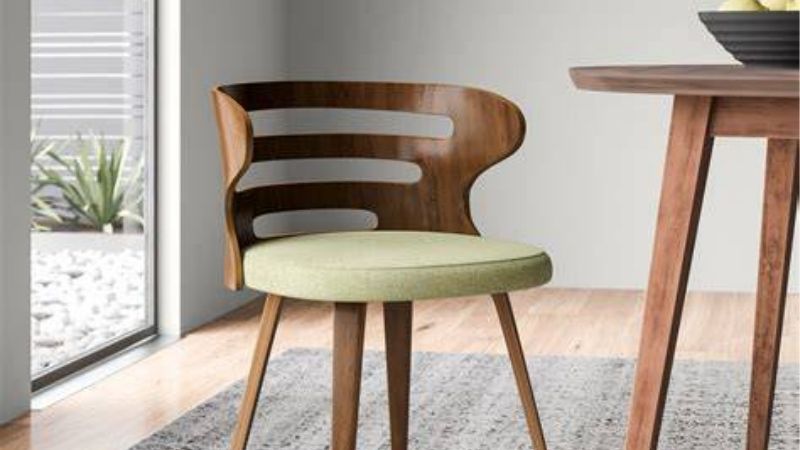
Match Seat Height to the Table Before You Style the Room
A 29.5-inch tabletop gives a useful common reference for these four chairs. Based on their published seat heights, the vertical seat-to-top gap is about 12.6 inches for IKEA ODGER, 11.8 inches for Castlery Austen, 11.5 inches for West Elm Framework, and 11 inches for Poly & Bark Ligna.
Those figures are not knee-clearance measurements because a table apron can sit several inches below the top. They are a first fit check only. If your table has a deep apron or thick edge, measure from the floor to the lowest obstruction and compare that dimension with the seat height of the chair you plan to use.
The lowest seat here is ODGER at 16.875 inches, while Ligna reaches 18.5 inches. That spread can change how the same table feels even before cushion softness is considered. If you already like your current chair height, measure it from floor to the compressed seating surface and use that as your personal benchmark.
Use Overall Width to Protect Each Place Setting
Chair width determines how many seats can realistically share a table edge. ODGER is 17.75 inches wide, Ligna is 18 inches, Framework is 18.7 inches, and Austen expands to 22 inches. The difference looks small on paper, but it compounds when several chairs sit side by side along one long edge.
Do not substitute seat width for overall width when planning the row. A curved back, splayed frame, or projecting arm can make the outside dimension wider than the usable perch. The safer method is to compare each chair’s maximum overall width with the clear distance between table legs or pedestal supports.
For a four- or six-chair layout, place painter’s tape at the published chair widths along the table edge before ordering. This reveals whether chair backs collide, whether end chairs crowd the corners, and whether a centered arrangement still leaves the spacing you want. Modern styling does not compensate for a squeezed row.
Check Overall Depth Against Pull-Back Space
Depth affects circulation because the chair occupies space even before someone pulls it away from the table. Ligna is the shallowest overall at 19.75 inches, followed by ODGER at 20.125 inches, Framework at 21 inches, and Austen at 22.4 inches. Upholstery and curved backs can add bulk without adding table capacity.
Measure from the table edge toward the nearest wall, cabinet, island, or sideboard with a chair in the position you use for sitting down. A room that looks open with chairs tucked in can become awkward during meals. Door swing and drawer access also matter, especially when the dining area shares space with a kitchen work zone.
If the passage behind the chairs is tight, prioritize the real traffic side rather than trying to make every side identical. A shallower chair on the busiest edge can be more useful than a matching set with extra depth. Keep the style relationship through color, wood tone, or back shape if you mix two chair types.
Let Overall Height and Material Control the Visual Weight
The lowest overall profile here is Austen at 30.1 inches, followed by Ligna at 31.75 inches, ODGER at 31.875 inches, and Framework at 33 inches. Lower backs expose more of the tabletop and can make a compact room feel less crowded, while taller backs create a stronger visual rhythm around a long table.
Material changes that effect. ODGER uses wood-plastic composite, Ligna combines solid and veneered American wood with an engineered seat, Framework uses a solid-wood frame with padded upholstery, and Austen pairs solid rubberwood with woven paper cord. None of those constructions is automatically more modern than another.
Choose one or two repeating cues instead of matching every finish. A warm wood chair can echo a sideboard, a black frame can repeat a light fixture, and a woven seat can add texture against a smooth table. For modern dining chairs, restraint usually reads more intentional than stacking several statement materials in one zone.
Top Picks
No single model is an outright overall winner because seat height, width, depth, and finish can reverse the decision. The table below keeps the same published dimensions in view for every chair. It also shows where each profile has a measurable advantage instead of treating modern appearance as a substitute for fit.
| Product | Best For | Key Spec | Watch Out For |
|---|---|---|---|
| IKEA ODGER Chair | Best For Narrowest Overall Width | 17.75W x 20.125D x 31.875H in; 16.875-in seat | Lower seat height; indoor use only |
| Poly & Bark Ligna Dining Chair | Best For Shallowest Overall Depth | 18W x 19.75D x 31.75H in; 18.5-in seat | Hard wood seat; natural grain varies |
| West Elm Framework Dining Chair | Best For Tallest Overall Profile | 18.7W x 21D x 33H in; 18-in seat | Sold as a set of 2; assembly required |
| Castlery Austen Chair | Best For Lowest Overall Profile | 22W x 22.4D x 30.1H in; 17.7-in seat | Widest footprint here; legs need fitting |
IKEA ODGER Chair – Best For Narrowest Overall Width
ODGER is the narrowest chair here at 17.75 inches overall, but its 16.875-inch seat is also the lowest of the group. IKEA lists a 20.125-inch depth, 31.875-inch overall height, 17.75-inch seat width, 16.125-inch seat depth, and a manufacturer-tested load of 243 pounds for the current chair.
The shell and leg frame are wood-plastic composite, with polypropylene and thermoplastic elastomer used in smaller components. IKEA states that ODGER meets EN 12520 and EN 1022 requirements for home-use durability and stability. It also uses a tool-free click-together assembly, which reduces setup hardware.
ODGER sits in a lower-to-mid tier among these picks and is recommended for indoor use. Its lower seat makes the derived gap to a 29.5-inch tabletop about 12.6 inches, slightly above Castlery’s common 10-to-12-inch guide. Check apron height carefully before choosing it for a table with a deep underside.
Poly & Bark Ligna Dining Chair – Best For Shallowest Overall Depth
Ligna is the shallowest overall choice at 19.75 inches deep, but it uses a firm wood seating surface rather than padding. Poly & Bark lists the chair at 18 inches wide and 31.75 inches high, with a 17.5-inch seat width, 16-inch seat depth, and 18.5-inch seat height. It arrives fully assembled.
The walnut version uses solid and veneered American walnut with engineered hardwood, while the oak version uses American oak. Poly & Bark notes that natural wood varies in color and texture, so a multi-chair set can show grain differences. Plastic foot glides are included, and the chair is recommended for indoor use only.
The 18.5-inch seat leaves about 11 inches to a 29.5-inch tabletop surface, comfortably inside Castlery’s general planning range. Ligna is a mid-tier option and ships by parcel. Buyers who want a cushioned perch should treat its 16-inch seat depth and hard surface as a real tradeoff, not a minor styling detail.
West Elm Framework Dining Chair – Best For Tallest Overall Profile
Framework is the tallest chair in this group at 33 inches overall, so it creates the strongest back-line above the table. West Elm lists an 18.7-inch overall width, 21-inch depth, 18.7-inch seat width, 18-inch seat depth, 18-inch seat height, 15-inch seatback height, and 275-pound capacity.
The chair uses a solid-wood frame with a padded upholstered seat and is sold as a set of two. West Elm describes the double T-back as a modern update to a classic show-wood frame. The current listing also identifies the chair as made in Vietnam and says assembly is required unless White Glove delivery is used.
With an 18-inch seat, the derived seat-to-top gap at a 29.5-inch table is about 11.5 inches. Framework sits in a mid-to-premium tier depending on fabric selection. Upholstery adds softness and color flexibility, but spills, fading, vacuuming, and periodic hardware checks create more care than a wipe-clean molded shell.
Castlery Austen Chair – Best For Lowest Overall Profile
Austen is the lowest overall chair here at 30.1 inches, but it is also the widest and deepest at 22 by 22.4 inches. Castlery lists an 18.5-inch seat width, 18.5-inch seat depth, 17.7-inch seat height, 13.4-inch backrest height, 15-pound product weight, and 286-pound maximum bearing support.
The frame is solid rubberwood and the seat uses woven paper cord, finished here in a white-wash stain. Castlery says the materials are tested to comply with applicable formaldehyde safety standards. The product carries a 10-year limited warranty, 30-day returns, and parcel delivery, with the legs fitted during assembly.
Austen leaves about 11.8 inches between its seat and a 29.5-inch tabletop surface, close to the center of Castlery’s planning guide. The low back can suit an airy dining zone, but the 22-inch width needs generous table-edge space. Measure between the legs before assuming a six-chair layout will work.
Frequently Asked Questions
Fit questions are where these dining chairs stop being a style exercise and become everyday furniture. These answers focus on seat-to-table spacing, mixing materials, compact-room planning, and how to compare published load figures without assuming that one specification predicts long-term comfort or durability.
What Seat Height Works With a 29- to 30-Inch Dining Table?
A seat around 17.5 to 19 inches is a practical starting band for many 29- to 30-inch dining tables. Castlery recommends roughly 10 to 12 inches between the seat and tabletop as a general guide. The correct fit still depends on apron depth, cushion compression, armrests, and the body dimensions of the user.
Among these picks, Ligna is 18.5 inches, Framework is 18 inches, Austen is 17.7 inches, and ODGER is 16.875 inches. That puts their seat-to-top references at roughly 11, 11.5, 11.8, and 12.6 inches against a 29.5-inch tabletop. Only the final setup can confirm knee room under the actual apron.
If your table has a thick edge, measure the floor-to-apron clearance and sit in a chair of similar height before ordering a full set. Armchairs need one more check: the arm height must clear the underside if you expect the chair to tuck in. This is more reliable than choosing by an 18-inch seat rule alone.
Can I Mix Different Modern Dining Chairs at One Table?
Yes, mixed modern dining chairs can work when one visual cue repeats and the seat heights remain reasonably close. Keep a shared wood tone, upholstery family, back shape, or frame color so the room has continuity. Then use the end chairs or the busiest side to introduce a different shape or material without creating visual noise.
Height matters more than perfect matching. A set that jumps from a low molded seat to a much taller cushioned seat can make the tabletop feel inconsistent from place to place. The four picks here span about 1.6 inches in published seat height, enough to notice if you mix the extremes around the same table.
Also compare outside width before mixing. A wider end chair such as Austen can work at the table heads while narrower side chairs such as ODGER use the long edges more efficiently. Check leg placement and corner clearance before buying, because a visually balanced combination can still conflict with the table base.
Which Modern Dining Chair Style Works Best in a Small Room?
For a small room, start with overall width and depth rather than back style. ODGER is the narrowest of these picks at 17.75 inches, while Ligna is the shallowest at 19.75 inches. Those dimensions do not guarantee more walking space by themselves, but they reduce the chair envelope before pull-back clearance is added.
A lower back can also reduce visual crowding. Austen is only 30.1 inches high, though its 22-inch width and 22.4-inch depth make it physically larger than the low silhouette suggests. This is why modern dining chairs should be compared on both visual profile and floor dimensions in compact dining zones.
Tape the chair outline on the floor and mark the table edge before ordering. Then open nearby cabinet doors, pull out drawers, and walk the route used during meals. In apartments and eat-in kitchens, that exercise can reveal conflicts that a room photo hides, especially where one chair sits near a wall or passage.
Does a Higher Weight Capacity Mean a Dining Chair Is More Durable?
No, a higher published capacity does not by itself prove that one chair will last longer. Capacity is only one manufacturer-stated limit, and brands may use different test methods. Joinery, fasteners, material quality, floor level, use pattern, and maintenance all influence how a dining chair performs over time.
The current published figures here include 286 pounds for Austen, 275 pounds for Framework, and 243 pounds tested for ODGER. Poly & Bark does not publish a comparable capacity on the current Ligna page, so it should not be ranked on that metric. A missing number is not evidence of a lower or higher real limit.
Use capacity as a screening figure when the manufacturer publishes it, then read the warranty, assembly requirements, and care instructions. Retighten hardware where the maker calls for it, protect finishes from inappropriate cleaners, and stop using a chair that develops loose joints, cracks, or structural movement until it is inspected.
Final Thoughts
Before ordering modern dining chairs, measure the clear span between your table supports with the chairs tucked in, then repeat the check with one chair pulled back on the busiest traffic side. That two-position test can overturn a style-first choice and prevent a good-looking chair from becoming an everyday circulation problem.