
Key takeaways
- 85 in assembled width, the narrowest main-wall footprint among these six
- Modular components, including a 61-in chaise, reconfigure as rooms change
- 22-in maker-stated seat depth suits upright sitting and shorter users
Squeezing a real L-shaped couch into a tight apartment comes down to one number nobody prints in big type: the assembled footprint. This guide compares six documented picks so you can match a small sectional to your floor plan, trading a little seat depth or chaise reach for a corner that genuinely fits.
As an Amazon Associate we earn from qualifying purchases.
By KK Home Furnishings Editorial Team
How to Choose a Small Sectional
Fitting a sectional into a small room is a measuring job before it is a style choice. The three criteria below work from the assembled footprint inward: overall width against your main wall, maximum depth into the room, and the seat geometry you actually sit on. Each uses a documented example from the six picks compared here.
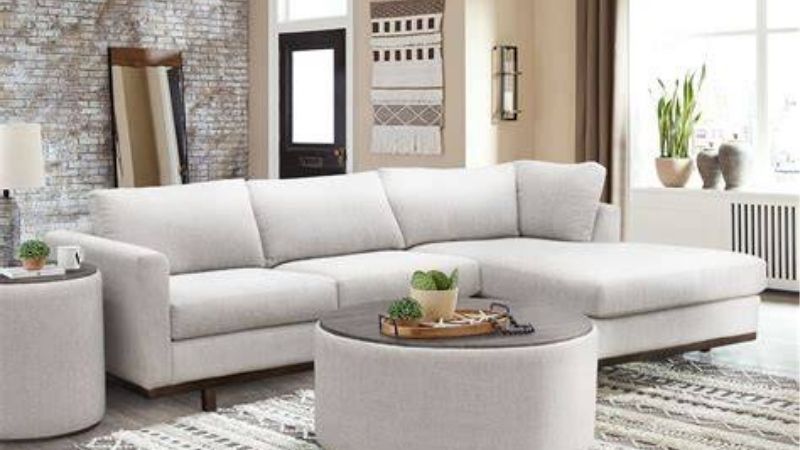
Measure the Assembled L-Shape Footprint
Overall width is the assembled bounding rectangle along your main wall, not the seat-cushion span a listing may quote. Among these picks it runs from 85 in on the Burrow Nomad to 93 in on the Living Spaces Basil, a difference of roughly eight inches that decides whether a sofa clears a doorway, a radiator, or a window trim on a short wall.
Guess this by eye and the piece either blocks a walkway or leaves the chaise stranded mid-room. Measure the wall, then subtract a few inches at each end for outlets and baseboard heaters, so you are not wrestling an oversized 85-to-93-inch carton back out the door weeks later.
Check the Room’s Actual Corner and Chaise Orientation
Maximum installed depth is how far the piece reaches into the room at its deepest point, usually the chaise or the corner return rather than the roughly 35-inch sofa body. It ranges widely here, from 59.5 in on the IKEA FRIHETEN to 89 in on the two Article corner models, so a true corner eats both walls while a chaise only projects from one.
Pick a corner when you have two free walls and a chaise when you have one; get it backwards and the longer return either splits the room or buries a doorway. A reversible or swappable chaise hedges that bet, but a fixed left- or right-facing leg locks your layout for the life of the couch.
Measure Shipping Cartons and Seat Geometry
Seat depth is the maker-stated cushion you lounge on, reported here as a fixed value from 22 in on the Burrow up to 30.75 in on the FRIHETEN Bomstad version. Shallower seats suit upright sitting and shorter users; deeper seats favor reclining but push the knees of shorter sitters off the front edge.
The bigger surprise is often the carton, not the couch: a one-piece 93-inch box needs a clear straight run that a finished 85-inch sofa does not. Measure your narrowest doorway, stair turn, and elevator before ordering, because a seat you love is worthless if the box cannot round the hallway corner.
Top Picks
These six are grouped by the job they do in a tight room, not by an overall winner, because prices here are not verified for a like-for-like ranking. Use the table to scan footprint and the one watch-out that matters most, then read the pick that matches your wall length and chaise side.
| Product | Best For | Key Spec | Watch Out For |
|---|---|---|---|
| Burrow Nomad Sofa Sectional — Arch Arms | Shortest main wall with a chaise | 85 × 61 in; seat 22 in | 61-in chaise projects far past the 35-in sofa depth |
| Article Leigh 87 Small Corner Modular Sectional — Napa White | Small symmetrical corner footprint | 87 × 87 in; seat 25 in | Even a small 87-in corner uses both adjacent walls |
| Article Nirvana 89 Leather Corner Sectional — Dakota Tan | Square leather corner layout | 89 × 89 in; seat 24 in | Long 91-in carton may defeat tight turning halls |
| Article Melo 92 Reversible Sectional — Valor Beige | Reversible short-wall solution | 92 × 67.5 in; seat 24 in | Single 93-in carton needs long clear circulation |
| IKEA FRIHETEN Sleeper Sectional w/ Storage — Bomstad Black | Compact guest bed plus storage | 90.5 × 59.5 in; seat 30.75 in | 30.75-in depth is the Bomstad version; confirm variant |
| Living Spaces Basil Putty 93-inch Left-Arm Chaise Sectional | Slim-arm fixed-chaise layout | 93 × 65 in; seat 23 in | Fixed left-facing chaise does not flip sides |
Burrow Nomad Sofa Sectional — Best for the Shortest Main Wall With a Chaise
Best For: Renters with the shortest usable wall who still want a chaise rather than a plain three-seater sofa.
At 85 in, the Nomad covers the least main wall of any pick here, which is the whole reason it earns a spot: if your free span is barely over seven feet, the wider corner models simply will not land. It still gives you an L with a real chaise instead of forcing a straight sofa into the gap.
The maker lists an 85 in overall assembled width by 61 in maximum depth, with a 22-in standard seated depth measured on the sofa body, not the chaise. That shallow 22-in seat is the trade for the small envelope. Burrow does not publish a verified checkout price for this exact Arch Arms configuration, so check the current price; modular performance-fabric sectionals in this direct-to-consumer tier generally land mid-range.
The 61-in chaise projects far past the 35-in sofa body, so leave clear floor on that side or the lounge end dominates a small room. It ships as several compact boxes rather than one long carton, which eases a tight stair, though the exact box sizes for this arm style should be confirmed before delivery. Care follows Burrow’s fabric instructions, with no machine washing authorized.
Pros:
- 85 in assembled width, the narrowest main-wall footprint among these six
- Modular components, including a 61-in chaise, reconfigure as rooms change
- 22-in maker-stated seat depth suits upright sitting and shorter users
Cons:
- 61-in chaise projects far beyond the 35-in sofa depth
- 22-in seated depth is shallow for deep, full-body lounging
Who Should Buy It: Buy it for a sub-eight-foot wall; if you have two free walls, choose the Leigh corner instead.
Article Leigh 87 Small Corner Modular Sectional — Best for a Small Symmetrical Corner
Best For: Buyers with a genuine nook of two free walls who want a true square corner, not a one-sided chaise.
Unlike the chaise models here, the Leigh turns a real 90-degree corner, seating people along two walls instead of projecting one lounge into the floor. That is what you want when the room already has an L-shaped nook: the couch follows the architecture instead of fighting it, and the modular frame lets you set the corner on either side.
Article lists a true 87 by 87 in corner envelope with a 25-in standard seated depth, the deepest everyday seat among the picks short of the FRIHETEN sleeper. The Napa White cover is a polyester-linen blend with reversible cushions. Article sits in the mid-range direct-to-consumer band, but the exact checkout price for this SKU is not verified here, so check the current price before comparing.
Because it occupies both adjacent walls, an 87-in square corner is not automatically smaller than a wider one-wall sofa, so map both walls first. It ships in three cartons, the largest about 28 by 41 by 46 in; measure that face against your doorway. As US upholstered furniture, verify the TB 117-2013 flammability label and the SB 1019 disclosure tag on this exact SKU rather than assuming a result.
Pros:
- True 87 by 87 in corner anchors two walls at once
- 25-in seated depth, the deepest non-sleeper seat in this set
- Modular frame with reversible cushions sets the corner either side
Cons:
- Even a small 87-in corner commits both adjacent walls
- White polyester-linen shows stains; machine washing is not authorized
Who Should Buy It: Buy it for a two-wall nook; if only one wall is free, pick the Melo reversible chaise instead.
Article Nirvana 89 Leather Corner Sectional — Best for a Square Leather Corner
Best For: Leather buyers with two free walls who prefer natural patina over a wipe-clean synthetic finish.
This is the only leather pick in the group, and that material choice is the reason to consider it over the fabric corners: full-aniline top-grain hide ages into a marked patina instead of staying flat and new. If you want a corner that looks more lived-in each year rather than one you blot clean, the Nirvana is the one here that does it.
Article lists an 89 by 89 in corner footprint with a 24-in standard seated depth, built on a solid wood frame with Pirelli webbing suspension rather than sinuous springs. Leather corner sectionals typically sit at the premium end of this segment, and the exact Dakota Tan checkout price is not verified here, so check the current price before you commit.
The geometry that fits the room may not fit the hallway: the longer of its two cartons runs 91 in, so a tight 90-degree turn or a stair landing can defeat delivery even when the assembled corner would sit fine. Uncoated full-aniline leather also needs a damp-cloth wipe and professional care for hard stains, and it will show marks a coated synthetic would resist.
Pros:
- Only full-aniline top-grain leather pick in this lineup
- 89 by 89 in corner on a solid wood frame
- Pirelli webbing suspension supports the 24-in seated depth
Cons:
- Longer 91-in carton may defeat tight turning hallways
- Uncoated aniline leather marks and patinas, not wipe-clean
Who Should Buy It: Buy it for leather and patina with wide hallways; if access is tight, choose the box-friendly FRIHETEN instead.
Article Melo 92 Reversible Sectional — Best for a Reversible Short-Wall Layout
Best For: Movers who want one chaise that flips to either side as floor plans and rooms change.
The Melo earns its place on flexibility: its chaise is reversible, so a single couch adapts to a left- or right-hand room without reordering. Against the fixed Living Spaces chaise, that is the difference between a sofa that moves with you and one that locks your layout. For renters who expect to change apartments, the reversible arrangement is the headline feature.
Article lists a 92 by 67.5 in envelope with a 24-in standard seated depth on a corner-blocked frame. The 67.5-in maximum depth is the chaise projection, not the sofa body, so it still needs real floor on the lounge side. It is priced in Article’s mid-range band, though the exact Valor Beige checkout figure is not verified here, so check the current price.
Flexibility inside the room comes with a delivery catch: the Melo arrives as one 37 by 42 by 93 in carton, a single long box that needs a clear straight run through the home, unlike the multi-carton picks. The Valor Beige performance fabric takes a dry blot for spills and professional care for persistent stains, so plan the delivery path before the truck arrives.
Pros:
- Reversible chaise sets the lounge on either side
- 92 by 67.5 in envelope on a corner-blocked frame
- 24-in seated depth on a reversible performance-fabric chaise
Cons:
- Single 93-in carton needs a long, clear circulation path
- 67.5-in chaise projection still consumes real floor space
Who Should Buy It: Buy it if you move often and want a flippable chaise; for a fixed nook, the Leigh corner fits better.
IKEA FRIHETEN Sleeper Sectional With Storage — Best for a Compact Guest Bed
Best For: Small households needing an occasional guest bed and hidden storage without adding a separate daybed.
No other pick here does double duty: the FRIHETEN folds out to a sleeper and hides storage under the chaise, which is the reason to choose it over a dedicated corner or chaise. In a studio or a one-bedroom that also hosts guests, it replaces a sofa plus a spare bed, and the chaise can be set left or right.
IKEA lists a 90.5 by 59.5 in envelope, the shallowest maximum depth here at 59.5 in, with a pull-out sleeper bed of 80 3/8 by 55 1/8 in. As IKEA flat-pack, it sits at the budget-friendly end of the category, though the exact assembled-combination price is not verified here, so check the current price. Its seated depth is deep at 30.75 in.
The flat-pack catch is assembly and the cover: the FRIHETEN comes as multiple components you build, and the Bomstad polyurethane-coated cover is fixed, not removable or machine-washable, so a damp sponge is the only cleaning route. Converting to the bed also needs clear access in front of the chaise, so keep that span open rather than crowding it with a coffee table.
Pros:
- Pulls out to an 80 3/8 by 55 1/8 in sleeper bed
- Shallowest 59.5-in maximum depth and hidden chaise storage
- Chaise can be set left or right at assembly
Cons:
- 30.75-in depth is the Bomstad version; confirm the fabric variant
- Fixed coated cover is not removable or machine-washable
Who Should Buy It: Buy it if guests stay over and budget matters; for an everyday-only seat, the Basil chaise sits better.
Living Spaces Basil Putty 93-inch Left-Arm Chaise Sectional — Best for a Slim-Arm Fixed Chaise
Best For: Buyers set on a left-facing chaise and a slim track arm that saves width on a long wall.
The Basil trades flexibility for a clean, space-saving profile: its track arm is slim, so more of the 93-in width becomes usable seat rather than bulky armrest. Where the reversible models keep their options open, this one commits to a left-facing chaise and, in return, reads trimmer along a long wall. If your layout is settled, that fixed simplicity is the draw.
Living Spaces lists a 93 by 65 in two-piece sofa-chaise with a 23-in standard seated depth and a track arm. At 93 in it is the widest pick here, so it needs the longest clear wall. Living Spaces generally runs mid-range, but the exact Putty checkout price is not verified here, so check the current price before ordering.
The commitment is literal: the left-arm chaise does not flip, so confirm the side against your room before buying, because a wrong-handed return is costly. The Putty cover carries care code W, meaning water-based cleaners only, and it ships as two cartons, the longer near 60.78 by 38.78 by 35.78 in, which is friendlier to a tight turn than a single 93-in box.
Pros:
- Slim track arm turns more of 93 in into seat
- Two-piece sofa-chaise ships as two separate, easier-to-maneuver cartons
- 23-in seated depth with a space-saving track-arm profile
Cons:
- Fixed left-facing chaise does not flip to the other side
- 93-in width is wider than the Burrow 85 and Leigh 87
Who Should Buy It: Buy it for a settled left-facing layout; if you may rearrange, the reversible Melo is the safer choice.
Frequently Asked Questions
A few questions come up again and again once the tape measure is out. These answers stick to how the measurements behave in a real room, not to any single model, so they apply whichever of the six picks you lean toward. Each starts with the direct answer, then the condition that can change it.
What width counts as a small sectional sofa?
There is no official cutoff, but most retailers apply the small or apartment tag to overall widths at or under roughly 95 in; the six here fall between 85 and 93 in. The label tracks marketing, not a standard, so a maker’s compact listing can still be wider than a full-size model from another brand.
What changes the answer is depth, not just width: a 93-in piece with a shallow 23-in body can read smaller in a room than an 87-in square corner that reaches 87 in back. Compare the assembled bounding rectangle, and treat the word small as a starting filter rather than a promise.
Does the chaise go on the left or right?
Face the seat from inside the room: the chaise is left- or right-facing based on which side the long lounge sits on from that view. Some models here, like the Melo and the FRIHETEN, let you swap or reverse the chaise, while the Living Spaces Basil is fixed left-arm-facing.
Which side to choose depends on your door and window placement; put the chaise away from the main traffic path so no one has to climb over it. If you rent or move often, a reversible leg is worth more than a fixed one, since the same couch can flip to suit the next apartment.
Will a compact sectional fit through a 30-inch doorway?
Often, but not because of the assembled size; it depends on the carton. A finished piece ships in boxes like the Nirvana’s 91-in-long carton or the Melo’s single 93-in box, and it is the box’s smallest face, around 21 to 42 in here, that must clear a 30-inch doorway.
The variable that flips this is the turn, not the opening: a straight push through 30 in is easy, but a 90-degree hallway or a stair landing can stop a long box cold. Measure the diagonal of your tightest turn, and favor multi-carton or modular designs when access is genuinely limited.
Is a corner sectional better than a chaise for a small room?
Neither is better outright; it depends on how many walls you can give up. A true corner like the 87-in Leigh or the 89-in Nirvana commits two adjacent walls, while a chaise model projects from one wall and leaves the other free for a console or a doorway.
If your room has a natural nook with two usable walls, the corner seats more people in the same footprint; if one wall holds a TV, window, or walkway, the single-sided chaise keeps circulation open. Match the shape to the room’s free walls, not to the showroom photo.
Final Thoughts
Start from the wall you have to fill, not the showroom photo: measure your main span and your tightest hallway turn, then let the role decide. Treat the narrow Burrow as your shortest-wall option, the FRIHETEN as the guest-bed workhorse, and a true corner like the Leigh when two walls are free. The right small sectional is simply the one whose footprint, chaise side, and carton all clear your actual room.
