Key takeaways
- A toddler chair is worth buying only when it gives a young child a low, stable place to sit down and stand up with less help. If your child already has a secure child-sized seat that fits the activity, you…
A toddler chair is worth buying only when it gives a young child a low, stable place to sit down and stand up with less help. If your child already has a secure child-sized seat that fits the activity, you may not need another. The useful differences are age fit, entry height, footprint, and cleanup.
As an Amazon Associate we earn from qualifying purchases.
By KK Home Furnishings Editorial Team
How to Choose a Toddler Chair
Toddler seating covers very different products, from soft foam loungers to upright play chairs and small rockers. Start with the stage your child is in, then match the seat to reading, table play, or quiet time. A low lounge chair can be excellent for books but awkward beside a craft table.
Match the Chair to the Child’s Development Stage
Age guidance is the cleanest first filter because a one-year-old and a three-year-old do not use furniture in the same way. Pottery Barn Kids lists its My First Anywhere Chair for ages 1 to 2, while Delta Children recommends the Cozee Chair from 18 months and Guidecraft lists the Kiddie Rocker for ages 2 to 7.
IKEA’s current U.S. MAMMUT page focuses on size and use, while an official IKEA buying guide lists the chair for ages 3 to 6. That puts it at the upper edge of toddler use rather than the center of the range. It can suit an older toddler, but it is not the first choice for a child who has just started sitting independently.
Do not treat age labels as a promise that every child will fit the same way. A taller two-year-old may be ready for a more upright seat, while a smaller child may still do better with a lower lounge chair. Use the maker’s age guidance as the boundary, then watch how easily the child can enter and leave the seat.
Prioritize Easy Entry and Exit Over a Grown-Up Look
A low seat can support independence because the child has less distance to climb. Pottery Barn Kids gives the My First Anywhere Chair a 6.5-inch seat height and a compact 10-inch-wide seat. Its soft form is made for reading and relaxing, not for bringing a toddler up to a standard dining or work surface.
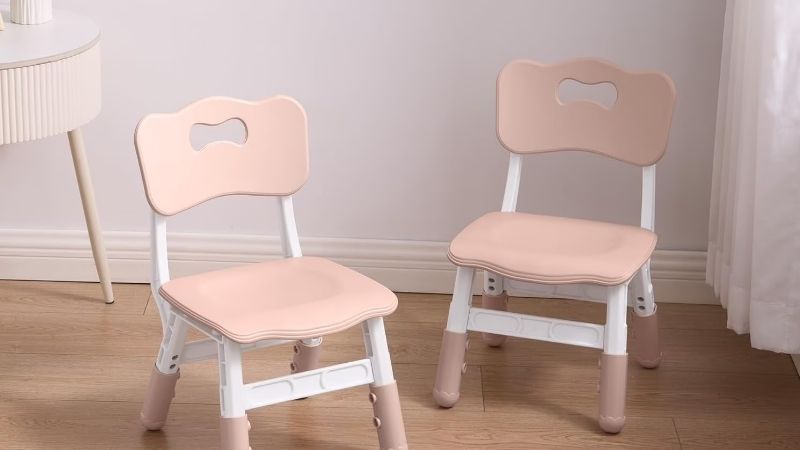
IKEA takes the opposite approach with the MAMMUT. Its seat sits 11 3/4 inches from the floor, with a seat depth of 10 1/4 inches. That higher, firmer geometry is better suited to table play for an older toddler or preschooler, but it asks more from a very young child getting on and off independently.
Delta and Guidecraft publish overall dimensions rather than a separate seat-height figure on the pages reviewed here, so neither should be ranked by seat height alone. For those models, judge the child’s entry and exit in real use. A chair that looks small in a photo can still be too deep or too tall for a short-legged toddler.
Plan the Footprint Around the Activity
Floor space changes the answer more than many parents expect. Delta’s Cozee Chair measures 18 inches wide, 25 inches deep, and about 18 inches high, so it uses more depth than an upright play chair. That shape works well in a bedroom or reading corner where the child can lean back without blocking a walkway.
Guidecraft’s Kiddie Rocker measures 16 inches wide, 19 inches deep, and 25.5 inches high. It is narrower and shallower than the Delta foam chair, but the rocking form needs open space around it. The front stabilizers are designed to limit forward tipping, yet the chair still belongs where movement will not hit a wall or shelf.
IKEA’s MAMMUT is the most table-oriented footprint here at 15 3/8 inches wide and 14 1/8 inches deep. Pottery Barn Kids sits between lounge and compact furniture at 20.5 inches wide and 16.5 inches deep. Before buying, mark the footprint on the floor and keep door swings and toy-storage paths clear.
Choose Surfaces That Match Real Toddler Mess
Cleanup is not a secondary feature with toddler furniture. Delta uses a removable machine-washable slipcover on the Cozee Chair, and Pottery Barn Kids also makes the My First Anywhere Chair with a removable washable cover. Those designs make sense for snacks, milk drips, marker transfer, and everyday fabric grime.
Guidecraft uses removable cotton canvas cushion covers that can be machine washed in cold water. The frame combines birch plywood with a powder-coated metal structure, so the chair is more furniture-like than a foam lounger. That mixed construction suits a reading area where you want padding without giving up a defined frame.
IKEA’s MAMMUT uses polypropylene and is designed to wipe clean with a damp cloth and mild cleaner. It can also be used outdoors because the plastic is UV treated. For a toddler chair that may move between crafts, snacks, and messy play, a wipe-clean shell is often easier to live with than a fabric seat.
Top Picks
No single toddler chair wins every use case because the age bands and seating styles differ too much. The strongest choice is the one that matches the child’s current stage and the job of the seat. These four options cover early lounging, portable reading, rocking, and upright table play without pretending they are interchangeable.
| Product | Best For | Key Spec | Watch Out For |
|---|---|---|---|
| Pottery Barn Kids My First Anywhere Chair | Best For Ages 1 to 2 | 6.5-inch seat height, ages 1 to 2 | Low lounge shape is not a table chair |
| Delta Children Cozee Chair for Kids | Best For 18 Months and Up | 18 inches wide, 6-pound product weight | Foam needs time to expand after unpacking |
| Guidecraft Kiddie Rocker | Best For Ages 2 to 7 | 16 inches wide, 19 inches deep | Rocking motion needs clear floor space |
| IKEA MAMMUT Children’s Chair | Best For 11 3/4-Inch Seat Height | 11 3/4-inch seat height, 15 3/8-inch width | Better for older toddlers and preschoolers |
Pottery Barn Kids My First Anywhere Chair – Best For Ages 1 to 2
The main limitation is its short age window, but that is also why this chair fits the earliest stage so well. Pottery Barn Kids lists the My First size for ages 1 to 2, with a 6.5-inch seat height, a 10-inch-wide seat, and an overall size of 20.5 inches wide, 16.5 inches deep, and 17.75 inches high.
The chair is light at 4 pounds and includes a handle, so an adult can move it easily between a bedroom, playroom, and family room. The removable slipcover is machine washable, and some versions are GREENGUARD Gold Certified. That makes this a strong premium-tier choice when the main job is reading, cuddling, or quiet play.
It is not the right pick for a toddler who needs an upright seat beside a play table, and the slipcover and insert may ship separately. That split delivery is a real ownership detail, not just packaging trivia. Choose it when low entry and a soft lounge posture matter more than table compatibility or long age-range value.
Delta Children Cozee Chair for Kids – Best For 18 Months and Up
The Cozee is less structured than a wood chair, so it is better for lounging than focused table work. Delta recommends it from 18 months and lists the chair at about 18 inches wide, 25 inches deep, and 18 inches high, with a product weight of 6 pounds. That gives it a low, portable profile for everyday rooms.
Delta adds a top handle, a removable machine-washable slipcover, and a fully assembled foam body. The chair may need up to 48 hours to expand after unpacking, so it is not an instant-use purchase straight from the box. Within a mid-tier range, the easy-clean cover and light weight are the strongest practical reasons to choose it.
The manufacturer says the chair meets or exceeds applicable safety standards, but the page does not publish a separate seat-height number. It should not beat a verified low-seat model on height alone. Pick it for books, television, or calm play when portable, washable fabric matters more than rigid table posture.
Guidecraft Kiddie Rocker – Best For Ages 2 to 7
The rocking motion demands more supervision and clearance than a fixed chair, so this is not the safest layout choice for a narrow aisle. Guidecraft lists the Kiddie Rocker for ages 2 to 7 and gives it an overall size of 16 inches wide, 19 inches deep, and 25.5 inches high, which keeps the footprint fairly compact.
Its frame combines steam-bent birch plywood with a powder-coated metal structure, while the cushions use cotton canvas covers that are machine washable in cold water. Front stabilizers are designed to resist forward tipping. Those features make it a useful mid-tier option for a reading zone where gentle motion is part of the appeal.
Assembly is required, and Guidecraft labels the product as safety tested without naming a specific standard on the page reviewed here. That is a reason to stay precise rather than overclaim certification. Choose this model when a two-year-old or older child enjoys movement and you can give the rocker a clear, level area away from hard edges.
IKEA MAMMUT Children’s Chair – Best For 11 3/4-Inch Seat Height
The MAMMUT sits higher than the soft lounge options, so it is a better match for older toddlers than for a new walker. IKEA lists a seat height of 11 3/4 inches, a width of 15 3/8 inches, a depth of 14 1/8 inches, and a total height of 26 3/8 inches. Those dimensions suit upright table play.
The polypropylene construction is lightweight, wipeable, and UV treated for indoor or outdoor use. An official IKEA buying guide lists MAMMUT for ages 3 to 6, although the current U.S. product page does not repeat that age range. That puts it in the budget tier for families transitioning from toddler lounging to preschool table activities.
Assembly is required, and the matching MAMMUT table is a separate purchase if you want a coordinated work surface. The seat is not padded, so comfort depends on the child and activity length. Choose it when a toddler is near age 3, can climb on and off confidently, and needs a washable chair for crafts, snacks, or play.
Frequently Asked Questions
Most toddler seating questions are really fit questions: how low the seat should be, when a child is ready for a chair without a harness, whether a rocker is appropriate, and how long a small chair will remain useful. The answers depend on the child’s stage, the room, and the activity rather than one universal size.
How Low Should a Toddler Chair Be?
Low enough that the child can sit down and stand up without a difficult climb, but not so low that the seat becomes awkward for the intended activity. In this group, Pottery Barn Kids publishes a 6.5-inch seat height for its My First chair, while IKEA’s MAMMUT sits much higher at 11 3/4 inches.
Those two numbers describe different jobs. The lower chair is built for lounging and independent access, while the higher MAMMUT is shaped for upright use near a child-sized table. Delta and Guidecraft do not publish a separate seat-height figure on the pages reviewed here, so judge those models by actual entry and exit rather than assumptions.
If your child needs hands on the arms, turns sideways, or drops heavily into the seat every time, the chair may not be a natural fit yet. A toddler chair should make sitting simpler, not create a new climbing task. Keep the floor level and clear so the child has room to approach, sit, and stand without hitting nearby furniture.
When Can a Toddler Use a Chair Without a Harness?
Use the manufacturer’s intended age range and product design rather than removing a restraint early from a feeding or infant seat. The chairs in this guide are ordinary child seating, not high chairs. Pottery Barn Kids starts its My First Anywhere Chair at age 1, while Delta starts the Cozee Chair at 18 months.
A child who can sit steadily, turn, and stand from the seat without being propped is a better candidate for independent floor-level seating than a child who still needs positional support. That does not make the chair a substitute for supervision. Young toddlers can climb, tip, or use furniture in ways the maker never intended.
If the product began life as a high chair, bouncer, or restrained seat, follow that product’s own transition instructions instead of using a general toddler-chair rule. Do not remove a harness simply because the child dislikes it. A dedicated low chair is often the cleaner choice once the child is ready for ordinary seating.
Are Rocking Chairs Good for Toddlers?
They can be, if the product is designed for the child’s age and the room gives it safe clearance. Guidecraft lists the Kiddie Rocker for ages 2 to 7 and adds front stabilizers intended to reduce forward tipping. Its 16-inch width and 19-inch depth keep the chair compact, but the rocking path still needs open space.
Place a rocker on a level surface away from sharp table corners, shelves, heaters, and traffic paths. A toddler may push harder than expected or use the arms as leverage, so the surrounding room matters as much as the frame. If the child repeatedly stands on the seat or rocks aggressively, switch to a fixed chair.
For calm reading, a rocker can give an older toddler a defined place to settle without the sprawling footprint of a foam lounge chair. For crafts and snacks, a fixed upright seat is usually easier to manage. The best toddler chair is the one whose movement matches the activity, not the one with the most playful feature.
How Long Will a Toddler Chair Stay Useful?
The useful life depends on age guidance, dimensions, and what the chair is asked to do. Pottery Barn Kids gives My First a narrow ages 1 to 2 window, while Guidecraft stretches the Kiddie Rocker from ages 2 to 7. Delta begins at 18 months without publishing an upper age limit on the page reviewed here.
IKEA’s older official buying guide places MAMMUT at ages 3 to 6, which makes it more of a transition into preschool furniture than an early toddler seat. That can be useful if you are buying near age 3 and want a chair for table play. It is less compelling if you are shopping for a newly independent one-year-old.
Watch the child’s posture and movement rather than waiting for a birthday. When the seat becomes difficult to enter, the back support feels too low, or a table no longer lines up comfortably, the chair has reached the end of its practical fit. A longer age label does not help if the child’s body has already outgrown the geometry.
Final Thoughts
The right toddler chair depends on stage more than style. Pottery Barn Kids is strongest for ages 1 to 2, Delta offers a portable washable lounge seat from 18 months, Guidecraft adds a rocker for ages 2 to 7, and IKEA works best near the transition to preschool table play. Choose the chair your child can use confidently today.