Key takeaways
- Map TV, top-panel and individual shelf loads separately, resolve unclear limits, and check assembly and equipment space before loading a TV stand.
What's inside
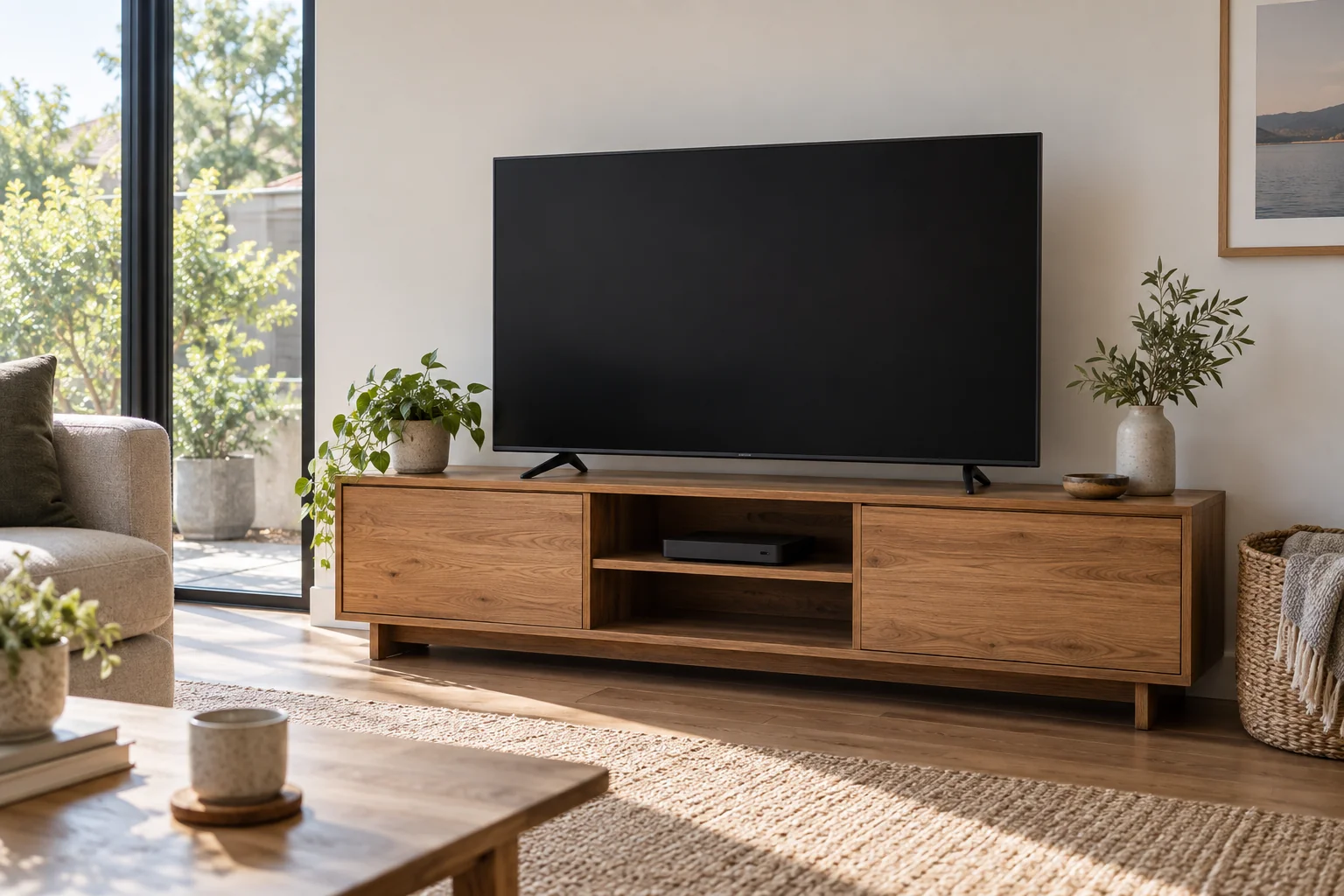
A TV stand can have different limits for its top, individual shelves, drawers and complete assembly. Compare each load with the rating that actually applies to its location. Do not add shelf capacities together to invent a total capacity, and do not assume that a large top-panel number permits an equally heavy television.
Identify the exact configuration first
Record the stand’s model, size, material variant and installation method. A floor-standing cabinet and a wall-hung version can have different conditions. Added legs, a glass shelf or a different width can also change which instructions apply. Use the documentation for the unit you will actually assemble.
Separate screen size from weight. A phrase such as “for 65-inch TVs” does not supply the television’s installed weight or establish how its feet load the furniture. Find the TV’s weight with its supplied stand when that is how it will be used, then check the furniture’s requirements for support placement as well as mass.
Read every relevant rating label
A listing may distinguish maximum TV weight from maximum load on a top panel. It may describe a uniformly distributed load rather than weight concentrated under small feet. If the wording is unclear, ask the manufacturer how the proposed TV and other objects should be compared with those values.
The IKEA UK BESTÅ/EKET combination listing illustrates why careful reading matters. At review, its product notes specified a maximum TV weight of 30 kg, while its measurement section listed 50 kg on the top panel and 20 kg per shelf. Those labels should not be collapsed into permission for a 50 kg TV. Confirm the intended meaning for the exact component and installation.
That example is not a recommendation for this furniture or a universal set of limits. Product data can change. Save the current relevant instructions, and resolve apparently conflicting statements with the maker before loading the stand.
Make a load map
| Location | Objects and weight | Applicable limit | Unresolved detail |
|---|---|---|---|
| TV position | Television with intended feet or stand | Maximum TV weight and support requirements | Foot spacing and concentrated contact |
| Top panel | TV plus soundbar and other top objects | Top-panel rating under stated conditions | What is included in the rating |
| Each shelf | Equipment and accessories separately | That shelf’s own rating | Glass or adjustable shelf differences |
| Each drawer | Contents only as specified | Drawer rating | Do not borrow shelf capacity |
| Whole assembly | Complete planned arrangement | Any stated total or installation limit | Ask if total capacity is unspecified |
Worked example: empty capacity cannot move between shelves
Suppose a hypothetical cabinet’s instructions give a 40 kg top limit and 10 kg for each of two shelves. Its top holds a 24 kg television and a 4 kg soundbar, making 28 kg there. One shelf is planned for 12 kg of equipment, while the second remains empty.
The overloaded shelf does not pass because the neighboring shelf is unused. Twelve exceeds its own ten-kilogram limit. Nor can the owner declare an 80 kg total capacity by adding unrelated numbers or assuming another unstated allowance. They need a layout that satisfies every applicable limit and any whole-unit condition.
Even the top’s arithmetic is only one check. The 28 kg figure does not prove that the TV’s feet are supported correctly, that the furniture is installed as required or that there is an additional TV-specific limit. This example shows bookkeeping, not structural certification.
Keep assembly and anchoring requirements separate
A weight below a published limit does not replace correct assembly. Use all required supports and fasteners, follow the product’s anchoring instructions and seek appropriate installation help where the wall or fixings are uncertain. Do not use anchoring as permission to exceed a shelf rating.
Do not sit or stand on a TV cabinet to test its strength. Do not remove a divider to fit equipment unless the manufacturer explicitly permits that configuration. Visible survival of a brief overload would not establish safe long-term use.
Check equipment space after the load map
A component can be light enough yet lack sufficient ventilation or cable clearance. Check its own instructions alongside the furniture dimensions. A closed door, tightly bent cable or blocked vent remains a problem even when the shelf has unused weight capacity.
Keep power equipment and cable routing within their own instructions. A cabinet’s furniture rating does not rate an integrated outlet or power strip. Treat electrical capacity and furniture support as separate questions rather than allowing one favorable number to stand in for the other.
Update the map when equipment changes
Save the weights, source documents and final placement sketch. Recheck when replacing the TV, adding a receiver or moving equipment onto a different shelf. If a rating cannot be confirmed, leave it unresolved and ask the maker; a clear unanswered question is more useful than an invented allowance based on how sturdy the cabinet looks.