Key takeaways
- Floating TV stands hang on concealed brackets or manufacturer-specific fittings that transfer weight into a suitable wall. That mechanism answers the question “how do floating tv stands work?” without assuming every wall or cabinet can support the same load. The…
Floating TV stands hang on concealed brackets or manufacturer-specific fittings that transfer weight into a suitable wall. That mechanism answers the question “how do floating tv stands work?” without assuming every wall or cabinet can support the same load. The furniture’s legless appearance alone is not a capacity rating.
As an Amazon Associate we earn from qualifying purchases.
By KK Home Furnishings Editorial Team
How Floating TV Stands Carry Weight
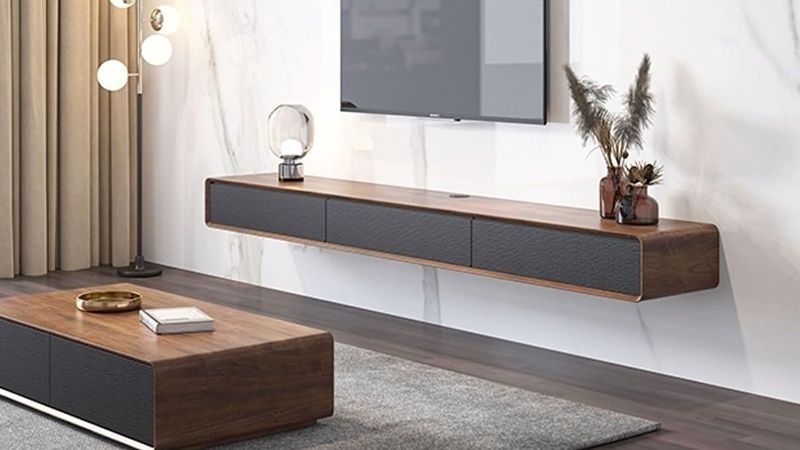
Unlike a floor-standing console, a suspended TV cabinet sends its load into the wall rather than down through legs. The wall fixing, cabinet structure, and any connector between them must work as one system. These common support arrangements illustrate the concept, but the manufacturer of the exact unit determines the approved attachment method.
| Support Arrangement | How the Load Reaches the Wall | Main Limitation | What to Confirm |
|---|---|---|---|
| Concealed metal brackets | Cabinet connects to rear-mounted support arms or plates | Connections may pull outward under a deep load | Correct bracket for exact cabinet |
| Manufacturer-specific hanger fittings | Fitted hangers engage prescribed wall-mounted hardware | Hardware and cabinet must be a compatible pair | Official assembly instructions |
| Proprietary suspension rail | Rail transfers cabinet load to approved wall fixings | A rail approved for one series may not fit a TV bench | Rail explicitly approved for model |
| Wood cleat or interlocking cleats | Mating pieces transfer load along a continuous rear support | DIY cleats are not automatically manufacturer approved | Engineered or approved hanging system |
| Wood-framed wall | Approved fasteners connect supports to suitable structural framing | Drywall finish itself is not the structural framing | Attachment locations and stud conditions |
| Masonry wall | Suitable anchors connect the support to verified masonry | Hollow blocks and solid masonry need different details | Base material and specified anchors |
The table explains load paths, not interchangeable construction recipes. IKEA, for example, approves some BESTÅ TV benches for wall hanging but expressly prohibits its familiar BESTÅ suspension rail for those benches [IKEA, BESTÅ 705.660.33, accessed October 2026]. Hardware that works for one cabinet family can be the wrong component for another.
The Cabinet Transfers Its Load Through Hidden Connections
Picture the cabinet as a box attached to the wall along its rear edge. Its shelves, side panels, top, and internal joints carry equipment loads toward the hanging connections. Those connections pass forces into brackets or fasteners, which transfer them into the building structure. A handsome front panel cannot replace a strong load path at the back.
Because the cabinet extends forward, an object near the front can increase the tendency for the unit to rotate away from the wall. This can create outward pulling forces at some fasteners as well as downward forces. A shallow shelf may behave differently from a deep media cabinet even when the objects placed on them weigh the same.
The Wall Material Determines What the Fixings Can Carry
A metal hanger cannot create structural strength where the wall has none. On wood-framed walls, the chosen attachment typically needs properly located structural framing and the manufacturer-approved fasteners. Plasterboard or drywall is a finish material, and its presence alone does not tell you the strength of the complete supporting assembly.
Masonry may provide another possible support path, but solid concrete, hollow block, and deteriorated brick do not accept the same fixing assumptions. Product manuals commonly instruct users to select fasteners suitable for their wall type. IKEA explicitly says the maximum loading of a wall-hung BESTÅ TV bench depends on the wall material [IKEA, 705.660.33].
A TV Weight Limit Is Not the Same as a Wall-Hung Load Rating
Manufacturers may list the maximum weight of a television that a furniture top can support, yet separately qualify the wall-hanging limit. IKEA lists a 35-pound maximum TV weight for its 47 1/4-inch BESTÅ TV bench, article 705.660.33, while stating that the maximum load when wall hung depends on the wall material [IKEA, October 2026].
The cabinet itself also weighs something, and stored consoles, books, and accessories add further demand to the support. Do not treat a published top-panel TV figure as approval to suspend that much additional weight. When the manufacturer does not specify a complete allowable mounted configuration for your wall, seek an installer or a different furniture design.
How the Support System Changes by Room and Load
Once the hidden load path is understood, the next question is which configuration makes sense in a particular home. The six examples below focus on mechanical differences rather than drilling steps. A wall that looks smooth and a cabinet that appears sturdy still require model-specific evidence before any hanging work starts.
A Media Cabinet Mounted to a Wood-Stud Wall
A typical interior framed wall has drywall covering structural studs. In a properly designed installation, the mounting hardware transfers the cabinet load to the framing rather than relying on the drywall surface alone. Stud spacing, fastener specifications, the cabinet connection points, and the framing condition all affect which arrangements are possible.
The important distinction is between locating possible supports and confirming the attachment system. A stud finder can help identify likely framing, but it does not measure the strength of a stud or show hidden pipes and wiring. This article addresses the support principle; the actual mounting sequence belongs to the instructions for the chosen model.
For renters, the visible benefit of a raised cabinet may be outweighed by the need for permanent structural fasteners and repair work when moving out. A freestanding TV console with the maker’s required anti-tip restraint can be a more practical option if permission to create appropriate wall fixings is unavailable.
A Wall Unit Hung Against Concrete or Brick
A solid masonry wall can support wall-mounted furniture when the selected anchors and embedment are suitable for the base material and the approved furniture system. The word masonry is not a capacity rating. Hollow block, older mortar, cracked brick, and concrete can behave very differently under outward pulling and downward loads.
The installer must distinguish the structural material from a finish coating and choose approved fixings for that substrate. Decorative cladding over masonry cannot safely be treated as solid concrete without evidence. A recommendation for one anchor in one wall type is not a universal alternative to the instructions supplied with a cabinet.
Where the exact wall construction cannot be established, the sensible decision is to postpone the hanging plan, not simply use a larger screw. A qualified installer can assess the wall and the specified fixings. The visual result may look identical after installation, but its reliability comes from the hidden substrate and connections.
A Cabinet That Uses Its Own Hangers Instead of a Generic Rail
Some systems suspend the case from shaped metal hangers or dedicated wall fixings while concealing those parts behind the furniture. Other storage lines use a horizontal rail that spreads the attachment across multiple positions. The details are not cosmetic: a different rail changes how the cabinet connects to the building structure.
IKEA says its 15-inch-high BESTÅ TV unit, article 705.660.33, can be mounted on the wall using its specified fasteners, but that the BESTÅ suspension rail must not be used [IKEA, October 2026]. By contrast, the company specifies suspension rails for certain BESTÅ storage frames, not for the TV bench. These pieces should not be mixed by guesswork.
This is why a wall-hung designation on a product page matters more than the furniture’s name or style. One IKEA 25 1/4-inch-high BESTÅ TV unit, article 805.660.37, expressly states that it must not be hung on the wall [IKEA, October 2026]. Similar front panels can conceal different structural restrictions.
A Floating Stand Holding a Receiver and Game Consoles
A cabinet filled with electronics carries more than the empty shell. Receivers, speakers, game consoles, and collections of media all contribute to the load, and the distribution of that weight matters. An especially deep piece of equipment near the front changes the forces on rear fixings compared with a similarly heavy object stored closer to the wall.
Avoid concentrating heavy equipment at an unsupported front edge merely because a shelf looks thick. Also check each shelf rating and the cabinet’s approved wall-hanging conditions rather than treating the entire unit as one unlimited storage space. Internal partitions and shelf connections may be less robust than the mounting bracket itself.
Heat is a separate concern from load. A media receiver can need ventilation even when the floating unit has generous space beneath it. Follow the receiver’s operating clearance guidance and leave cable access for future servicing. Raising the cabinet off the floor cannot compensate for vents blocked inside a closed compartment.
A Wall-Mounted TV Above the Floating Console
When the television hangs on its own wall mount, its weight should be carried by the TV mount and the building structure, not by the floating furniture beneath. That creates two independently supported systems: one for the screen, one for the cabinet and stored objects. Neither system inherits a load rating from the other.
A TV can therefore be wider or heavier than the media cabinet without necessarily loading the cabinet at all, provided its separate wall mount is installed within its own specifications. The picture may be visually centered over the console, but the bracket positions must follow structural requirements rather than being shifted to match the furniture.
Keep the two kinds of hardware distinguishable if either component is later removed or replaced. CPSC recommends securing televisions and furniture to prevent injuries from falls or tip-overs [CPSC, Anchor It!]. Those safety principles apply even in rooms where a floating layout seems to eliminate conventional furniture legs.
A Television Resting Directly on the Floating Cabinet
Setting a television on a suspended cabinet changes the cabinet from storage to a supporting platform for an additional concentrated load. The manufacturer must permit both the wall-hung arrangement and the TV on top. The television’s feet must fit entirely on the approved surface without overhanging in a way the manual prohibits.
IKEA lists its wall-mountable 47 1/4-inch BESTÅ TV unit with a 35-pound maximum TV weight for the top, but separately notes that the wall-hung load depends on the wall material [IKEA, 705.660.33]. The listed TV limit therefore does not guarantee that an entire cabinet, its contents, and a TV may safely hang from any wall.
If either capacity question cannot be answered from the model instructions and the actual attachment design, use a wall-mounted television with its own approved bracket or a properly anchored floor-standing media unit. Do not rely on the appearance of solid wood or a salesperson’s generic description of a floating console.
Frequently Asked Questions
The most useful follow-up questions separate the floating appearance from structural facts. Check an exact product number before treating a general statement about brackets, walls, or televisions as permission for a particular installation. The answers below address common assumptions that may be missed when comparing product photographs.
Do Floating TV Stands Need Wall Studs?
Not every installation requires wood studs, because some wall-mounted cabinets may be supported on suitable engineered masonry fixings. On wood-framed drywall construction, however, approved connections to structural framing are commonly central to the intended load path. Drywall finish alone is not evidence of a safe mounting method for a heavy cabinet.
Do not substitute a generic hollow-wall anchor for a specified stud connection or assume that more anchors make the system strong enough. Wall construction and approved cabinet fixings govern the decision. If the manufacturer does not identify a suitable configuration for the actual wall, consult a qualified installer before using the cabinet.
Can a Floating TV Stand Fall Even With Strong Brackets?
Yes. Brackets can remain intact while a weak wall connection, unsuitable fastener, damaged cabinet joint, or overloaded shelf fails elsewhere in the load path. The strength of one metal component does not establish the strength of the completed assembly. Poorly secured units can fall even if the installation initially seems level and firm.
Unexpected movement, widening gaps, cracked finishes near mounting points, or loose connections warrant immediate unloading and professional assessment. Do not attempt to conceal movement by tightening random fasteners or adding weight to counterbalance it. The correct remedy depends on identifying which connection or material is no longer performing as intended.
Is a Floating TV Stand the Same as a Wall-Mounted TV?
No. A floating TV stand is furniture suspended on the wall, generally to provide shelves or storage without resting on visible legs. A wall-mounted TV is a television supported by a separate screen bracket. The two items can be installed together, but each needs an appropriate mounting system and capacity assessment.
If a television sits directly on the floating cabinet instead, the suspended furniture must be rated to accept that use. Pictures of a wall-mounted television above a floating console should not be taken as evidence that the console can carry the screen. Look for separate product documentation that addresses the actual load arrangement.
Why Does One BESTÅ TV Unit Hang While Another Cannot?
Because the approved mounting configuration is model specific. IKEA allows wall mounting of its 15-inch-high BESTÅ TV unit 705.660.33, subject to the appropriate specified fasteners and wall conditions. The 25 1/4-inch-high BESTÅ TV unit 805.660.37 expressly states that it must not be wall hung [IKEA, October 2026].
Do not infer permission from shared styling, cabinet color, or the BESTÅ family name. Height is a visible difference in these particular examples, but the true authority is the maker’s instruction for the exact article number. Check its current assembly documents rather than applying a rail or mounting scheme from another product variant.
Final Thoughts
Understanding how do floating tv stands work means looking beyond hidden brackets to the complete path carrying each load. Before buying, ask the seller for the exact wall-hanging instructions and confirm that the proposed television and equipment configuration is covered. If those answers are missing, a secured floor-standing unit is the more defensible choice.