Key takeaways
- 15 – 20 lbs per tier: Light-duty. Fine for 2 pairs of flats, loafers, or kids’ shoes. Thin wire tiers under 4mm diameter often fall in this range and will bow with boots.
- 20 – 30 lbs per tier: Standard aluminum or light steel. Holds 3 pairs of men’s sneakers (about 6-7 lbs per pair) or 2 pairs of ankle boots. Suitable for 1-2 people.
- 35 – 50 lbs per tier: Heavy-duty steel. Holds 3 to 4 pairs of winter boots or 4 pairs of sneakers plus shoe boxes. Look for horizontal cross-bracing under the tier and welded joints rather than just push-pin connectors.
What's inside
- Steel vs. Aluminum: The Core Trade-Off
- Weight Capacity Per Tier: What the Numbers Mean
- Rust Resistance Is About Coating, Not Just Metal
- Exact Width and Depth for Hallways and Entryways
- Decision Matrix: Which Metal Shoe Rack Fits Your Situation
- Assembly, Moving, and What Wears Out First
- Choosing Tier Style for the Shoes You Own
- FAQ
A metal shoe rack with a steel frame is the best choice for maximum weight capacity and stability, while an aluminum frame is better for rust resistance, lighter weight, and narrow hallways where you need to move the rack often. For most entryways, choose a rack that is 10 to 12 inches deep and 24 to 36 inches wide to leave at least 30 inches of clear walkway.
- Steel vs. Aluminum: The Core Trade-Off
- Weight Capacity Per Tier: What the Numbers Mean
- Rust Resistance Is About Coating, Not Just Metal
- Exact Width and Depth for Hallways and Entryways
- Decision Matrix: Which Metal Shoe Rack Fits Your Situation
- Assembly, Moving, and What Wears Out First
- Choosing Tier Style for the Shoes You Own
- FAQ
Steel vs. Aluminum: The Core Trade-Off
The frame material determines weight, strength, and how well the rack handles moisture from wet shoes and winter slush.

SONGMICS Shoe Rack, 3-Tier Shoe Organizer, Metal Storage Shelf
Included for 'Metal Shoe Rack: Durable Options for Entryways and Small Spaces' because the listing specifies 3-Tier Shoe Organizer and Metal Storage Shelf, details this guide uses to compare options.
View on Amazon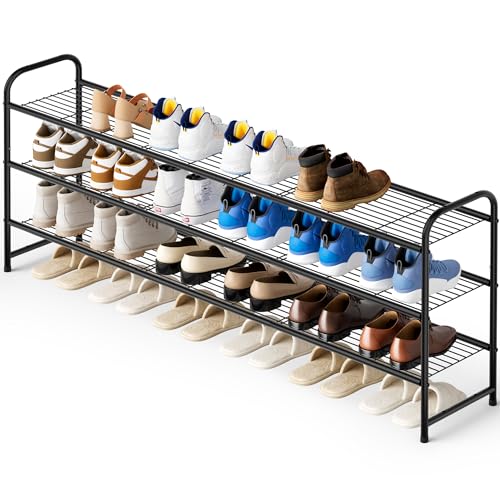
KEETDY 3-Tier Long Shoe Rack for Closet Metal Shoe Organizer for Entryway, Wide Stackable Shoe Storage Shelf with Sturdy Wire Grid for Closet Floor, Bedroom, Black
Included for 'Metal Shoe Rack: Durable Options for Entryways and Small Spaces' because the listing specifies Bedroom and Black, details this guide uses to compare options.
View on Amazon
MWQ 3 Tier Shoe Rack for Closet, Heavy Duty Metal Shoe Storage Organizer for Entryway 27" Wide, Space-Saving, Black
Included for 'Metal Shoe Rack: Durable Options for Entryways and Small Spaces' because the listing specifies Space-Saving and Black, details this guide uses to compare options.
View on Amazon
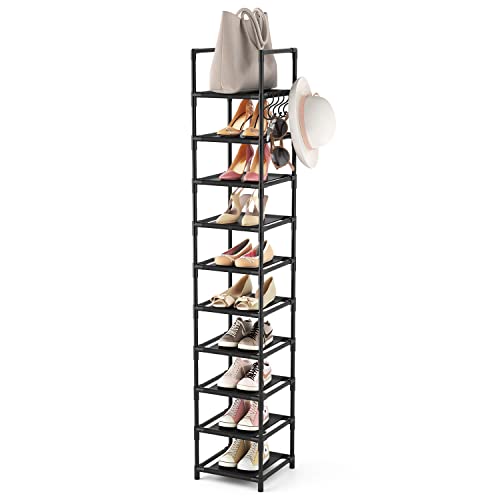
VTRIN 10 Tier Shoe Rack Tall Large Capacity Wide Shoe Organizer with Two Hooks Sturdy Metal Shoe Shelf for Entryway, Closet, Bedroom
Included for 'Metal Shoe Rack: Durable Options for Entryways and Small Spaces' because the listing specifies Closet and Bedroom, details this guide uses to compare options.
View on Amazon| Feature | Powder-Coated Steel | Anodized or Powder-Coated Aluminum |
|---|---|---|
| Weight per 4-tier rack (30″W x 26″H) | 14 – 18 lbs | 8 – 11 lbs |
| Weight Capacity Per Tier | 35 – 50 lbs (holds 3-4 pairs of boots) | 20 – 30 lbs (holds 2-3 pairs of sneakers) |
| Total Capacity (4 tiers) | 140 – 200 lbs | 80 – 120 lbs |
| Rust Resistance | Good if coating intact; chips can rust | Excellent; naturally corrosion-resistant |
| Frame Deflection | Very low; stays rigid under load | Slight flex on tiers over 30″ wide |
| Price Range (3-5 tier) | Usually $35 – $90 | Usually $60 – $130 |
| Best For | Heavy use, families, boot storage | Damp entryways, coastal homes, renters |
When Steel Makes More Sense
Steel is denser and stiffer. A standard 1-inch square-tube steel frame with 0.8mm wall thickness will support work boots, hiking boots, and shoe boxes without bowing. If you need to store 12 to 16 pairs for a family of four, steel keeps the tiers level over time. The downside is that any scratch through the powder coating exposes bare steel, which will rust if wet shoes sit on it repeatedly.
When Aluminum Makes More Sense
Aluminum weighs 30 to 40% less than steel for the same dimensions, so a 4-tier aluminum rack can be lifted with one hand. It does not rust even if scratched, only develops a dull oxide layer. It is the better pick for an uncovered apartment entryway, a garage-adjacent mudroom, or a home within a few miles of salt air. The trade-off is lower weight capacity and a slightly higher price for the same size.
Weight Capacity Per Tier: What the Numbers Mean
Manufacturers list capacity per tier, not just total capacity. That number tells you what you can actually place on one shelf without sagging.
- 15 – 20 lbs per tier: Light-duty. Fine for 2 pairs of flats, loafers, or kids’ shoes. Thin wire tiers under 4mm diameter often fall in this range and will bow with boots.
- 20 – 30 lbs per tier: Standard aluminum or light steel. Holds 3 pairs of men’s sneakers (about 6-7 lbs per pair) or 2 pairs of ankle boots. Suitable for 1-2 people.
- 35 – 50 lbs per tier: Heavy-duty steel. Holds 3 to 4 pairs of winter boots or 4 pairs of sneakers plus shoe boxes. Look for horizontal cross-bracing under the tier and welded joints rather than just push-pin connectors.
Check how capacity is measured. A tier rated at 40 lbs evenly distributed may only hold 25 lbs if all the weight is in the center. Tiers with 5 to 6 metal rods or a mesh grid distribute weight better than 2-rod rails, which let heels sink through and concentrate load.
Rust Resistance Is About Coating, Not Just Metal
Both metals are coated, and the coating quality matters more than the marketing claim of “rust-proof.”
- Powder-coated steel: The most common finish. A good coating is 60-80 microns thick and covers welds and inside joints. Rust starts at uncoated screw holes, weld spots, or where feet scratch the floor. Choose racks with plastic foot caps and sealed tube ends to keep moisture out of the hollow frame.
- E-coat or electrophoretic steel: Better coverage in crevices than spray powder-coat. Usually found on racks priced above $70. Worth it for wet climates.
- Anodized aluminum: The aluminum itself resists corrosion. Anodizing hardens the surface against scratches. Even budget aluminum with simple powder coating will not rust through.
- Stainless steel hardware: Check that screws and bolts are stainless. Standard zinc-plated screws are the first point to show orange rust in a damp entryway.
Practical care: place a small boot tray or absorbent mat under the rack in winter, wipe tiers dry if water pools, and touch up any chip on steel with appliance touch-up paint to prevent spread.
Exact Width and Depth for Hallways and Entryways
Hallway fit is about remaining clearance, not just the rack’s footprint. Building code requires a minimum 36-inch wide hallway, but many apartments have 38 to 44-inch entry hallways. You need at least 30 inches of clear passage to walk comfortably and 32 to 36 inches to carry groceries or a laundry basket.
| Rack Size (W x D x H) | Pairs Stored | Needs Hallway Width At Least | Best Placement |
|---|---|---|---|
| 24″W x 10″D x 30″H (3-tier slim) | 6 – 9 | 36″ (leaves 26″ walkway if placed on one side – tight) | Very narrow hallways, apartment doors that open inward |
| 26″W x 11″D x 26″H (4-tier low) | 8 – 12 | 42″ (leaves 31″ walkway) | Standard 40-44″ hallway, under a console |
| 32″W x 12″D x 36″H (5-tier) | 12 – 15 | 44″ (leaves 32″ walkway) | Wide entryway or mudroom wall |
| 39″W x 11″D x 18″H (2-tier bench style) | 6 – 8 | 42″ (leaves 31″ walkway) | Entryway where you need a sitting height of 18″ |
How to Measure Before You Buy
- Depth is critical: A men’s size 12 sneaker is about 12.5 inches long. A 10-inch deep rack will hold it with the toe or heel overhanging slightly, which is fine for wire tiers. For a flat mesh shelf, you need 11 to 12 inches to keep the shoe fully on the shelf.
- Door swing: Measure from the wall to the edge of the door when open at 90 degrees. Many entry doors need 28 to 32 inches of clearance. Place the rack on the hinge side, not the handle side, so the door does not hit it.
- Heated vents and baseboards: Leave 1 to 2 inches between the rack and a wall heater or baseboard. Metal conducts heat and can warp shoe soles if directly against a heater.
- Closet fit: Inside a standard 24-inch deep coat closet, a 10 to 11-inch deep rack leaves room for coats to hang in front without brushing shoes.
Decision Matrix: Which Metal Shoe Rack Fits Your Situation
| Your Situation | Recommended Spec | Why |
|---|---|---|
| Small apartment, 36-40″ hallway, 1-2 people | Aluminum, 24-26″W x 10-11″D, 3-4 tiers | Slim depth preserves walkway, light to move for cleaning |
| Family of 4, heavy boots and sneakers | Steel, 32-36″W x 12″D, 4-5 tiers, 35+ lbs per tier | Higher per-tier capacity prevents sagging |
| Damp or coastal entryway, wet shoes daily | Aluminum or e-coated steel with stainless hardware | No rust at scratches, survives standing water |
| Renters who move yearly | Aluminum, bolt-together frame under 11 lbs | Easy to disassemble, no damage to floors, fits through 28″ doorways assembled |
| Need seating to put shoes on | Steel bench rack, 18″ seat height, 39″W+, 250+ lb bench capacity | Steel bench supports adult weight; aluminum benches often limited to 180 lbs |
Assembly, Moving, and What Wears Out First
Metal shoe racks ship flat in a box typically 30 x 13 x 5 inches and weigh 10 to 18 lbs, so they fit through any standard 30-inch interior doorway without disassembly. Most use 8 to 16 bolts with an included Allen key and take 15 to 25 minutes to assemble. Welded side frames with only tier bolts are faster and more rigid than fully knock-down racks where every joint is a connector.
Stability tips: on hard floors, use rubber foot caps to prevent sliding. On carpet, choose a rack with wider feet or a lower height (under 30 inches) to avoid tipping when loaded top-heavy. If the rack is over 36 inches tall and narrow (under 26 inches wide), anchor it to the wall with a furniture strap if children will pull on it.
What fails first is rarely the metal frame. The first wear points are plastic connectors that crack after 2 to 3 years, thin wire tiers that bend, and powder coating that chips at the tier edges from shoe friction. Racks with all-metal joints (metal-to-metal bolts and welded crossbars) last 5 to 8 years longer than those relying on plastic sleeves.
Choosing Tier Style for the Shoes You Own
- Flat mesh tiers: Best for all shoe types, including heels and kids’ shoes. Prevents shoes from tipping. Slightly harder to clean.
- 2-rod angled tiers: Good for sneakers and flats, saves 1 to 2 inches of depth, but boots can slip through. Look for rod spacing under 2.5 inches.
- Stackable vs. fixed: Stackable tiers let you adjust height for boots (need 10 to 12 inches of vertical clearance for tall boots vs. 6 to 7 inches for sneakers) but can separate if bumped. Fixed racks are more stable.
For a mix of boots and shoes, choose a rack with at least one tier that offers 11 to 12 inches of vertical clearance, or a 2-tier boot section plus 3 standard tiers.
FAQ
How deep should a metal shoe rack be for a narrow hallway?
Stick to 10 to 11 inches deep. That fits women’s shoes fully and men’s shoes with minimal overhang, while leaving 31 to 33 inches of walkway in a 42 to 44-inch wide hallway.
Can a metal shoe rack hold winter boots?
Yes if the per-tier capacity is 35 lbs or higher and vertical spacing is at least 10 inches. Place heavy boots on the lowest tier to keep the center of gravity low.
Will a steel shoe rack rust near the front door?
Powder-coated steel will not rust unless the coating is chipped and moisture sits on bare metal. In wet entryways, aluminum or e-coated steel with stainless screws provides longer protection. Wiping up standing water extends the life of any metal rack.