Key takeaways
- Choose key lock if only one or two adults need access and you can store the spare key securely elsewhere, like a separate locked drawer. It is the simplest and most reliable long-term.
- Choose combination
if you rent out a room, have a cleaning service, or run a small studio where handing out keys is impractical. You can reset the code in under a minute without a locksmith.
- Choose digital keypad if 3+ people need access, you want to change codes frequently, or you need quick one-handed access. Look for models with a low-battery warning light and a mechanical override key — avoid cabinets with no backup entry.
A lockable storage cabinet is best chosen by matching the lock type to how many people need access, the construction material to where it will live, and the interior layout to what you are securing — key locks for single-user simplicity, digital or combination locks for shared access, steel for maximum security and fire resistance, and wood or wood-steel hybrids when the cabinet needs to blend into a living room or home office.
Key Lock vs. Combination vs. Digital Lock: Which Security Level Do You Need?
All three lock types will keep documents, cash, passports, and supplies out of sight, but they fail and succeed in different ways. Your choice should depend on access frequency, number of users, and how serious the consequence of a lost key or forgotten code would be.

Yizosh Metal Storage Cabinet with Lock - 72" Garage Storage Cabinet with 2 Locking Doors and 5 Adjustable Shelves, Black Steel Lockable for Office,Home,Garage
Included for 'Lockable Storage Cabinet: Best Secure Cabinets for Home and Office' because the listing specifies Black Steel Lockable for Office and Home, details this guide uses to compare options.
View on Amazon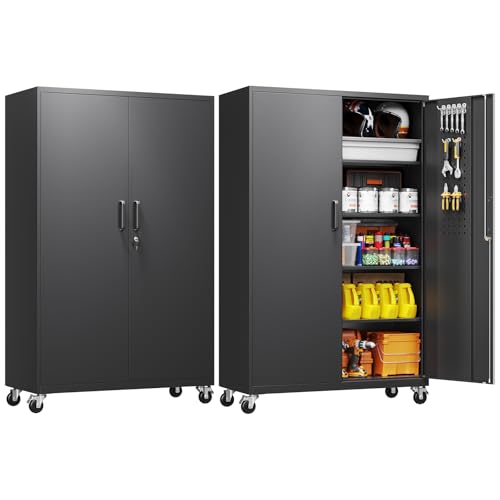
Yizosh Metal Garage Storage Cabinet with Locking Doors and Adjustable Shelves,- 71" Rolling Steel Tool Cabinet for Home Office,Garage,Warehouse
Included for 'Lockable Storage Cabinet: Best Secure Cabinets for Home and Office' because the listing specifies 71" Rolling Steel Tool Cabinet for Home Office and Garage, details this guide uses to compare options.
View on Amazon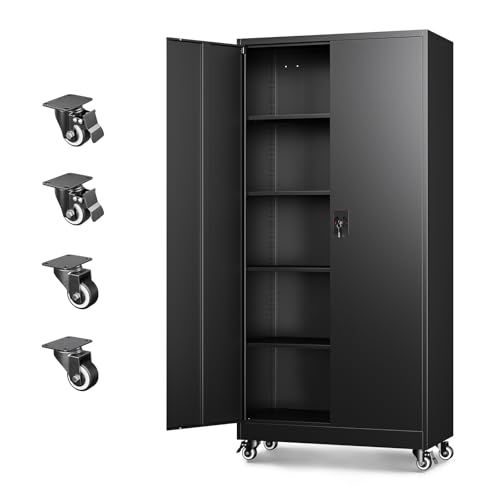
Letaya Metal Garage Storage Cabinets with Wheels,Steel Tool Cabinets Lock Door and Adjustable Shelves for Home,Office,Warehouse Organisieren (Black, 74.41" H)
Included for 'Lockable Storage Cabinet: Best Secure Cabinets for Home and Office' because the listing specifies Office and Warehouse Organisieren (Black, details this guide uses to compare options.
View on Amazon| Lock Type | How It Works | Best For | Key Limitation | Typical Price Range for Cabinet |
|---|---|---|---|---|
| Key Lock (cam or tubular) | Physical key, often 2 keys included, 200-300 unique key codes per series | Single user, low-traffic home office, securing cleaning supplies from children | Lost keys require drilling or locksmith; no way to change code without replacing core | Usually $120–$350 |
| Combination Lock (3- or 4-digit dial) | Mechanical dial, 1,000 to 10,000 possible combinations | Shared spaces where you want to avoid keys, e.g., family craft room, small business supply closet | Mechanical wear can make dials loose over 5-7 years; slower to open | Usually $180–$450 |
| Digital / Electronic Keypad | Battery-powered keypad with 4-8 digit PIN, often with override keys | Multiple users, frequent access, offices needing quick code changes when staff changes | Requires 4x AA batteries every 10-14 months; electronics can fail in very humid or cold garages | Usually $250–$650 |
| Digital + Key Override (hybrid) | Electronic keypad plus hidden key cylinder | Home offices storing tax records, passports, and valuables where you need backup access | Highest cost; more parts that can eventually need replacement | Usually $350–$800 |
How to decide in 30 seconds
- Choose key lock if only one or two adults need access and you can store the spare key securely elsewhere, like a separate locked drawer. It is the simplest and most reliable long-term.
- Choose combination
if you rent out a room, have a cleaning service, or run a small studio where handing out keys is impractical. You can reset the code in under a minute without a locksmith.
- Choose digital keypad if 3+ people need access, you want to change codes frequently, or you need quick one-handed access. Look for models with a low-battery warning light and a mechanical override key — avoid cabinets with no backup entry.
For legal documents, firearms, or controlled medications, none of these replace a true safe. Lockable storage cabinets deter casual access and theft; they are not rated burglar or fire safes unless explicitly listed as such with UL or ETL ratings.
Steel vs. Wood vs. Hybrid: Construction Trade-Offs
Construction determines not just appearance, but weight, durability, and how much protection you actually get. A garage or utility room has different demands than a living room sideboard.
| Feature | Steel (16-22 gauge) | Solid Wood / Wood Veneer | Engineered Wood (MDF / Particleboard with laminate) | Hybrid (Steel frame + Wood doors) |
|---|---|---|---|---|
| Security & Durability | Highest. Resists prying, water, and pests. Powder-coat resists scratches. | Moderate. Solid hardwood resists warping but can be pried more easily than steel. | Lowest. Vulnerable to moisture swelling and stripped screws over time. | High. Steel body provides security with warmer appearance. |
| Weight (typical 36″W x 72″H x 18″D cabinet) | 95–140 lbs empty | 80–120 lbs empty | 65–90 lbs empty | 90–130 lbs empty |
| Shelf Weight Limit (per shelf) | 120–180 lbs | 50–80 lbs | 30–50 lbs | 100–150 lbs |
| Moisture / Environment | Best for garages, basements. May rust if coating is chipped in damp areas. | Needs stable indoor humidity (35-55%). Avoid unheated garages. | Swells quickly with any water contact or high humidity. | Steel interior resists moisture; wood exterior needs indoor conditions. |
| Appearance | Industrial / office. Colors usually gray, black, beige. | Furniture-grade. Blends with dressers and bookcases. | Wide range of finishes, but edge banding can peel after 3-5 years. | Best compromise for home offices and dining rooms. |
| Assembly | Often arrives fully welded or flat-pack with bolt-together frame (45-75 min) | Often fully assembled or needs door/leg attachment only | Flat-pack, 60-120 min, requires careful cam-lock assembly | Mixed. Steel body may be welded, wood elements attached on site. |
If your priority is securing tools, paint, or chemicals in a garage, choose 18-gauge steel or thicker. For a bedroom or hallway where the cabinet functions as furniture, a hybrid or solid wood cabinet with an interior steel lockbox compartment often makes more sense. Avoid thin 22-gauge steel if you plan to store heavy reams of paper — it will bow under stacked file boxes — and avoid engineered wood if the cabinet will sit on a concrete basement floor where moisture wicks up.
Interior Layout: Shelving, Drawers, and File Rails Compared
The interior matters more than the exterior for daily use. Before buying, inventory what you are actually locking up.
1. Adjustable Shelves
Most cabinets offer 2-4 shelves adjustable in 1-inch increments. Look for at least 11 inches of clearance between shelves for standard letter-size binders (11.75 inches tall with clearance) and 13-14 inches if you store 12-inch storage bins. Steel cabinets usually have slotted side rails with metal clips; wood cabinets use peg holes. Metal clips hold heavier loads without wallowing out the holes.
2. File Rails and Hanging Folders
If you need to secure documents, choose a cabinet at least 18 inches deep with built-in hanging rails for letter (12-inch) or legal (15-inch) files. A 36-inch wide cabinet can hold two rows of letter files side-by-side, roughly 60-70 folders per shelf. Without rails, files slump and waste space.
3. Drawers vs. Doors
- Door-only cabinets maximize vertical storage and are best for large items, small safes inside, or bulk office supplies.
- Drawer cabinets (often 2-3 locking drawers) are better for small valuables, jewelry, USB drives, or medications where you want separation. Each drawer typically holds 25-40 lbs.
- Combination door + drawer layouts — for example, double doors on top with two locking drawers below — provide the most flexibility for home offices that store both paper archives and daily-use valuables.
Check shelf depth as well. A 16-inch deep interior will not fit a standard 15-inch printer paper box front-to-back without leaving the door ajar. For supplies, 18-20 inches deep is the most versatile.
Decision Matrix: Which Cabinet Fits Your Situation?
| Your Situation | Recommended Lock + Material + Interior | Why |
|---|---|---|
| Small apartment / 10×12 ft home office | Digital lock, hybrid or wood, 36″W x 18″D x 60-72″H with adjustable shelves | Narrow depth saves floor space; digital lock avoids key clutter; 60-inch height keeps sightlines open and fits under 80-inch ceilings with 6+ inches clearance for ventilation |
| Family with kids and pets | Key or digital lock, steel, doors with 2-point locking bar | Steel resists climbing and chewing; 2-point latch prevents doors from being pried open at top or bottom |
| Renter who may move within 2 years | Combination lock, steel flat-pack or engineered wood, under 90 lbs | No keys to lose during move; flat-pack fits through 29-30 inch apartment doorways when disassembled (most pre-assembled cabinets need 32+ inches) |
| Securing business documents / client files | Digital + key override, 18-gauge steel, with file rails and at least one fixed shelf | Allows code changes when staff turns over; fixed middle shelf prevents cabinet racking under paper weight (paper is ~30 lbs per cubic foot) |
| Garage or basement storage | Key lock, powder-coated steel, adjustable steel shelves 120+ lbs capacity | Simplest lock performs best in temperature swings; steel tolerates humidity if kept off floor on 3-4 inch leveling feet |
Sizing, Clearance, and Room Fit: Real Measurements
A common mistake is buying a cabinet that fits the wall but not the room’s function. Use these clearances before ordering:
- Door swing: Add the cabinet depth plus 2 inches to the front clearance. A cabinet 18 inches deep with 90-degree doors needs at least 20 inches of clear floor in front to open fully. For 180-degree hinges, allow 36-38 inches total.
- Wall clearance: Leave 1-2 inches at the back for baseboards and airflow, and 2-4 inches on the hinge side so doors do not scrape walls.
- Room fit: In a 10×12 ft room with a 60-inch desk and office chair (needs 36 inches of push-back space), a 36-inch wide cabinet along the 10-foot wall still leaves a 34-inch walkway — the minimum comfortable passage is 30 inches, 36 inches if you move file boxes.
- Height: Standard ceiling is 96 inches. A 72-inch tall cabinet needs at least 76 inches to stand upright and allows space on top for storage baskets. If your doorway is 80 inches tall and 30 inches wide, measure the diagonal box dimensions — many 72-inch cabinets ship in a 74 x 38 x 20 inch carton that will not turn a tight hallway corner.
- Weight on floors: A fully loaded steel cabinet with paper can exceed 400-500 lbs concentrated on four small feet. On upper floors or older wood floors, distribute weight with a low platform or choose a wider 2-door model to spread the load.
Assembly, Moving, and What Wears Out First
Expectations save frustration. Steel bolt-together cabinets usually ship flat in one heavy carton (70-110 lbs) and require two people to assemble — the side panels are unwieldy alone. Assembly time is typically 45-75 minutes with a included Allen key and wrench; engineered wood takes longer due to many cam locks and dowels. Pre-assembled wood cabinets ship heavier but avoid assembly errors that cause doors to misalign.
What wears first depends on material: on engineered wood, it is the hinge screws stripping and laminate peeling at the bottom edge where mops hit. On steel, it is the lock cylinder becoming gritty from dust and the powder coat chipping at the feet. On digital locks, it is the battery contacts corroding if batteries are left in for more than a year without change. Simple maintenance — tightening hinge screws every 12 months, touching up paint chips, and replacing batteries proactively — extends life from 5 years to 12-15 years.
For moving, empty the cabinet completely and remove shelves. Never move a loaded cabinet, even a few feet — the torque will bend the frame and doors will never latch cleanly again. If you must relocate a welded steel cabinet intact, use furniture sliders rated for at least 300 lbs and keep it upright; laying it on its side can spring the door frame.
Frequently Asked Questions
Do I need to anchor a lockable storage cabinet to the wall?
Yes if the cabinet is taller than 60 inches, stands on carpet, or will be in a home with children. Use the included anti-tip strap into a wall stud. This prevents tipping when a loaded upper shelf is open and a child climbs.
Are combination and digital locks more secure than key locks?
They are more convenient for shared access, not inherently more secure against forced entry. A tubular key lock and a 4-digit digital lock offer similar deterrence on a standard storage cabinet. True security comes from steel gauge, welded seams, and a multi-point locking bar rather than the lock type alone.
Can I store a small fire safe inside a lockable wood cabinet?
Yes, and it is a common strategy for layered security — the cabinet provides privacy and organization, the interior safe provides fire or burglary rating. Ensure the shelf can support the safe’s weight; small fire safes weigh 40-80 lbs empty. Reinforce the shelf or place the safe on the cabinet floor.