Key takeaways
- A big tote is only efficient if its capacity justifies the floor space it takes, and a bulky box with modest volume wastes the room it occupies. This guide to a storage box with lid large enough for bedding or…
A big tote is only efficient if its capacity justifies the floor space it takes, and a bulky box with modest volume wastes the room it occupies. This guide to a storage box with lid large enough for bedding or seasonal gear compares four high-capacity totes on gallons per square foot, lid design and how easily they move.
As an Amazon Associate we earn from qualifying purchases.
By KK Home Furnishings Editorial Team
How to Compare Large Lidded Storage Boxes
The four criteria below judge a large box on efficiency and handling: how its capacity compares to its exterior footprint, how interior differs from exterior, whether it uses snap lids or latches, and how it moves when full. Gallons divided by footprint is an organization metric only; it is not internal volume, because tote walls taper.
Capacity versus exterior footprint
Efficiency here means capacity per floor space, so divide gallons by the exterior footprint. Among these picks the Brightroom 50-gallon delivers about 7.66 gallons per square foot, the Sterilite 40-gallon 7.33, the Project Source Commander 6.85, and the IRIS 91-quart about 5.82, so the Brightroom packs the most capacity into its floor area.
That metric matters when floor or shelf space is the constraint, since a box that holds more per square foot lets you store the same volume in less room. A large storage box with lid that is tall rather than sprawling often wins on this measure, which is why the Brightroom and Sterilite lead the clear, shorter IRIS.
This is an organization figure, not a measure of usable interior volume, because tote walls taper and the rim and lid consume space. Use gallons per footprint to compare how efficiently each box uses the floor, and the actual dimensions to confirm it fits the room, rather than treating the ratio as internal capacity.
Exterior versus interior dimensions
A large box’s interior is always smaller than its exterior, so read both to know what actually fits inside. The outside dimensions decide where the box sits, while the interior decides what it holds, and the gap between them grows with tapered walls and thick rims common on big totes.
For bulky items like comforters or holiday decor, the usable interior depth and width matter most, so a box that fits the room may hold less than its gallon rating suggests if it tapers sharply. Where a maker publishes interior bottom dimensions, use those for packing and the exterior for placement.
Never estimate the inside from the outside, since on a large tote the difference can be several inches in each direction. A box that looks huge externally can have a surprisingly modest usable base, so for anything you must fit precisely, confirm the interior measurement rather than assuming the capacity translates to packing space.
Snap lids versus latches
Lid type affects security and stacking on a large box. The Brightroom uses a snap-on recessed lid, the Sterilite and IRIS latch, and the Commander has a snap lid with six lock holes, so the closure determines how firmly the lid stays on a heavy, often-moved box and whether it stacks securely.
Latching lids hold more firmly than snap lids, which matters more on a large tote because the lid spans a bigger opening and a full box is heavy to handle. A recessed lid lets another box nest on top, so for a stack of big totes, latches plus a recessed lid give the most stable, secure column.
On water, read the exact wording: Sterilite calls its lid drip-resistant while Lowe’s explicitly marks the Commander as not waterproof, so neither should be treated as a sealed box. For a damp basement or garage, that means the lid sheds incidental moisture but will not keep out standing water on its own.
Wheels and handling
A large box’s weight when full is its biggest practical problem, so handling features matter. The Sterilite 40-gallon adds wheels and a pull handle, which turn a heavy tote into one you can roll across a garage, while the others rely on side handles that still require lifting a full, bulky box.
Wheels are a real advantage for anything stored on a floor and moved seasonally, since a 40- or 50-gallon box packed with bedding gets heavy fast. If the box will live on a shelf, wheels matter less than a secure lid and a footprint that fits, so match the handling feature to where the box will be used.
For stacking, loading order and weight control the risk: keep the heaviest box on the bottom, since makers rarely publish a maximum loaded stack weight. A storage box with lid large enough to hold a lot can become too heavy to lift safely, so plan to roll it, keep stacks low, or store it where it will not need moving.
Top Picks
These four large totes cover the high-capacity range from a 22-gallon clear box to a 50-gallon workhorse. Specs are manufacturer-stated and prices move, so use the tiers and check the current figure; gallons per footprint and the lid and handling design are the details that decide whether a big box earns its floor space.
| Product | Best For | Key Spec | Watch Out For |
|---|---|---|---|
| Brightroom 50-Gal | Best Overall Large | 50 gal; 42.75 x 22 x 18 in; ~7.66 gal/sq ft; recessed snap lid | Keep heaviest on bottom when stacking |
| Sterilite 40-Gal Wheeled Industrial | Best Wheeled | 40 gal; 36.75 x 21.375 x 18 in; latches; wheels; drip-resistant lid | Drip-resistant, not waterproof |
| Project Source Commander 40-Gal | Best Heavy-Duty Stackable | 40 gal / 160 qt; 38.2 x 22 x 16.4 in; snap lid; six lock holes | Marked not waterproof; snap lid |
| IRIS 91-Qt Clear | Best Clear Large Box | 91 qt / 22 gal; 31.5 x 17.28 x 13 in; latching; clear; stackable | Lowest gal/sq ft; often sold in packs |
Brightroom 50-Gal — Best Overall Large
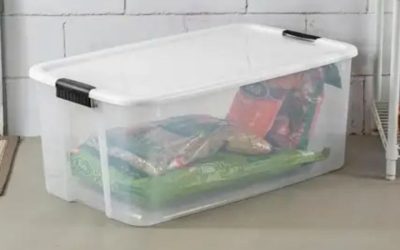
The Brightroom 50-gallon is the most efficient storage box with lid large enough for bulky storage, about 42.75 by 22 by 18 inches with a recessed snap lid, delivering roughly 7.66 gallons per square foot, the best ratio here. It packs the most capacity into its floor footprint, which suits a garage or closet where space is tight.
Its recessed stacking lid lets another box nest on top, and the tall, deep body swallows comforters, pillows or seasonal gear. For buyers whose main constraint is floor or shelf area, its leading capacity-per-footprint means fewer boxes to store the same volume, which is the practical payoff of its efficient shape.
The caveats are weight and stacking: a full 50-gallon box is heavy, with no wheels here, and Target advises keeping the heaviest bin at the bottom of a stack with no stated maximum stack weight. The snap lid secures but is not waterproof, so use a liner for anything moisture-sensitive in a damp space.
Sterilite 40-Gal — Best Wheeled
The Sterilite 40-gallon wheeled industrial box is the pick when you need to move a big tote, about 36.75 by 21.375 by 18 inches with latches, a recessed lid, wheels and a pull handle. The wheels solve the main problem of a large box, letting a full, heavy tote roll across a garage instead of being lifted.
Latches hold the lid firmly for stacking and handling, and the roughly 7.33 gallons per square foot is close behind the Brightroom, so it is efficient as well as mobile. For floor storage of heavy seasonal items that move once or twice a year, the wheels make it far more practical than a handle-only box.
The lid is described as drip-resistant, not waterproof, so it sheds incidental moisture but will not keep out standing water, which matters in a basement. Confirm the current price and the footprint, and note that while wheels help on smooth floors, they offer less benefit if the box lives on a shelf.
Project Source Commander — Best Heavy-Duty Stackable
The Project Source Commander is the heavy-duty stackable pick, a 40-gallon, 160-quart box about 38.2 by 22 by 16.4 inches with a snap lid, stackable design and six lock holes. It is built for a sturdy stack in a garage or basement, with the lock holes allowing it to be secured for storage or transport.
Its robust construction and stacking design suit a workshop or garage where totes are piled and occasionally secured, and the 160-quart capacity handles tools, hardware or bulk supplies. At about 6.85 gallons per square foot it is a touch less efficient than the Brightroom but still a substantial large box.
Lowe’s explicitly marks it as not waterproof, so treat the snap lid as dust and splash protection rather than a seal, and add a liner for moisture-sensitive contents. Interior dimensions were not published in the retrieved data, so measure the opening if you need to fit a specific item precisely before buying.
IRIS 91-Qt — Best Clear Large Box
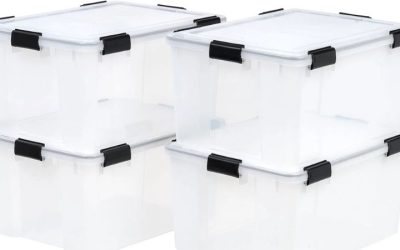
The IRIS 91-quart, about 22 gallons, is the clear large box, roughly 31.5 by 17.28 by 13 inches with a latching lid and a clear, stackable body. It is the pick when you want large-ish capacity and the ability to see the contents, often sold in multipacks for building a matching, visible storage system.
Being clear is its distinguishing feature, letting you identify contents without opening a heavy box, which suits closets and seasonal storage you access occasionally. The latching lid secures it for stacking, and the smaller footprint than the 40- and 50-gallon boxes fits shelves that cannot take the biggest totes.
At about 5.82 gallons per square foot it is the least floor-efficient here, since the clear body and shorter height trade some capacity density for visibility. It is also the smallest capacity of the four and may be sold out as a single unit, so confirm availability and treat the latch as secure rather than sealed.
Frequently Asked Questions
These answers cover what buyers ask about a storage box with lid large enough for bulky items, from what counts as large to whether snap lids keep water out. The guidance is practical, and none of these lids is waterproof, so treat them as dust and drip protection rather than sealed containers in damp spaces.
Is 40 or 50 gallons considered a large storage box?
Yes, 40 to 50 gallons is firmly in large-box territory, which is why the picks here center on that range alongside a 22-gallon clear option. A 40- or 50-gallon tote holds bulky items like comforters, pillows or holiday decor that smaller bins cannot, which is the practical definition of a large storage box.
The size also brings weight: a full 40- or 50-gallon box gets heavy quickly, which is why features like wheels or careful stacking matter more at this scale. Large is as much about handling as volume, so consider whether you can move it full before choosing the biggest option available.
If you need more than 50 gallons, you generally move to multiple boxes rather than a single larger one, since bigger totes become unwieldy to lift and stack. For most household bulk storage, a 40- or 50-gallon box is the sweet spot between capacity and manageability, which is where these picks sit.
Can large plastic boxes be stacked when full?
Large plastic boxes can be stacked when full, especially those with a recessed stacking lid like the Brightroom and Sterilite, provided you keep the heaviest on the bottom. Makers rarely publish a maximum loaded stack weight, so build columns conservatively and keep them to a height you can safely manage.
The lid design is key: a recessed stacking lid lets another box nest securely, while a simple snap lid stacks less stably. Loading matters too, since overfilled lower boxes can bow under the weight above, so keep stacks low and on a level surface to prevent a heavy column from leaning and toppling.
Because a full large box is heavy, consider how you will get the top one down before building a tall stack. Wheeled boxes like the Sterilite are easier to move but not necessarily to stack high, so for a column of big totes, prioritize latching or recessed lids and a stable, low arrangement.
Are snap-on lids waterproof?
Snap-on lids are not waterproof; they secure the lid and keep out dust and incidental moisture but do not create a sealed barrier against water. Among these picks, Lowe’s explicitly marks the Commander as not waterproof, and Sterilite calls its lid drip-resistant, which sheds drips but does not withstand standing water.
Waterproof requires a gasket or tested seal that general-purpose large totes do not have, so read the exact wording rather than assuming a snap lid seals. In a damp basement or garage, treat even a latching large box as drip protection and add a liner for anything that truly must stay dry.
If keeping contents dry is essential, choose a container that specifically states a gasket or waterproof rating. For typical storage of clothing, bedding or seasonal gear in a reasonably dry space, a snap or latching lid keeps out dust and incidental moisture well enough, which is what most large-box storage needs.
Should I compare gallons or outside dimensions?
Compare both, since they answer different questions: gallons tell you how much a box holds, while outside dimensions tell you where it fits and, divided into gallons, how efficiently it uses floor space. Relying on gallons alone can leave you with a box that holds enough but overhangs a shelf or blocks a path.
For a space-constrained spot, start with the outside dimensions and the gallons-per-footprint ratio, which is why the efficient Brightroom leads on that measure. For a volume need with room to spare, the raw gallon figure matters more, but still confirm the box physically fits where it has to go.
Use the interior dimensions too, where published, to know what actually fits inside, since a large exterior can hide a modest usable base. Treating gallons, exterior size and interior space as three separate checks, rather than one number, is what ensures a large box both holds and fits what you need.
Final Thoughts
A storage box with lid large enough for bulky items should earn its footprint, so compare gallons per square foot alongside capacity. The Brightroom 50-gallon leads on efficiency, the Sterilite adds wheels, the Commander suits heavy-duty stacking, and the IRIS offers clear visibility; keep the heaviest box at the bottom of any stack.