
Key takeaways
- For a typical fitted heated mattress pad, the basic order is mattress, heated pad, then fitted sheet. The pad lies flat, with the connector oriented as its manual directs—often toward the foot of the bed. Correct heated mattress pad placement…
For a typical fitted heated mattress pad, the basic order is mattress, heated pad, then fitted sheet. The pad lies flat, with the connector oriented as its manual directs—often toward the foot of the bed. Correct heated mattress pad placement also means keeping cords clear and checking compatibility before adding a topper or protector.
As an Amazon Associate we earn from qualifying purchases.
By KK Home Furnishings Editorial Team
Heated Mattress Pad Placement: Which Layer Goes Where?
The most useful starting point is to separate the bed’s structural layers from the thin layers that touch the sleeper. In a common manufacturer-described arrangement, the heated pad rests on the mattress and the fitted sheet covers the heated pad. Sunbeam’s heated-bedding setup instructions put the label and connector toward the foot of the bed for the models covered by that guide [Sunbeam Home, IMBD21ES-B, 2022]. That is an example, not permission to arrange every brand the same way.
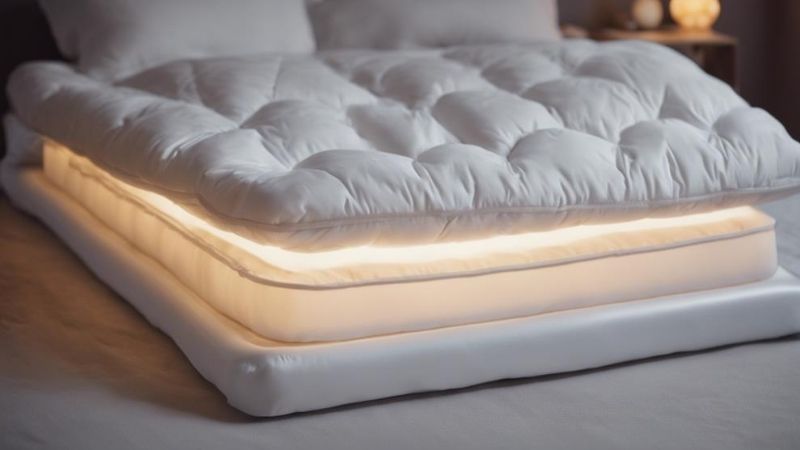
A topper, waterproof protector, encasement, or specialty foam mattress makes the answer less automatic. The following chart is a placement decision tool, not a universal approval list. When documents disagree, do not experiment with a live heating product; check the actual pad model and the mattress or accessory instructions first.
| Bed Setup | Layer Guidance | Check Before Use |
|---|---|---|
| Conventional mattress, no extra layer | Mattress → approved heated pad → fitted sheet | Usual starting arrangement; confirm your pad manual |
| Mattress with protective encasement | Encased mattress → pad → fitted sheet, only if permitted | Treat a fitted encasement as part of the mattress; verify material compatibility |
| Removable waterproof protector | Placement varies; no single approved order | Check both labels before putting it above or below the heater |
| Thick foam, latex, or wool topper | Do not assume the heater can sit above or below it | Both topper and heating-product makers must approve the complete arrangement |
| Adjustable or articulated bed | No generic placement can be recommended | Some heated-bedding manuals prohibit mechanically adjustable beds |
| Pad that bunches under the sheet | Remove and correct fit; do not heat while folded | Change size or product if a flat, secure fit is impossible |
Basic Mattress, Heated Pad, and Fitted Sheet Order
Picture a regular mattress with no removable topper or specialized cover. The mattress supports the bed; the electric pad is spread across its sleeping surface; and the fitted sheet goes over the heated pad. This is distinct from laying a therapeutic heating pad on the bed or placing a blanket underneath the mattress. Sunbeam describes its mattress pad as warming from below rather than functioning as an over-body electric blanket [Sunbeam, “Heated Mattress Pad vs. Heated Blanket,” accessed October 2026].
The fitted sheet is not an invitation to pile extra insulation over the warming surface. Use only the sheet arrangement the pad maker permits, and leave the heated fabric smooth rather than stretched into a fold at the edge. For a skirted design, the elastic skirt secures around the mattress; for designs that use another attachment method, use that specific method. The instruction to cover a mattress pad with a fitted sheet does not transfer to general-purpose personal heating pads.
Where a Mattress Protector or Waterproof Encasement Fits
A zippered encasement and a removable protector are not always interchangeable. An encasement may surround the mattress as a permanent protective cover, whereas a removable waterproof protector might form an additional layer nearer the sleeper. Neither its name nor its apparent thinness proves it belongs on top of or below an electric pad. Thick waterproof barriers and coated materials also deserve scrutiny because heating and moisture-management conditions may change when layers are added.
For an encased mattress, a possible configuration is encasement around mattress, compatible heated pad above it, and fitted sheet at the top—but only when both product instructions allow it. For a removable protector, the maker may specify a different sequence or forbid use with electrical bedding. Do not guess based on spill protection alone. If neither manufacturer documents the combined arrangement, use the bed without active heating or ask for written guidance before adding the extra layer.
How a Topper or Specialty Foam Changes the Answer
A topper is substantial enough to change both the sleeping surface and the route warmth takes. Placing an electric pad beneath a thick topper may reduce the warmth reaching the sheet while introducing an arrangement the heating manufacturer has not approved. Putting the pad above the topper may expose the topper material to sustained warmth. Neither order should be recommended simply because the pad fits and lies flat. This is a compatibility question, not a preference for which layer seems softer.
For a concrete U.S. example, Tempur-Pedic says it does not recommend electric blankets or heating pads with its TEMPUR-material mattress toppers because of their temperature-sensitive response [Tempur-Pedic, Product Care, accessed October 2026]. That restriction applies to the stated material and product line, not automatically to every topper on the market. If the heater and topper makers do not both explicitly permit the combination, leave one out rather than inventing a safe stacking order. The separate topper comparison covers whether you need active warmth or cushioning in the first place.
Six Placement Checks Before You Put the Bed Back Together
These steps deal specifically with physical position and layer clearance, rather than repeating instructions for choosing a heat setting or diagnosing a failed controller. Keep the heating product disconnected from power while positioning it. Use the brand’s illustrated setup for the exact model, since different pad designs may place the connector, tag, skirt, and controllers differently.
Step 1: Identify the Head, Foot, and Connector Side
Lay the unpowered pad out so you can read its permanent tag and find the controller module. On the Sunbeam Home guide IMBD21ES-B, the label is placed at the foot of the bed facing upward and the connector is at the bottom of the heated product [Sunbeam Home, 2022]. That gives a useful example of an intentional orientation: the connector is positioned away from the normal pillow and shoulder area rather than wherever the nearest outlet happens to be.
If your pad has a different label or a connector on one side, follow its own drawing instead of rotating it to imitate another model. Do not turn the entire pad sideways, flip it over, or reverse head and foot solely to shorten the cord unless the manufacturer explicitly supports that orientation. A matching size and a reachable outlet are separate purchasing constraints; one should not be solved by defeating the instructions for the other.
Step 2: Center the Heated Area on the Mattress
Spread the heater evenly across the upper face of the mattress, following the maker’s marked head and foot edges. Align the designed sleeping area rather than pulling the wired section toward one side to reach a corner. The surface should be smooth and unbunched before you add any sheet. A visible ripple at this stage is easier to fix than a fold concealed beneath several layers, and heated bedding instructions warn against bunching or sharp folds during use [Sunbeam Home, IMBD21ES-B, 2022].
Do not hide unused length under the mattress or roll the active heating section around a bed corner. If the pad is too long, too wide, or too narrow for the sleeping surface, use a compatible size instead of folding it to fit. The maker’s size chart and the mattress’s actual dimensions matter more than whether the listing merely says “queen” or “king.” A secure fit must preserve a flat heating area, not create tension at the connector.
Step 3: Secure the Skirt Without Pulling the Wiring Tight
If the product has a fitted skirt, draw its corners over the mattress in the manner shown in the manual. A skirt is meant to hold the pad in position, not to stretch the electrical heating area beyond its designed footprint. Recheck the top after securing the last corner: the fabric should still rest naturally across the mattress, with no ridge created by the elastic or a seam. A shallow fitted sheet cannot correct a badly fitting heated pad beneath it.
Pay attention to deep mattresses, sewn-in pillow tops, and rigid edges. The total mattress depth can determine whether a skirt reaches without strain, and a tall topper can make the stack thicker still. If the skirt rides up or the pad slides as you move, do not pin, staple, tape, or sew it into place; metallic fasteners and alterations can harm heated wiring [Sunbeam Home, IMBD21ES-B, 2022]. Choose a compatible pad or revise the non-electric bedding instead.
Step 4: Keep the Connector and Cord Out of Pressure Points
Before any power connection, look at the connector on the pad and the path of its control cord. Sunbeam Home’s illustrated instructions direct users to seat the controller plug fully and run the control cords along the floor under the bed without sandwiching them between the mattress and box spring [Sunbeam Home, IMBD21ES-B, 2022]. The important placement principle is to keep the cable clear of compression, pinching, tangling, and moving bed-frame parts.
Check that the cord is not wedged against a headboard, caught under a bed leg, crossing a sharp frame edge, or trapped where a drawer or adjustable mechanism moves. A controller should not be buried inside bedding or positioned where it may become wet. Dual-control beds may have separate left and right leads that must match the maker’s diagram. Do not reroute, splice, or substitute controllers to make the power point more convenient. If the approved path cannot reach a suitable outlet, choose another bed setup or product.
Step 5: Add Only the Approved Sheet and Other Layers
Place the fitted sheet over the pad only after you have verified the basic placement and checked the manufacturer’s allowed covering. Smooth the sheet without pulling the electric pad out of alignment; the fitted sheet should not drag a corner into a tight fold. If you have a separate comforter or blanket for normal sleeping, distinguish that regular top bedding from stacking a thick protector or topper directly against the pad. The electrical pad manual, not a universal layer diagram, sets the limits.
If you want an extra waterproof cover, mattress pad, or cushioned topper, revisit the compatibility decision before turning on heat. Avoid the assumption that all extra layers are safe because they are sold as bedding. Electrical Safety Foundation International gives general warnings about covering or folding heated electrical products [ESFI, “Heating Pads and Electric Blankets Safety”]; a manufacturer-authorized fitted sheet over a purpose-built heated mattress pad is a product-specific configuration, not permission to add arbitrary layers.
Step 6: Recheck Position After Sheet Changes or Bed Movement
A bed can look properly assembled on day one and become misaligned after a fitted-sheet change, a deep-cleaning session, or moving the frame closer to a wall. With the pad disconnected, lift the sheet enough to look for shifted corners, rolled edges, a twisted connector, or a cord now pinched behind furniture. This short physical check is especially useful when a freshly washed sheet fits more tightly than the old one. Do not rely on a smooth sheet surface as proof the electric pad underneath is smooth.
If you find damage, exposed wiring, scorching, a compromised connector, or persistent folds that cannot be flattened, do not power the product to see if it still warms. Stop using it and follow the manufacturer’s support instructions [Sunbeam Home, IMBD21ES-B, 2022]. This placement inspection is different from troubleshooting electrical fault codes. Correct physical position can prevent avoidable strain, but it cannot diagnose or repair an internal heating fault, controller problem, or damaged cable.
Frequently Asked Questions About Placement
These additional questions address unusual bed dimensions and orientation decisions that often become visible only after the regular mattress, pad, and sheet have been identified. For any situation not covered by a manufacturer’s diagram, an explicit model-specific response is more reliable than a generic bedding illustration.
Does a Built-In Pillow-Top Count as a Separate Topper?
A pillow-top sewn into the mattress is normally part of the mattress construction, not a loose accessory that can be rearranged. That distinction may help you identify which surface counts as the mattress top, but it does not automatically establish compatibility with electric bedding. Check the mattress maker’s heat restrictions and the heated pad’s approved mattress types before positioning a pad over a pillow-top surface.
A detachable foam topper remains a separate layer and should be evaluated independently. Do not use the fact that a pillow-top has a padded feel as evidence that any loose topper and heated pad combination will behave the same. Construction, coatings, attachment, and sensitivity to heat can vary substantially between products. If the manufacturer does not specify a compatible combination, ask rather than guessing.
Can You Rotate the Pad to Put the Connector Near an Outlet?
Not as a general workaround. Some heated bedding designs clearly mark the intended head and foot positions, and the controller connection is meant to land at a particular end of the bed. For example, Sunbeam Home’s IMBD21ES-B setup places the label toward the foot [Sunbeam Home, 2022]. Moving the cord connection to the pillow area simply to reach a socket could violate those specific directions.
If a pad’s own manual explicitly allows more than one orientation, follow that model’s instructions. Otherwise, retain the instructed orientation and solve the outlet problem by changing the room arrangement or selecting a suitable product. Avoid extension cords or improvised adapters when the heater manual forbids them. The plug should not be stretched, pinched, or forced into a wall outlet that does not accept it securely.
What If You Have a Split King or Two Different Mattress Heights?
A split king usually consists of two separate sleep surfaces. Do not assume a one-piece king-size heated pad can span a moving gap or a height difference without bending. Check whether the heater’s manufacturer expressly offers a model for that bed configuration; individual twin XL pads may be a purchasing option only if each is approved for the bed in question. Controls, cord exits, and the size of the fitted sheets can differ across setups.
If either half of the bed articulates, read the restriction on adjustable beds before considering the product. The Sunbeam Home IMBD21ES-B instructions, for instance, prohibit mechanically adjustable beds for the designs covered there [Sunbeam Home, 2022]. That does not prove every newer pad shares the restriction, but it does mean a split or moving base cannot be assumed suitable without written model-specific authorization.
Can a Heated Pad Go Beneath the Entire Mattress?
A product sold as a heated mattress pad is generally designed for the sleeping surface according to its owner’s manual, not for installation underneath the whole mattress and foundation. The commonly documented Sunbeam arrangement is on the bed with a specific connector orientation, and its cords must not be trapped between the mattress and box spring [Sunbeam Home, IMBD21ES-B, 2022]. Putting the entire appliance under a heavy mattress is not an alternative layer arrangement.
If the product label is confusing, stop and verify whether the item is an under-mattress system, a fitted heated mattress pad, or a personal heating pad—those categories may have different approved locations. Do not infer that all heating devices can be used in the same way. Use only the configuration explicitly provided by the correct manufacturer documentation, and keep the product disconnected until its category and intended position are clear.
Final Thoughts
Correct placement begins with a flat, correctly oriented heated pad in the manufacturer-approved layer order, usually on the mattress beneath a fitted sheet. Keep the electrical connection and cords out of pressure points, and never solve fit issues by folding the wired area. A protector, topper, pillow-top, or adjustable bed requires a separate compatibility check. If you cannot confirm an approved arrangement for the exact products, do not use the heater in that arrangement.
