Key takeaways
- A heated mattress pad can warm your bed, but no timer, low setting, or safety logo removes the risk of burns, electrical faults, or trapped heat. The safest decision starts with the exact model instructions, the person using it, and…
A heated mattress pad can warm your bed, but no timer, low setting, or safety logo removes the risk of burns, electrical faults, or trapped heat. The safest decision starts with the exact model instructions, the person using it, and the condition of the pad and cords. This heated mattress pad safety guide explains when use may be appropriate, when it is not, and which warning signs mean you should stop before switching on.
As an Amazon Associate we earn from qualifying purchases.
By KK Home Furnishings Editorial Team
Heated Mattress Pad Safety: What Actually Determines Risk
Safety is a conditional judgment, not a product category promise. A fitted electric mattress pad is designed for a particular bed arrangement, controller, electrical supply, and set of users. UL 964 covers electrically heated bedding, including mattress pads, but a claim that a design meets a safety standard is not a license to ignore its usage restrictions [UL Standards & Engagement, UL 964, revision 2020; OSHA, NRTL Program].
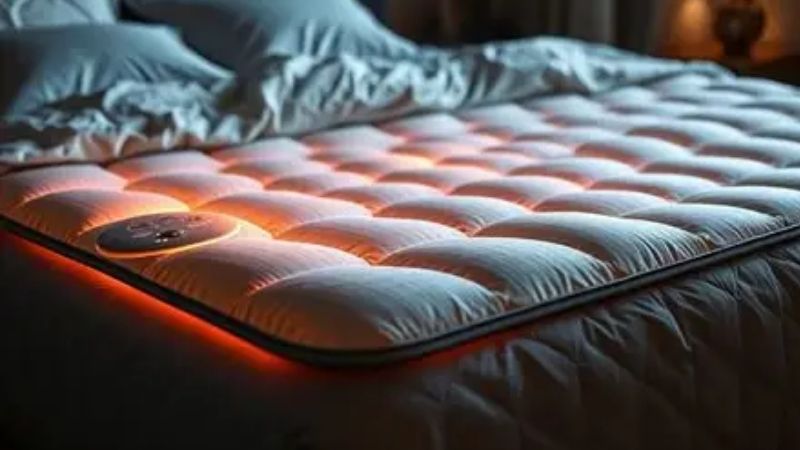
Use this decision table before you consider warmth or convenience. It is a triage tool, not a certificate or a substitute for the manufacturer manual. An unknown model, missing identification label, or unresolved restriction means you cannot establish the conditions for safe use.
| Safety Gate | Condition to Confirm | Action if Unclear |
|---|---|---|
| Exact product label and manual | Model identified; instructions cover your bed and planned use | Read the stated restrictions before connecting power |
| Certification claim | Recognized testing laboratory mark and product identification can be checked | Verify the mark and matching listing; do not trust a product-page badge alone |
| Pad, connector, and cord | Fabric intact; no scorch spots, exposed wiring, cracks, or damaged plug | Stop using any unit showing damage; do not repair internal wiring |
| Who will use it | User can perceive heat, move away, and operate the controls; manual permits use | Do not use with anyone the manufacturer excludes |
| Bed and surroundings | Approved mattress and base; cords stay free; no prohibited heated layer | If compatibility is uncertain, leave the pad unplugged |
| Recalls and incidents | Full model number checked against current CPSC notices | A matching recall overrides apparently normal operation |
Separate Real Certification From Marketing Language
For U.S. electrically heated bedding, the relevant UL standard is UL 964, which explicitly includes electric mattress pads [UL Standards & Engagement, UL 964, scope, revision September 2020]. The OSHA Nationally Recognized Testing Laboratory program identifies recognized testing bodies, such as UL and Intertek, and explains how authorized certification marks are used [OSHA, NRTL FAQ]. A mark can support confidence that a listed model was evaluated for a specified standard under stated conditions. It is not an independent promise of zero risk.
Look for a mark on the product label or documentation, identify the testing body, and where practical match the manufacturer and exact model in the certifier’s listing. “UL standard,” “ETL style,” “tested for safety,” or a logo in an online image does not establish a current listing by itself. Do not claim an individual pad is UL or ETL certified without evidence for that exact model. Certification and a working auto-off control address different questions.
Understand Burn, Fire, and Connection Hazards
Heat can be trapped by folds, pressure points, incompatible layers, or a damaged conductor. ESFI warns against operating damaged electric bedding, folding an energized electric blanket, or mixing different electrical heating appliances [Electrical Safety Foundation International, Heating Pads and Electric Blankets Safety]. A fitted heated mattress pad is not the same product as a small therapeutic heating pad, so do not transfer one device’s placement or sleeping instructions to the other.
The 2026 North American Sunbeam heated-bedding manual, IMBCCY24EF-A, gives model-family-specific warnings against an incomplete controller connection, pinched cords, and using a control from another item [Sunbeam Home, IMBCCY24EF-A, 2026]. It instructs users to check their product before use. A crackling noise, smoke, burning odor, scorched patch, or unusually hot connector is a reason to turn it off and disconnect power if safe to do so, not an invitation to try a lower heat level. If there is fire or immediate danger, leave the area and contact emergency services.
Treat Auto-Off as a Backup, Not Permission to Ignore Warnings
Some controllers allow users to choose when heating stops. For example, the current Sunbeam manual documents a selectable one-to-twelve-hour auto-off control for products it covers [Sunbeam Home, IMBCCY24EF-A, 2026]. That range is a feature of the documented controller, not a rule for all mattress pads. Auto-off does not inspect every wire, confirm that bedding is arranged correctly, or detect whether a sleeper has become unable to respond to excess warmth.
Advice about nighttime use needs an honest distinction: a manufacturer may market a bed-warming product for sleep, while ESFI takes the more conservative position that personal electric heating appliances should not be left unattended or operated while sleeping [ESFI, Heating Pads and Electric Blankets Safety]. Follow any prohibition in your own manual. If the instructions are unclear or conflict with independent precautionary advice, prewarm only while awake and switch off before sleep, or use non-electric bedding. Do not describe a timer as a safety guarantee.
Six Situations That Change the Safety Decision
The central question is not “How high can I set it?” but whether this person, bed, and product satisfy the manufacturer’s conditions. The following situations focus on decisions and warning signs rather than repeating a setup tutorial. Where Sunbeam documentation provides a specific restriction, it is labeled as an example for its products, not imposed on every competing pad.
Situation 1: A Healthy Adult Wants Heat Through the Night
For an adult who can sense warmth, move freely, and use the controller, a heated pad may be an option only within its documented instructions. That is a lower-risk starting point than using the product with someone who cannot react, but it is not proof that overnight heating is safe. Compare your manual’s intended use with ESFI’s recommendation not to operate electric heating appliances while sleeping. If doubt remains, an awake prewarming session followed by switching off removes continued active heat from the sleeping period.
Do not turn the setting up in response to an unheated corner or place a second electric blanket above the pad to boost warmth. Those actions change how heat is distributed and can violate the manufacturer’s restrictions. Instead, check that the bed is in the permitted configuration. If it still feels cold with the heating stopped, consider a conventional comforter better matched to the season. This is a safety decision, not a contest between controller settings.
Situation 2: Someone Has Reduced Heat Sensation or Limited Mobility
The 2026 Sunbeam North American manual specifically prohibits use of its covered heated bedding with people who have diabetes, impaired sensitivity to heat, or an inability to operate the controls, among other restricted groups [Sunbeam Home, IMBCCY24EF-A, 2026]. A person may feel comfortable at first yet fail to notice localized overheating. Do not assume that another person periodically checking the controller cancels a written restriction, and do not lower the setting as a workaround.
Other manufacturers may word their exclusions differently. Check the exact model and, if a medical condition affects heat perception, circulation, or mobility, consult a qualified healthcare professional before choosing electrically heated bedding. This is not a medical recommendation to use it at any setting. A non-powered layer can be the more practical alternative when the user cannot reliably sense, stop, or move away from a hot area.
Situation 3: Children, Pets, or Vulnerable Sleepers Share the Bed
The Sunbeam heated-bedding documentation excludes infants and children from using the covered product; its consumer FAQ also advises against use around pets because of overheating and cable damage concerns [Sunbeam Home, IMBCCY24EF-A, 2026; Sunbeam Home, Heated Bedding FAQ]. Treat the restriction as a reason to keep that unit off in a child’s sleeping space, even if an adult controls it remotely. Infants should not be placed on electrically heated bedding. A pet that chews wires or digs at the pad adds a separate equipment hazard.
If a pet jumps onto the bed during heating or a child may turn the control on unnoticed, the exposure is not reliably controlled. Put away or disconnect the product as your model requires and use conventional bedding instead. Do not interpret a removable controller as evidence that the heating fabric itself is suitable for a child or pet. This paragraph addresses access and vulnerability; the exact layering of sheets and protectors is a separate compatibility question.
Situation 4: The Bed Is Adjustable or Uses Unapproved Layers
A mattress pad that fits the mattress dimensions can still be unsuitable for the bed. Sunbeam IMBCCY24EF-A excludes use on a mechanically adjustable bed for its covered product family [Sunbeam Home, 2026]. The broader UL 964 standard recognizes that mechanically adjustable beds and waterbeds involve additional considerations, so fit alone is not proof of approved use [UL Standards & Engagement, UL 964, scope]. Do not assume foam mattresses, waterbeds, pull-out frames, or a moving base are universally permitted or forbidden; check the actual restrictions.
The same caution applies to layers above and below the heated surface. A waterproof protector, thick topper, weighted covering, or a second electrically heated item may change the operating conditions. Follow the specific manufacturer’s approved arrangement rather than adding a layer because it seems thin enough. If you cannot verify permission for your configuration, leave the pad unplugged. The separate bedding-placement guide can address which product goes where; this safety check simply decides whether heating should occur at all.
Situation 5: A Cord, Outlet, or Pad Shows Signs of Damage
Stop before use if the plug fits loosely, the socket feels unusually warm, the cord has a split jacket, the fabric has scorch marks, the controller housing is damaged, or a connection will not seat as designed. The 2026 Sunbeam instructions prohibit extension cords, smart plugs, multi-outlet adapters, converters, generators, and inverters for the products it covers [Sunbeam Home, IMBCCY24EF-A, 2026]. Another model may have different specifications, but no user should improvise a replacement power connection to bypass a damaged component.
A pad that got wet should remain unplugged until its exact cleaning and drying instructions are satisfied; if water entered the connector or controller, obtain model-specific advice rather than assuming surface dryness makes it safe. Do not splice wires or attempt to patch an internal heating circuit. ESFI directs consumers to replace worn electric heating products [ESFI, Electric Blanket Fire Prevention]. A suspected defect calls for stopping and inspecting, not repeatedly cycling power to see whether the problem disappears.
Situation 6: The Pad Is Older, Secondhand, or Potentially Recalled
A secondhand pad without a model label, instructions, or original controller is difficult to assess. Condition matters more than a seller’s claim that it “still works.” ESFI warns about deterioration in older electric heating products, but its published ten-year figure is a preventive context about older electric blankets, not a measured lifespan that automatically applies to every heated mattress pad [ESFI, Heating Pads and Electric Blankets Safety]. A newer unit with damaged wiring can be unsafe too.
Before reusing a stored or secondhand unit, search the U.S. Consumer Product Safety Commission recall database using the full brand and model number. Be precise about product type: CPSC recall 26-778, announced September 17, 2026, concerns JKMAX heated blankets and heating pads, not an identified line of electric mattress pads [CPSC, recall 26-778]. Do not claim an unrelated mattress pad is recalled simply because the name sounds similar. If your exact model matches an official notice, stop using it and follow the published remedy. No visible damage is required for a recall to matter.
Frequently Asked Questions
These answers address less obvious questions that can change the decision after a product appears to pass the basic checks. They are not permission to override the labeling or medical restrictions on a specific unit.
Can I Use a Heated Mattress Pad During Pregnancy?
Do not assume it is appropriate during pregnancy based on a low setting or an automatic timer. The relevant manufacturer instructions and individual medical advice matter more than a generic product description. No specific body-temperature threshold is established by this guide, and a consumer bedding article should not substitute for pregnancy-related clinical advice.
Ask your prenatal care professional whether electrically heated bedding is suitable for your situation, then follow any restriction stated in your exact product manual. If you cannot obtain a clear answer, conventional bedding is an alternative that avoids active mattress heating. Avoid reading a retailer’s “cozy all night” phrase as a medical safety claim.
Is a Low-Voltage or Automatic-Shutoff Pad Completely Safe?
No. Low-voltage descriptions and automatic timers refer to design features, not a guarantee against damage, trapped heat, or incorrect installation. Read the actual electrical rating and test-laboratory certification information for the model rather than comparing feature names. A product can have more than one protective feature while still requiring clearances, intact wiring, and a permitted user.
If a listing claims “no burn risk” or “fireproof,” ask for evidence instead of treating the phrase as a technical specification. A credible purchase decision checks a traceable manufacturer, a recognized certification mark, a published manual, and an accessible support channel. None replaces stopping use when a fault or recall is identified.
Can I Run a U.S. Heated Mattress Pad in an RV or Abroad?
Not without explicit authorization for that environment and power supply. The documented 2026 Sunbeam North American manual bars generators, inverters, and converters for its covered heated-bedding products, and the Sunbeam FAQ says its household heated products are not recommended for RV electrical systems even when shore power is available [Sunbeam Home, IMBCCY24EF-A, 2026; Sunbeam Home, Heated Bedding FAQ].
A plug adapter changes plug shape, not the product’s designed electrical conditions or testing scope. Do not assume an overseas outlet, portable power station, or campground hookup makes the pad suitable. Use a product specifically rated and authorized for your destination or choose unheated bedding instead. These restrictions describe documented Sunbeam examples; verify your own model rather than borrowing their voltage label.
Where Can I Report a Heated Bedding Safety Problem?
In the United States, consumers can report a dangerous product or incident to the CPSC through SaferProducts.gov. Keep the brand, model, controller identification, approximate purchase date, and a description of what happened; photograph damage only if doing so is safe. The official CPSC recall page is the appropriate place to verify an existing notice and the manufacturer’s remedy [CPSC, SaferProducts.gov and Recalls].
For a defective product that has not been recalled, also contact the manufacturer’s support team and ask for the procedure tied to your model. Do not continue operating it while waiting for a response. Reporting an issue is different from declaring a product recalled; only an official notice identifies the affected models and corrective action.
Final Thoughts
Good heated mattress pad safety begins with a verified model, an eligible user, undamaged equipment, and a bed arrangement the manufacturer allows. Treat auto-off and certification as safeguards with limits, not guarantees. If the instructions, condition, or recall status are uncertain, leave the pad unplugged and use ordinary bedding until the question is resolved.