Key takeaways
- Unplug the pad, remove every detachable controller, wash its fabric only as the product label allows, and wait until it is completely dry before reconnecting anything. That is the essential sequence for how to wash heated mattress pad fabric without…
Unplug the pad, remove every detachable controller, wash its fabric only as the product label allows, and wait until it is completely dry before reconnecting anything. That is the essential sequence for how to wash heated mattress pad fabric without exposing electrical parts to water or placing unnecessary stress on the internal wires. The steps below use a North American Sunbeam instruction manual as a concrete example, not as permission to wash every brand the same way.
As an Amazon Associate we earn from qualifying purchases.
By KK Home Furnishings Editorial Team
Before Washing: Read the Label and Prepare the Pad
A heated mattress pad is different from an ordinary quilted mattress protector because heating conductors remain inside the fabric. A manufacturer may permit a cold, gentle machine cycle, but that permission applies only to the model covered by its directions. For example, Sunbeam instruction manual IMBD21ES-B describes cold-water gentle washing or hand washing for the covered heated bedding products [Sunbeam Home, instruction manual IMBD21ES-B, accessed October 2026]. Check your own model number and care label before following the example below.
| Pre-Wash Check | What to Look For | Decision Before You Start |
|---|---|---|
| Wall outlet | Power plug still inserted | Unplug from the wall before handling the pad connector |
| Controllers and leads | One or two detachable controllers | Remove every detachable controller as the manual specifies; never immerse them |
| Fabric and wiring | Frayed spot, scorch mark, exposed wire, broken connector | Stop using; seek manufacturer guidance rather than washing as a repair |
| Care label | Machine wash, hand wash, or cleaning restriction | Use the method printed for your exact product; never assume all models match |
| Washer fit | Pad packed tightly or folded against an agitator | Use an adequately roomy approved washer or hand-wash if allowed |
| Drying route | Line dry or permitted delicate tumble cycle | Follow the label; finish drying fully before reconnecting |
Find the Correct Manual Rather Than Guessing From Fabric Type
Look for the small product label near the fitted skirt, connector module, or hem. Write down the brand, exact model, and controller identifier before you remove the pad from the bed. Two products with the same polyester top can have different connector designs and cleaning limitations. A website description saying “machine washable” does not settle the permitted wash temperature, spin setting, or dryer treatment.
On current U.S. Sunbeam listings, certain mattress pads are advertised as machine washable with removable controllers; the detailed IMBD21ES-B manual adds the operational limits [Sunbeam Home, product catalog and manual, accessed October 2026]. If the care label is unreadable and no matching manufacturer instructions can be found, do not improvise a wash cycle. Ask the maker for the instructions associated with the particular product and generation.
Choose a Washer That Lets the Fabric Move Freely
A heated pad for a queen or king mattress has a fitted skirt and a large quilted panel that can crowd a small drum. Stuffing it into the washer can create sharp folds or tension around the connector area. Lay the unpowered pad loosely in the tub first: if you have to force it around a center agitator or wedge it against the door, that machine is not a good choice.
An approved hand-wash option may make more sense for a bulky pad that will not move freely in your home washer. Sunbeam permits hand washing for products covered by manual IMBD21ES-B, but this does not establish a hand-wash option for every heated pad. Commercial laundromat equipment also warrants special care: Sunbeam specifically prohibits commercial dryers for its covered products because they can get too hot [Sunbeam Home, IMBD21ES-B].
Know When a Small Spot Needs Less Than a Full Wash
A removable sheet or separate mattress protector may be the item that actually needs laundering after a minor spill. Inspect which layer is soiled before stripping the heated pad from the mattress. If the pad itself only has a little loose lint, a gentle dry lint roller on its surface, without pressing against the wire paths, may be enough. Do not saturate the electrical connector or apply a stain-removing solvent to a pad without model-specific approval.
For a liquid spill on the heated pad, turn it off and unplug it immediately. Decide between localized care and a full wash only after consulting the label; an apparently clean surface does not prove the connector is dry. A pad with damaged wiring, scorching, or a cracked connector is a stop-use problem, not a laundry problem. Electrical Safety Foundation International recommends replacing damaged heated bedding rather than continuing to operate it [ESFI, Electric Blanket Fire Prevention, 2022].
How to Wash a Heated Mattress Pad in Six Steps
The sequence below is a practical walk-through for a detachable-controller model whose own manual permits laundering. For example, Sunbeam manual IMBD21ES-B specifies disconnecting the wall plug first, then detaching the controller, using a cold gentle wash or hand wash, and keeping the control dry [Sunbeam Home, IMBD21ES-B, accessed October 2026]. Whenever your label differs, use the model-specific direction instead of this example. Complete every stage before moving to the next.
Step 1: Switch Off, Unplug, and Remove All Controllers
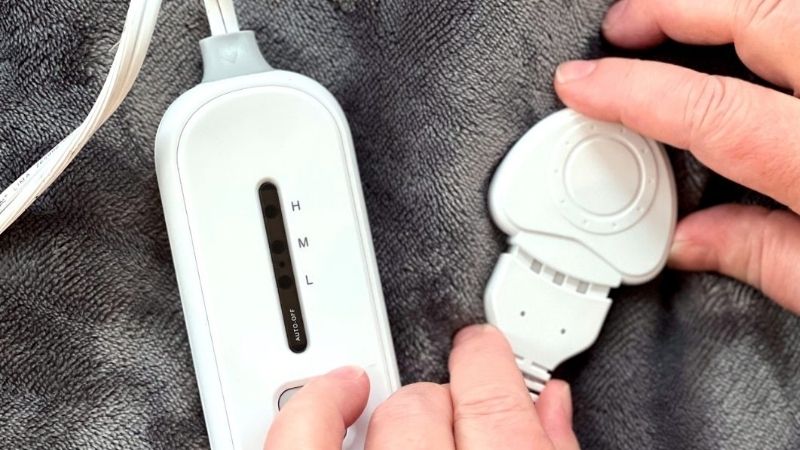
Turn the heat control off, pull the power plug from the wall, and only then disconnect the control cord from the pad. On a two-zone queen or king model, check both sides for a second lead or controller. Sunbeam specifies squeezing its connector hinges to detach the controller cord from the module; do not assume another brand has the same release mechanism. Grip the connector housing rather than yanking the cord or pulling against the stitched fabric.
Put the dry controllers and power cords well away from the laundry area so none can be accidentally dropped into water. Never wash a controller, power adapter, or a detachable lead with the fabric. If a connector will not release as the manual describes, stop and contact the manufacturer. Forcing a stubborn connector risks damaging the component that must make a reliable electrical connection after washing.
Step 2: Inspect Seams, Wiring, and the Connector Housing
Spread the pad flat on a clean surface and check both faces, particularly around the bottom connector, fitted elastic, corners, and places where a sleeper may have repeatedly sat on the edge. Look for exposed conductors, broken stitches that reveal a wire, charring, melted spots, or a brittle plug housing. Sunbeam says to check that no wires have worn through the fabric before washing [Sunbeam Home, IMBD21ES-B].
If you find a defect, do not attempt to seal a wire with tape, sew across heating conductors, or run a wash to see whether the problem disappears. Photograph the model label and damage for the maker if warranty support is needed. A harmless wrinkle in the outer skirt is different from a sharp kink along the wired heating area. Let the manufacturer determine whether the pad should be retired rather than trying to repair its internal electrical system.
Step 3: Load Loosely and Select a Cold Gentle Cycle
For a model with Sunbeam IMBD21ES-B care directions, use cold water and a gentle machine cycle, or the hand-wash route allowed by the instructions. Use a detergent compatible with the fabric as directed by the product label and its detergent instructions; do not add bleach. Place the pad into the machine without tightly rolling or stuffing it, keeping the connector housing from being crushed under a stiff fold.
Avoid trying to make the fabric “extra clean” through an aggressive cycle, hotter water, vigorous scrubbing, or repeated high-speed spinning. Ordinary mattress sheets can tolerate routines that powered bedding should not automatically inherit. If a care tag prescribes a different temperature or forbids machine washing, that model-specific instruction wins. Do not dry-clean, iron, or wring the Sunbeam products described in the cited manual [Sunbeam Home, IMBD21ES-B].
Step 4: Finish the Wash Without Twisting or Wringing
Once the approved gentle cycle is complete, remove the pad promptly and support its weight with both hands. A soaked fitted skirt can be much heavier than the dry one, so do not lift the whole pad by one corner or the connector. Do not hand-twist the heated panel to squeeze out water; Sunbeam specifically prohibits using a wringer on the covered heated bedding [Sunbeam Home, IMBD21ES-B].
Check for detergent residue and a fabric panel that has bunched unevenly. If your manual allows hand washing, rinse carefully according to that model’s instructions while avoiding twisting and compressing the wire channels. Do not add an extra machine cycle automatically just because an ordinary quilt can take it. If the pad emerges visibly misshapen or a seam has separated, set it aside for inspection instead of rushing it into the dryer.
Step 5: Use Only the Drying Method Your Model Allows
Sunbeam manual IMBD21ES-B permits a low, delicate tumble cycle followed by removal while the item is still damp. It then instructs users to gently stretch the pad toward its original shape and finish drying by draping it over a clothesline or shower rod without clothespins [Sunbeam Home, IMBD21ES-B]. This is a model-family example, not authorization to tumble every heated pad, and it does not mean the product can be used when merely surface dry.
The same Sunbeam instructions warn against commercial dryers and laundromat dryers because excessive heat can damage wiring. Do not substitute a high-heat cycle to speed up drying. If your own care label calls for line drying only, bypass the tumble dryer entirely. Support the fabric broadly while it dries rather than suspending all the wet weight from a small corner. Keep connectors off wet floors and away from direct sources of intense heat.
Step 6: Verify Complete Dryness and Inspect Before Reuse
Leave the pad disconnected until the entire fabric, the seams, and the connector region are fully dry. Sunbeam states that its covered heated products must be completely dry before either the power plug or control plug is reconnected [Sunbeam Home, IMBD21ES-B]. A dry-feeling top panel can still hide dampness in a thick quilted edge or fitted skirt. There is no universal number of hours that guarantees full drying in every room or climate.
When the pad is fully dry, check that it lies flat and that the connector, cords, and fabric show no new damage. Replace it on the mattress only in the arrangement permitted by its manual, then reattach the matching controller securely while the wall plug is still disconnected. If an error appears, the controller smells unusual, or the pad does not operate normally, turn it off and consult manufacturer support. Do not run a prolonged powered test on a folded pad to “dry the inside.”
Frequently Asked Questions
Should You Wash a New Heated Mattress Pad Before the First Use?
Only if your product instructions permit or recommend it. Sunbeam manual IMBD21ES-B recommends washing the covered heated bedding before initial use [Sunbeam Home, accessed October 2026]. That guidance applies to the products using that manual, not automatically to a different brand or fabric construction. Read the care tag and the setup guide together before opening a wash cycle.
If the label permits prewashing, keep the controllers and cords out of the water and allow the pad to dry completely before first setup. Prewashing is not a way to verify the wiring or remove a manufacturing defect. A brand-new item with torn stitching, an exposed wire, or a damaged connector needs customer service attention rather than laundering.
Can You Add Fabric Softener or Scented Laundry Beads?
Do not assume extra laundry additives are allowed just because the fabric is polyester or cotton. The Sunbeam care excerpt specifies cold gentle washing and prohibits bleach, but it does not provide blanket authorization for fabric softener or scent beads [Sunbeam Home, IMBD21ES-B]. Products marketed for ordinary sheets are not necessarily intended for textiles with embedded heating wires and special connector housings.
If the heated pad label or the manufacturer does not address an additive, a conservative approach is to skip it and use only the cleaning agent the maker permits. Avoid treating a fragrance preference as a reason to add heat or an extra rinse outside the approved cycle. If odors remain after the authorized cleaning process, ask the manufacturer rather than trying solvents or concentrated deodorizing sprays.
Can You Wash a Heated Mattress Pad in a Laundromat?
The answer depends on both the pad’s manual and the specific machines. A front-loading commercial washer may have enough room for a bulky fitted pad, but size alone does not establish permission to use its program. Some industrial cycles are more aggressive than a domestic gentle wash. Confirm that the chosen machine can truly perform the model’s specified cleaning process without harsh spinning or excessive handling.
For Sunbeam products under manual IMBD21ES-B, commercial dryers and local laundromat dryers are expressly prohibited [Sunbeam Home, accessed October 2026]. If the approved home drying method is not available, postponing the wash is better than choosing hotter commercial equipment out of convenience. A professional cleaner should not dry-clean the product unless the model’s written instructions explicitly allow it.
How Often Does a Heated Mattress Pad Need Washing?
There is no single manufacturer-independent schedule that fits every household. Washing frequency depends on the pad’s direct contact with skin, use of a washable sheet or protector, visible spills, and the care guidance for the particular model. A pad isolated beneath routinely washed bedding may need full laundering less often than one exposed to sweat or repeated accidental spills.
Check for visible contamination and odor, keep ordinary sheets on their own washing schedule, and avoid washing the wired pad more frequently just to meet an arbitrary number. When laundering is needed, use the six-stage process appropriate to your model. If the issue is a persistent burning odor, scorch mark, or electrical fault, do not treat it as a cleanliness problem: stop using the appliance and seek the manufacturer’s advice.
Final Thoughts
The safest way to wash a heated mattress pad is to follow the correct model manual, remove the controls first, use only an approved gentle wash, and let the pad dry completely before reconnecting. Never use laundering to fix damaged wiring. Keep the steps straightforward, and treat the manufacturer’s care label as the final authority.