Key takeaways
- A heated throw is usually the better fit for relaxing in a chair or on a sofa, while a bed-size electric blanket makes more sense when you need coverage across a mattress. The heated throw vs electric blanket choice comes…
A heated throw is usually the better fit for relaxing in a chair or on a sofa, while a bed-size electric blanket makes more sense when you need coverage across a mattress. The heated throw vs electric blanket choice comes down to size, heat-zone layout, and where you use it, not a promise that either type is always warmer.
As an Amazon Associate we earn from qualifying purchases.
By KK Home Furnishings Editorial Team
Heated Throw vs Electric Blanket: Key Differences
Both products use electrical heating elements sewn into fabric, but their names describe different intended uses. A throw is generally sized around a seated person; a bed blanket may cover a twin, queen, or king mattress. Actual dimensions and usage restrictions still come from the specific model, because retailers sometimes call small electric blankets “throws” and use the terms loosely.
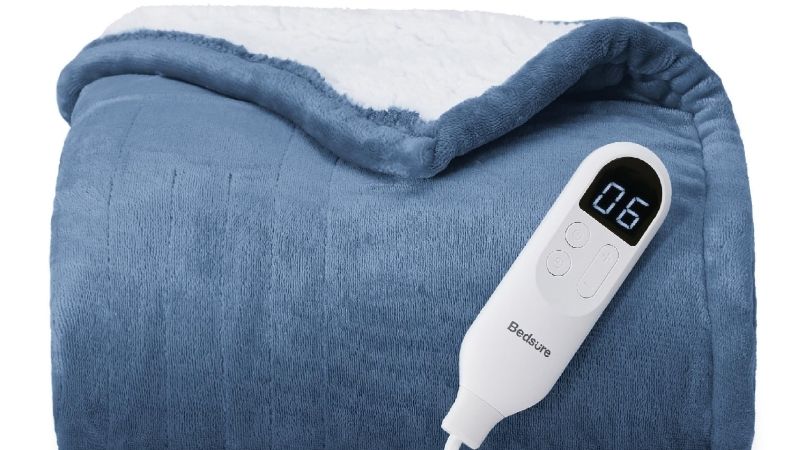
| Factor | Heated Throw | Electric Blanket | What to Check |
|---|---|---|---|
| Typical example size | 50 by 60 inches on Sunbeam model 32810123 | 84 by 90 inches on Westinghouse queen model PM-YFL-GR-RCN-2 | Examples, not mandatory category dimensions |
| Main area covered | Lap, legs and torso while seated | Larger sleeping surface or bed prewarming | Measure the area you want covered |
| Heat-zone arrangement | Usually one user-facing control; verify model | Some queen or king models divide left and right zones | Dual-zone is a feature, not a blanket rule |
| Room setup | Useful on sofa or chair with clear cord path | Sized to sit flat across an approved bed | Read the designated use and placement rules |
| Storage and moving | Compact to carry between rooms when unplugged | Larger folded footprint when fully cool and unplugged | Never run folded or crumpled |
| Most useful routine | Supervised warmth while sitting awake | Prewarming a bed while awake before switching off | Auto-off is not permission to leave unattended |
Coverage and Dimensions Matter More Than Product Names
A 50 by 60-inch throw can cover a person sitting with legs tucked up, but it may leave feet or shoulders exposed when stretched across a bed. Sunbeam lists that dimension for its U.S. microplush heated throw, model 32810123 [Sunbeam Home, accessed October 2026]. This is a product example, not a universal cutoff separating a throw from a blanket.
For contrast, Westinghouse lists an 84 by 90-inch queen heated blanket under model PM-YFL-GR-RCN-2 [Westinghouse, accessed October 2026]. More fabric can cover more mattress area, yet its heating pattern may not reach every seam or edge. Compare the published dimensions, unheated borders, and usable width rather than trusting the words “oversized” or “queen” alone.
Controllers, Heat Zones and Timer Labels Work Differently
A basic throw often concentrates controls on one seated user’s comfort. The U.S. Sunbeam 32810123 listing specifies four heat settings and a four-hour auto-off feature; those details belong to that particular model, not all throws [Sunbeam Home, accessed October 2026]. Check whether the controller is easy to reach from your actual seat without tugging its cable.
A large blanket may have a different arrangement. Westinghouse describes independently adjustable left and right zones in its 84 by 90-inch queen model and lists selectable heat levels and timers [Westinghouse, accessed October 2026]. A dual-zone layout is useful for two preferences, but a timer only describes the controller. It does not cancel independent precautions about active heating during sleep.
Fabric Feel Is Different From Electrical Heat Performance
Microplush, fleece, and Sherpa can feel soft or insulating even after the controller is off, but textile thickness alone does not establish which powered product heats faster. The heating design, setpoint, contact area, and surrounding room all affect perceived warmth. Do not treat a thicker pile or a marketing phrase such as “extra cozy” as a verified temperature measurement.
It also matters how the fabric drapes. On a sofa, a short throw can stay close to your lap without needing to wrap around the chair. On a bed, a larger blanket gives more placement flexibility if its manual permits the arrangement. Compare texture, weight, and how easily you can lay it flat; a premium fabric is not a substitute for a suitable heating design.
Choose the Right Heated Cover for Six Everyday Situations
Start with the place where you need warmth, the number of people using it, and the distance to a safe wall outlet. The following scenarios turn the measurements and controls above into specific choices. These are practical preferences rather than safety certifications; for either style, use the model as instructed and follow the Electrical Safety Foundation International prevention advice [ESFI, 2022].
Situation 1: Watching TV Alone on a Living-Room Sofa
Choose a heated throw when most of your cold-weather time is spent sitting on one spot of a couch. It can warm the legs and midsection without draping excess fabric over the other cushions. A 50 by 60-inch product such as the Sunbeam example is a useful size to visualize, although a taller person may prefer more length or ordinary socks for uncovered feet.
Before buying, sit in your normal position and see where a power cord could reach the outlet without crossing a walking route. A throw that forces the cord across a doorway is a poor fit regardless of how plush it feels. Keep the heated material spread out and avoid placing pillows, pets, or a second comforter over powered areas. Switch it off whenever you leave the sofa.
Situation 2: Reading in a Recliner or Armchair
A smaller throw is often easier to manage in an armchair because there is less trailing fabric than with a queen-size electric blanket. You can move it from your lap to your shoulders after switching the heat off and disconnecting it as instructed. Check the controller position before settling in; an awkwardly placed switch can make a simple reading session inconvenient.
A moving recliner adds a special limitation: hinges and footrest tracks can catch fabric or pinch a cable. Do not route any powered throw through moving joints, and do not put heating wires under your body. If you cannot keep the cord outside the mechanism while reclined, use a regular throw rather than improvising a risky setup. The same caution applies to powered lift chairs.
Situation 3: Keeping Warm at a Home-Office Desk
For a drafty desk, a heated throw may be more practical than a full bed blanket if you mainly want warmth over your knees. The smaller size is easier to keep clear of a keyboard, rolling chair, and chair casters. It is a comfort accessory, not a replacement for fixing a persistently cold workspace or an approved room-heating system when room temperature is the actual problem.
Set the throw where you can disconnect it before standing, and keep the controller off the floor where wheels could crush it. A desk user’s feet may still feel cold because heated fabric over the lap does not heat the room or floor. Rather than folding an energized throw around the ankles, consider non-electric socks or a conventional lap blanket sized for that task.
Situation 4: Prewarming a Bed Before Getting In
Choose a bed-size electric blanket when your main goal is distributing warmth over a mattress rather than warming a seated person’s lap. A queen-size example gives substantially more surface coverage than a standard sofa throw, although mattress fit and the manufacturer’s permitted positioning still need checking. A short heated throw is not automatically a substitute for one designed for bed use.
Follow the blanket’s manual for positioning and any preheat function, remain awake and attentive while it operates, and turn it off before sleep. ESFI advises against leaving electric heating appliances unattended or operating them while sleeping [ESFI, 2022]. This is a placement and coverage decision, not a claim that a queen-size blanket can safely run overnight because its controller shows an auto-off time.
Situation 5: Two Adults Want Different Warmth in Bed
If two adults share a larger bed but disagree about warmth while awake, look for a bed-size model with independently controlled zones. Westinghouse describes separate left and right adjustment on the queen PM-YFL-GR-RCN-2, illustrating a feature a small single-controller throw would not replicate across two sides of a bed [Westinghouse, accessed October 2026]. Check the controls for the exact size you are considering.
Two zones do not mean every inch has equal heat or that one partner should borrow a second electric throw on top. Bedding layers, distance from the mattress edge, and the route of both control cords may affect comfort. If only one person wants warmth while watching television, a single throw is the simpler choice; if the goal is broad bed coverage for both, compare proper bed-size layouts.
Situation 6: Small Apartment, Guests, Pets and Shared Seating
A heated throw can be a flexible choice in a small home when one person uses the same chair in different rooms, provided it is switched off, unplugged, and cool before moving. It stores in less space than many bed-size electric blankets and can accompany a seated guest who wants warmth. That portability does not make it appropriate for walking around, outside in wet weather, or sleeping under live heat.
If children or pets often climb onto the sofa, supervision and the ability to keep the heating area clear may decide the purchase before size does. ESFI warns not to put objects on an operating electric blanket and to replace damaged cords or fabric [ESFI, 2022]. Where that is difficult to control, choose an ordinary throw for the shared room and reserve electric bedding for a suitable, supervised setup.
Frequently Asked Questions
The details below address common shopping misunderstandings that the side-by-side comparison does not settle: running cost, care rules, warmth ratings, and controller replacements. In each case, treat a manufacturer’s specification as applying to its stated model and size, rather than to every heated throw or electric blanket on the market.
Is a Heated Throw Always Cheaper to Run Than a Large Electric Blanket?
No. A smaller textile does not by itself prove lower electrical use. Power rating, cycling, temperature setting, and how long it stays on determine consumption. For reference, Sunbeam publishes 100 watts for its 50 by 60-inch model 32810123 [Sunbeam Home, accessed October 2026], but the correct comparison requires the actual rated wattage of the specific full-size blanket.
Some larger products have multiple independently controlled zones, which complicates a simple small-versus-large assumption. If power costs matter, use the labels of the two models you are considering and compare them under equivalent use conditions. This article addresses which cover suits the room and person; it does not treat the number of heat settings or fabric area as a substitute for measured electrical input.
Are Heated Throws and Electric Blankets Equally Easy to Wash?
Not necessarily. A smaller throw may be easier to fit in a household washer, but washability depends on the electrical connectors, the fabric, and the exact care label. Sunbeam describes its 32810123 heated throw as machine washable, and Westinghouse gives cleaning instructions for its queen model [Sunbeam Home; Westinghouse, accessed October 2026]. Those claims are model-specific.
Do not wash either product while connected to power, and do not assume a detachable controller means that every washing or drying cycle is permitted. Check connector handling, washer capacity, and drying restrictions on the product instructions. Larger blankets can need more room to move in the drum, but choosing the smaller item only for laundry convenience may sacrifice the coverage you need.
Does Sherpa Make an Electric Throw Warmer Than a Plain Blanket?
No fixed ranking follows from the word “Sherpa.” Plush backing can change how the surface feels and how much residual warmth it holds after power is off, but it is not a standardized measure of a product’s heating performance. Both a throw and a bed-size electric blanket can use Sherpa, fleece, or flannel. Their heating-element layout and operation remain separate questions.
When touching two fabrics in a store, compare softness and weight without assuming a warmer hand feel predicts a hotter heating wire. The more useful shopping questions are whether the cover stays flat in the intended space, whether its controller is convenient, and whether the actual size is sufficient. If you dislike bulky pile, a lighter fabric may be more comfortable despite feeling less plush.
Can You Replace One Heated Blanket Controller With Another?
No. Do not interchange controllers between models, even when the connectors appear to fit. Heat regulation, electrical ratings, connector wiring, and safety monitoring may differ. A damaged or missing controller should be replaced only with an exact part the manufacturer identifies as compatible with your product. A generic replacement is not proven safe by matching plug shape alone.
Before ordering, record the blanket and controller model codes and contact the manufacturer’s support service for the approved part number. If a correct replacement cannot be obtained, stop using the heated product rather than bypassing its controls. This applies to both heated throws and full-size blankets and can be more important to safe ownership than a difference of a few inches in size.
Final Thoughts
For a sofa, desk, or reading chair, a compact heated throw usually offers the most convenient coverage. For broader prewarming of a shared mattress, a bed-size electric blanket offers a better starting point, especially if separate zones matter. Decide by your real room setup, confirm the exact model instructions, and switch off before leaving or sleeping.