
Key takeaways
- Choosing the best at home dumbbells is easier when the first purchase stays small enough to understand. Instead of ordering the widest range available,...
What's inside
- Define a first collection, not a finished gym
- Use adjustment frequency to compare formats
- Plan a review point for expansion
- Product listings to compare
- Avoid making the room permanent too early
- Evaluate the delivered equipment before adding to it
- Let the second purchase answer a recorded need
- Additional product links
- Related reading
Choosing the best at home dumbbells is easier when the first purchase stays small enough to understand. Instead of ordering the widest range available, identify the equipment needed for the routine you already follow. Then decide what evidence would justify expanding later. This is especially useful when a spare room has not yet become a permanent exercise space.
This guide provides practical selection and use considerations. It does not report hands-on product testing.
Define a first collection, not a finished gym
Write down the loads and quantities needed for your established exercises, using appropriate instruction to resolve any uncertainty. A single pair, several fixed pairs and an adjustable system are different answers to that brief. None becomes the best choice simply by offering more possible combinations.
Separate a present need from an appealing future activity. If you have not learned the exercise or decided whether it belongs in your routine, it need not dictate today’s equipment range. Leaving part of the budget unspent is a legitimate option while those questions are answered.
Use adjustment frequency to compare formats
Look at how often your actual session changes load. If the same pair serves the planned work, a complex adjustment mechanism may add little convenience. If several loads are needed, compare the documented selection process and the settings available between the minimum and maximum.
Do not choose solely for the quickest promotional demonstration. Find out whether the weight must be seated in a base, whether plates are handled separately and how the selected configuration is checked. Those details describe the routine you would own, rather than an abstract feature count.
Plan a review point for expansion
After using an appropriate initial setup, record what actually limited a session. Was a required setting unavailable, was equipment being shared at the same time, or was retrieving a pair awkward? Each problem suggests a different response. Buying more weight is not the solution to every inconvenience.
For an adjustable system, research supported expansion before purchase if that path matters. Ask for exact compatible parts and the relevant limits. For fixed pairs, check whether adding one useful load would solve the gap without replacing the original collection.
Product listings to compare
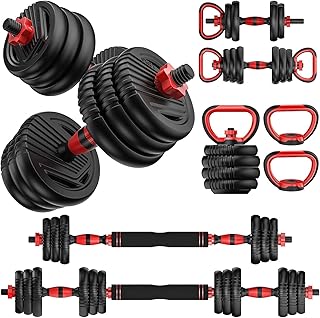
As an Amazon Associate we earn from qualifying purchases at no extra cost to you. Product prices and availability are accurate as of the date shown and are subject to change. Compare the selected variant and its current description with the requirements above.
As an Amazon Associate we earn from qualifying purchases at no extra cost to you. Product prices and availability are accurate as of the date shown and are subject to change.


Avoid making the room permanent too early
Choose appropriate equipment storage for the initial collection and the room’s present use. Do not install a large decorative arrangement around a hypothetical future set. Leave normal access to furnishings and allow the equipment’s actual operating requirements before deciding which wall should become an exercise feature.
If the room may change purpose, consider how the documented storage and handling arrangements would work elsewhere. This is not a promise that any set is easy to move. It is a reason to understand the actual pieces and their supports before committing to a location-dependent layout.
Evaluate the delivered equipment before adding to it
Check the order against the selected configuration and read the instructions. Understand the assembly, inspection and care requirements before using the weights. Keep purchase records and follow the seller’s procedure if contents are missing or a component appears damaged.
Keep the support information accessible. Record the exact configuration so a later accessory inquiry starts with the correct model. If a later problem concerns a mechanism or securing component, follow the manufacturer’s service guidance rather than trying an unapproved repair. Compatibility and condition matter more than retaining a perfectly matching visual collection.
Let the second purchase answer a recorded need
Before expanding, return to the limitation you identified. Compare an addition, a supported upgrade and a change in storage or scheduling. Include the consequences for the whole collection, especially if a new system would leave the original set unused.
A deliberate small start can lead to a well-chosen larger setup, or it may remain sufficient for the intended routine. The useful outcome is equipment that has a clear purpose and an appropriate place in the home. Buy the next item because it solves an observed need, not because an empty rack position or a larger advertised range makes the current purchase appear incomplete.
Additional product links
- Start 30-Day Prime Free Trial →
- See Today’s Amazon Deals
- ▸ Try Amazon Prime — free 30-day trial
- ▸ Start an Audible Premium Plus free trial
- ▸ Read free with Kindle Unlimited
Related reading
- Best at home dumbbells
- Chris Parker
- Best Ab Workouts with Dumbbells: 6 Support Picks Compared
- Best Budget Adjustable Dumbbell: 6 Picks and Trade-Offs
- Best Abs Exercise with Dumbbells: 6 Picks by Coating Type
- Best Abs Workout with Dumbbells: 6 Picks for Fast Circuits
- Best Dumbbells Home Gyms Use: 6 Picks Ranked by Delivery
- Best beginner jump rope
- Best boxing jump rope
- Best boxer jump rope
- Best cheapest yoga mat
- Best workout exercise equipment
- Best Shoulder Workouts With Dumbbells: 6 Home Gear Picks
- Best Workout Dumbbells: 7 Picks for Small Home Gym Spaces
- Best Dumbbells for Home Gyms: 6 Picks Rated on Durability



Write Your Review
No reviews yet. Be the first to share your experience!