Key takeaways
- Best overall cheap 1080p card: Radeon RX 7600 (8GB) or GeForce RTX 4060 (8GB). Both handle 1080p ultra at 60+ fps in most modern games and are very power efficient.
- Cheapest usable 1080p card: Radeon RX 6600 (8GB) or Intel Arc A580 (8GB). Usually $180–$230 and still delivers 60 fps at 1080p high/medium in demanding titles.
- Best cheap card for 1440p: Radeon RX 7600 XT (16GB) or GeForce RTX 4060 Ti (8GB/16GB). The extra VRAM on the 7600 XT helps at 1440p with texture-heavy games, while the 4060 Ti is more efficient and offers DLSS 3.
- Best for a small prebuilt or office PC upgrade: GeForce RTX 4060. Its low 115W TDP means it runs on a 450–550W PSU and often comes in compact dual-fan sizes under 9 inches long.
- Best for streaming and creative apps on a budget: GeForce RTX 4060 / RTX 3060 12GB. NVIDIA’s NVENC encoder and broader app support are stronger for streaming, video editing, and AI features.
The best cheap graphics cards GPUs for gaming in 2026 are the AMD Radeon RX 7600 and NVIDIA GeForce RTX 4060 for solid 1080p ultra gaming under $300, the Intel Arc A580 and Radeon RX 6600 for budget 1080p under $200, and the Radeon RX 7600 XT and GeForce RTX 4060 Ti 8GB for 1440p on a budget when you find them in the $300–$400 range.
Which Cheap GPU Is Best for Your Situation?
If you just want the simplest answer by resolution and PC type, use this:

ASUS Dual GeForce RTX 3050 6GB GDDR6 OC Edition Gaming Graphics Card
Included for 'Best Cheap Graphics Cards and GPUs for Gaming' as a relevant option in this category; details come from the product listing.
View on Amazon
ASUS Prime GeForce RTX 5070 12GB GDDR7 OC Edition Gaming Graphics Card
Included for 'Best Cheap Graphics Cards and GPUs for Gaming' as a relevant option in this category; details come from the product listing.
View on Amazon
GIGABYTE Radeon RX 9070 XT Gaming OC 16G Graphics Card, PCIe 5.0, 16GB GDDR6, GV-R9070XTGAMING OC-16GD Video Card
Included for 'Best Cheap Graphics Cards and GPUs for Gaming' because the listing specifies PCIe 5.0 and 16GB GDDR6, details this guide uses to compare options.
View on Amazon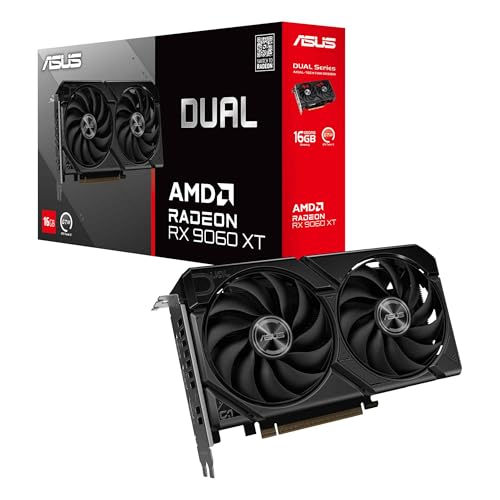
ASUS Dual Radeon RX 9060 XT 16GB GDDR6 Gaming Graphics Card
Included for 'Best Cheap Graphics Cards and GPUs for Gaming' as a relevant option in this category; details come from the product listing.
View on Amazon- Best overall cheap 1080p card: Radeon RX 7600 (8GB) or GeForce RTX 4060 (8GB). Both handle 1080p ultra at 60+ fps in most modern games and are very power efficient.
- Cheapest usable 1080p card: Radeon RX 6600 (8GB) or Intel Arc A580 (8GB). Usually $180–$230 and still delivers 60 fps at 1080p high/medium in demanding titles.
- Best cheap card for 1440p: Radeon RX 7600 XT (16GB) or GeForce RTX 4060 Ti (8GB/16GB). The extra VRAM on the 7600 XT helps at 1440p with texture-heavy games, while the 4060 Ti is more efficient and offers DLSS 3.
- Best for a small prebuilt or office PC upgrade: GeForce RTX 4060. Its low 115W TDP means it runs on a 450–550W PSU and often comes in compact dual-fan sizes under 9 inches long.
- Best for streaming and creative apps on a budget: GeForce RTX 4060 / RTX 3060 12GB. NVIDIA’s NVENC encoder and broader app support are stronger for streaming, video editing, and AI features.
How to Choose: 5 Specs That Actually Matter at This Price
1. 1080p vs 1440p Performance
Most cheap GPUs are designed for 1080p. At 1080p ultra, expect 60–90 fps in esports and competitive shooters and 55–75 fps in AAA single-player games on an RX 7600 or RTX 4060. At 1440p, those same cards drop to 45–60 fps, so you will need to use upscaling (FSR, DLSS, XeSS) or lower settings. If your monitor is 1080p 144Hz, prioritize raw 1080p fps. If it is 1440p 60/75Hz, prioritize VRAM and upscaling support.
2. VRAM: 8GB Is the Minimum, 12GB/16GB Is Safer
8GB is enough for 1080p in 2026, but newer games at high textures can exceed 8GB at 1440p. The GeForce RTX 3060 12GB and Radeon RX 7600 XT 16GB give you headroom for texture packs and future titles without a large price jump. On an 8GB card, you can manage VRAM by setting textures to High instead of Ultra, which rarely affects visual quality at 1080p.
3. Power Draw and PSU Compatibility
This is where budget PCs get caught out. A modern budget GPU can draw as little as 130W or as much as 225W, which determines if your existing power supply and case airflow are enough. Check the label on your PSU and whether it has the required 8-pin PCIe connectors.
4. Cooling Size and Physical Fit
Cheap GPUs now come in three main sizes: compact dual-fan (around 8–9.5 inches long), standard dual-fan (10–11.5 inches), and triple-fan (12+ inches). Triple-fan cards are quieter but often do not fit in older mid-towers or small-form-factor cases. Measure from the back plate to the front drive cage or case fan before you buy.
5. Upscaling and Feature Support
At the low end, upscaling is not optional. DLSS 2/3 (NVIDIA), FSR 2/3 (AMD, works on any card), and XeSS (Intel) can add 30–50% more frames at 1080p and 1440p with minimal quality loss. If you want frame generation, you need an RTX 40-series or a card that supports FSR 3 frame generation. For ray tracing on a budget, NVIDIA RTX 40 cards have the lead; AMD and Intel require larger performance trade-offs.
Best Cheap GPUs Ranked for 1080p and 1440p Gaming
| GPU | VRAM | Avg 1080p Ultra FPS* | Avg 1440p Ultra FPS* | TDP / Suggested PSU | Typical Card Length | Street Price Range |
|---|---|---|---|---|---|---|
| Radeon RX 6600 | 8GB GDDR6 | 65–75 | 42–50 | 132W / 450W | 8.5–9.5 in (216–241 mm) | usually $180–$230 |
| Intel Arc A580 | 8GB GDDR6 | 68–78 | 44–52 | 175W / 500W | 9.5–10.5 in (241–267 mm) | usually $170–$220 |
| Intel Arc A750 | 8GB GDDR6 | 75–85 | 48–58 | 225W / 550W | 11.0 in (280 mm) | usually $200–$260 |
| Radeon RX 7600 | 8GB GDDR6 | 82–95 | 55–65 | 165W / 550W | 8.0–9.5 in (204–241 mm) | usually $240–$300 |
| GeForce RTX 3060 12GB | 12GB GDDR6 | 78–88 | 50–60 | 170W / 550W | 9.0–11.2 in (229–285 mm) | usually $250–$320 |
| GeForce RTX 4060 | 8GB GDDR6 | 85–100 | 58–68 | 115W / 450–550W | 8.5–9.7 in (216–247 mm) | usually $270–$330 |
| Radeon RX 7600 XT | 16GB GDDR6 | 88–102 | 62–72 | 190W / 550W | 10.0–11.2 in (254–285 mm) | usually $310–$380 |
*Averaged across recent AAA titles (like Cyberpunk 2077, Starfield, Hogwarts Legacy, Call of Duty: Modern Warfare III) at Ultra/High without upscaling or ray tracing on a midrange CPU such as Ryzen 5 5600 / Core i5-12400. Using FSR/DLSS Quality adds roughly 25–40%.
Decision Matrix: Match Your Setup to the Right Card
| Your Situation | Recommended GPU Type | Why It Fits |
|---|---|---|
| Small apartment, desk in bedroom, compact PC case | RTX 4060 dual-fan compact or RX 7600 compact | Low heat output, fits 14–15 in deep cases, quieter at night, runs on smaller PSU |
| Family PC that kids and pets use, shared living room | RTX 3060 12GB or RX 6600 with large dual-fan cooler | Durable cooler design, extra VRAM forgives high texture settings, less sensitive to dust |
| Renter with a prebuilt Dell/HP/Lenovo from 2019–2022 | RTX 4060 (115W) | No PSU upgrade needed in most 450–500W systems, single 8-pin connector, shortest length |
| 1440p 27-inch monitor on a budget | RX 7600 XT 16GB | 16GB prevents texture-related stutter at 1440p, FSR 3 keeps frames above 60 |
| Value-first 1080p 60Hz TV or monitor | RX 6600 or Arc A580 | Lowest cost for 60 fps, frees budget for SSD/RAM upgrade |
Will It Fit? Real Measurements for Budget PCs and Home Setups
A GPU listing shows length, but not whether it actually fits your furniture and airflow. Use these real-world numbers before you order.
Case and Desk Clearance
- Measure case interior length: Open the side panel and measure from the rear bracket to the nearest obstruction (front fans, radiator, or hard drive cage). Add 0.6 in (15 mm) for power cables. If your clearance is under 11 in (279 mm), avoid triple-fan models.
- Card thickness: Most budget cards are 2-slot (1.6 in / 41 mm thick). Some RX 7600 XT and RTX 4060 Ti models are 2.5-slot (2.0 in / 51 mm). In a micro-ATX case with a Wi-Fi card or bottom-mounted PSU, a 2.5-slot card can block the slot below it.
- Desk and airflow: For a tower on or under a desk, leave at least 4 in (10 cm) behind the case for the power cable and exhaust, and 6 in (15 cm) above or to the side of intake vents. A closed desk cabinet with only 2–3 in of clearance can raise GPU temperatures by 10–15°C and cause thermal throttling.
- Room-size fit: In a 10×12 ft (3.0×3.6 m) room, a standard 47–55 in wide (120–140 cm) gaming desk with a 20 in deep (51 cm) mid-tower on top leaves about 30–36 in (76–91 cm) of chair movement space. If you are tight on space, place the tower on the floor on a small stand to free desk surface and improve floor airflow – just keep it off carpet.
Height, Weight, and Load Limits
- Desk height: Standard desk height is 29–30 in (74–76 cm). With a tower that is 16–18 in (41–46 cm) tall on the desk, your eye level to a 24–27 in monitor on its stock stand will be about 16–20 in (41–51 cm) above the desk, which is correct for most adults in a 17–19 in (43–48 cm) seat-height chair.
- Weight: Budget GPUs weigh 1.5–2.2 lb (0.7–1.0 kg), but the full system can be 25–35 lb (11–16 kg). Most engineered-wood desks are rated for 100–150 lb (45–68 kg) total. Solid wood or steel-frame desks are typically 200 lb+ (91 kg+). Distribute weight near the legs, not the center span.
- Box and doorway: The GPU retail box is about 13x10x6 in (33x25x15 cm) and 3–5 lb (1.4–2.3 kg). Your full PC case box is typically 22x20x12 in (56x51x30 cm) and will not fit through a narrow 24 in (61 cm) closet doorway without tilting. Plan the unboxing path before delivery.
| Furniture / Space Element | Standard Dimension | What to Check for GPU Setup |
|---|---|---|
| Desk surface (budget gaming desk) | 47–55 in W x 23–27 in D (120–140 cm x 58–69 cm) | Needs 10–12 in (25–30 cm) depth for case feet if tower sits on desk; 24 in+ depth if monitor + case share surface |
| PC tower (mid-tower) | 17–18.5 in H x 8–9 in W x 16–18 in D | Confirm case GPU clearance: compact 8.5 in vs standard 11–12 in cards |
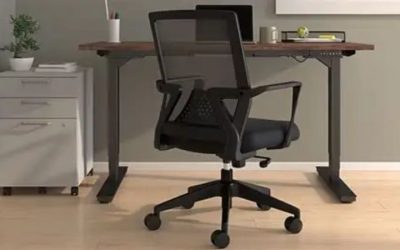
| Chair seat height | 17–19 in (43–48 cm) | Aligns eyes to monitor center when desk is 29–30 in high; prevents neck strain during long sessions |
| Wall clearance behind desk | 4–6 in (10–15 cm) minimum | Allows exhaust and cable bend; less than 3 in traps heat |
| Floor stand for tower | 4–6 in H off carpet | Prevents bottom PSU fan from choking on carpet fibers |
Assembly, Power, and Durability Realities
Budget GPUs are easier to install than high-end models, but budget PCs create specific issues:
- Power connectors: The RTX 4060 and RX 6600 typically need one 8-pin PCIe. The Arc A750 and RX 7600 XT often need two 8-pin. If your PSU only has one 8-pin, choose a single-connector card rather than using adapters.
- Driver and CPU pairing: An older quad-core CPU will bottleneck even a cheap modern GPU at 1080p. A Ryzen 5 3600 / 5600 or Intel Core i5-10400 / 12400 or newer is a balanced match. Intel Arc cards benefit the most from enabling Resizable BAR in BIOS, which most boards from 2019 onward support.
- Noise and thermals: Dual-fan cards in a tight case will run 72–80°C and the fans will be audible. Cleaning the front dust filter every 2–3 months matters more than the brand of thermal paste. What wears first is usually the fans after 3–4 years of heavy use, not the chip itself – look for models with replaceable fan modules if you keep PCs long-term.
- Moving: If you move apartments often, remove the GPU before transporting the PC. The PCIe slot and card bracket bear all the weight during bumps; a 2 lb card bouncing in a 30 lb case is the most common cause of cracked slots in budget boards.
Material and Furniture Trade-Off for a Gaming Station
Your desk and chair material affects how pleasant a budget gaming setup is day-to-day, especially with a warm-running PC in a small room.
| Material | Pros | Cons | Best For |
|---|---|---|---|
| Solid wood desk (rubberwood, acacia) | Holds 200 lb+, resists sag, ages well, dampens vibration | Heavy to move, higher price, can scratch | Long-term setup where PC stays put |
| Engineered wood (MDF/particleboard with laminate) | Light, affordable, smooth surface | Sags under center load over time, swells with moisture, lower screw-hold strength | Budget or rental setups under 3–4 years |
| Metal frame + wood top | Best weight-to-strength, open frame improves airflow | Assembly has more bolts, can wobble if not leveled | Gamers who want tower on desk and strong monitor arm support |
| Mesh vs foam chair | Mesh breathes with PC heat; foam is cushioned | Mesh is firmer; low-density foam (<1.8 lb/ft³) flattens in 12–18 months | Mesh for warm rooms / long sessions; high-density foam (1.8+ lb/ft³) for comfort priority |
Final Picks by Budget
Under $230: Get the Radeon RX 6600 if you want plug-and-play simplicity, or the Intel Arc A580 if you are comfortable updating drivers and enabling Resizable BAR for the best value. Both are comfortable at 1080p high.
$240–$330: Get the Radeon RX 7600 for the best frames per dollar, or the GeForce RTX 4060 if your PSU is small, your case is compact, or you stream. Both will push a 1080p 144Hz monitor well with upscaling.
$310–$400: Get the Radeon RX 7600 XT 16GB if you play at 1440p or want to keep textures at Ultra for several years, or a GeForce RTX 4060 Ti if you find it near $350 and want the most efficient 1440p entry point.
For kkhomefurnishings.com readers building a complete room, pair whichever card you choose with a desk at least 47 in wide and 24 in deep, a chair with adjustable seat height, and 4–6 inches of rear clearance for the PC. That combination keeps a budget GPU cool, quiet, and performing like it should without needing a larger room or a new power supply.