Key takeaways
- Desk edge: Measure desktop thickness and the unobstructed depth beneath the back edge. Allow room for the clamp plate and tightening knob.
- Wall and furniture clearance: Measure from the desk edge to the wall, shelf, or window trim. A monitor moved backward may need more room for its rear casing and cables.
- Base footprint: For a freestanding mount, reserve the listed base depth and width. A base around 12 in. deep can take up noticeable room on a shallow desk.
- Screen position: Check that the display can move through its intended range without striking a lamp, speaker, or second monitor.
- Room layout: In a 10 × 12 ft room, a clamp can preserve useful desk surface in a compact workstation, but only if the desk is sturdy and accessible from the back. In a shared room, leave a clear walking path rather than extending an arm into it.
Best Gaming Monitor Mounts for Your Setup
The best gaming monitor mounts are heavy-duty desk-clamp arms for most single-monitor setups, dual arms rated for both screens for matched displays, and freestanding bases when you cannot clamp to your desk. Choose by the monitor’s actual weight, VESA pattern, usable height range, and how firmly the mount holds position—not by screen size alone.
Choose by setup
| Your situation | Best fit | What to check first |
|---|---|---|
| One monitor on a sturdy desk | Single desk-clamp arm | Monitor weight, VESA fit, desk thickness, and clamp clearance |
| Two similar-sized monitors | Dual arm with independently adjustable heads | Per-arm weight limit and stability with both screens extended |
| Glass, thin, or clamp-incompatible desk | Freestanding base, if its footprint fits | Base dimensions, total weight, and how far the monitors can reach |
| Large or unusually heavy display | Heavy-duty arm or freestanding mount rated for that load | Maximum supported weight and screen-size range for the exact model |
| Rental or shared workspace | Clamp or freestanding mount, depending on desk rules | Whether the clamp leaves marks and whether the base blocks desk space |
Desk clamp vs. freestanding: the head-to-head
| Factor | Desk-clamp mount | Freestanding mount |
|---|---|---|
| Desk space | Frees most of the surface below the screen | Uses space for its base, commonly around 10–16 in. deep |
| Desk requirements | Needs a reachable edge and a top the clamp can safely grip | Does not need an edge clamp; still needs a level, stable surface |
| Movement and reach | Often offers more positioning range, depending on the arm | Can be easy to relocate, but the base limits how far the screen can extend |
| Stability | Depends on clamp grip, desk construction, and arm extension | Depends on base mass, footprint, and screen position |
| Cable routing | Often includes clips along the arm or pole | May route cables down the stand; check whether clips are included |
A clamp is not automatically safer on every desk. A hollow-core top, a beveled edge, a rear cable tray, or a thick apron can prevent secure installation. Check the mount’s stated desk-thickness range and measure the clear space under the edge. If the clamp’s small contact area would press directly on a fragile surface, use a manufacturer-approved reinforcement plate or choose another mounting style.

HUANUO FlowLift™ Dual Monitor Stand, Fully Adjustable Gaming Monitor Desk Mount for 13–32″ Computer Screens, Full Motion VESA 75x75/100x100 with C-Clamp & Grommet Base, Each Arm Holds 4.4 to 19.8 lbs
Included for 'Best Gaming Monitor Mounts for Your Setup' because the listing specifies Fully Adjustable Gaming Monitor Desk Mount for 13 and 32″ Computer Screens, details this guide uses to compare options.
View on Amazon
ErGear Single Monitor Arm, Fully Adjustable Monitor Mount for 13–34 Inch Screens, Fast Install Computer Monitor Stand with Tool-Free VESA Mount, Cable Management, Holds 19.8 lbs
Included for 'Best Gaming Monitor Mounts for Your Setup' because the listing specifies Fully Adjustable Monitor Mount for 13 and 34 Inch Screens, details this guide uses to compare options.
View on Amazon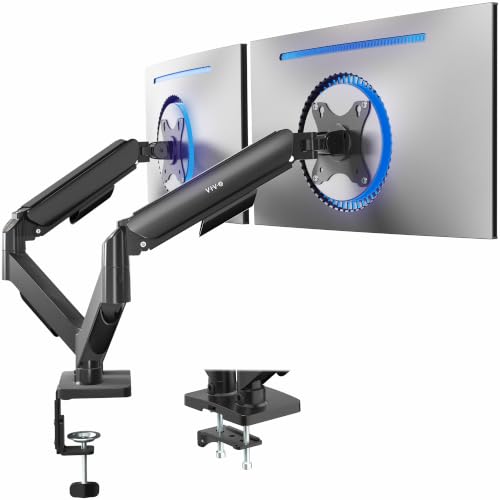
VIVO Dual Monitor Stand, Fully Adjustable Arms for 17 to 32 inch Screens, Mechanical Articulating Desk Mount, Gaming and Office Setups, VESA 75x75, 100x100, Max 19.8 lbs, Classic, Black, STAND-V002O
Included for 'Best Gaming Monitor Mounts for Your Setup' because the listing specifies Fully Adjustable Arms for 17 to 32 inch Screens and Mechanical Articulating Desk Mount, details this guide uses to compare options.
View on Amazon
ErGear Dual Monitor Arm, Full Adjustable Monitor Mount for 13–32″ Screens, Fast Install Computer Monitor Stand with Tool-Free VESA Mount, Max Load 19.8 lbs, Max VESA 100x100mm
Included for 'Best Gaming Monitor Mounts for Your Setup' because the listing specifies Full Adjustable Monitor Mount for 13 and 32″ Screens, details this guide uses to compare options.
View on AmazonMatch the mount to your monitor
Size and weight
Screen size is a useful first filter, not a substitute for weight capacity. A large, light display may work on an arm that cannot safely hold a smaller but heavier monitor. Look up the weight without the original stand and compare it with the mount’s capacity per screen. Leave a margin rather than choosing a mount that reaches its limit exactly; an extended arm can feel less steady even when the load is within spec.
For ultrawide or deep-backed monitors, verify the mount’s listed screen-size range and check whether the display can rotate without hitting a wall, shelf, or neighboring screen. A mount’s headline capacity does not guarantee clearance for a wide screen.
VESA compatibility
Most monitor arms attach through a VESA pattern on the back of the display. Common patterns include 75 × 75 mm and 100 × 100 mm. Check the monitor manual or measure the distance between the four mounting holes. Some displays have recessed holes, unusual mounting positions, or no VESA holes; these may need a compatible adapter, if one is available for that model. Confirm that the adapter and screws are suitable before installation.
Height, tilt, and range
Compare the mount’s vertical travel—not just its maximum height—with your sitting position. A practical starting point is to place the top of the screen at or slightly below eye level, then adjust for posture, glasses, and screen size. If two people share a desk, prioritize smooth height adjustment and enough travel for both users rather than a fixed pole with limited settings.
What makes a dual setup stable?
For two screens, check the capacity of each arm, not just a combined total. Two independently adjustable arms are useful when monitors differ in size or weight. A crossbar can help keep matched displays aligned, but can be less flexible when you want different heights or angles.
Stability also depends on leverage. Two screens pushed far forward or sideways create more movement than the same screens kept close to the mounting point. On a desk that shakes easily, use shorter extensions, tighten the joints as instructed, and avoid treating an arm as a handle. For large or heavy displays, a pole-style dual mount or a mount with a broad, substantial base may be more suitable than a long, thin arm; compare the model’s load and reach specifications.
Measure before you buy
Take these measurements before choosing a mount:
- Desk edge: Measure desktop thickness and the unobstructed depth beneath the back edge. Allow room for the clamp plate and tightening knob.
- Wall and furniture clearance: Measure from the desk edge to the wall, shelf, or window trim. A monitor moved backward may need more room for its rear casing and cables.
- Base footprint: For a freestanding mount, reserve the listed base depth and width. A base around 12 in. deep can take up noticeable room on a shallow desk.
- Screen position: Check that the display can move through its intended range without striking a lamp, speaker, or second monitor.
- Room layout: In a 10 × 12 ft room, a clamp can preserve useful desk surface in a compact workstation, but only if the desk is sturdy and accessible from the back. In a shared room, leave a clear walking path rather than extending an arm into it.
Cable management and day-to-day use
Built-in clips make a cleaner route, but they do not make every cable long enough. Before mounting, check that the display, power, and video cables can reach at the arm’s full extension without pulling tight. Leave a relaxed loop near the monitor and keep cables clear of pivot joints. Avoid bundling cables so tightly that the arm cannot move freely. A removable clip or open channel is easier to maintain than a closed route that requires disconnecting everything to replace one cable.
Assembly, moving, and durability
Most mounts require attaching the clamp or base, assembling the arm, and securing the VESA plate to the monitor. The screen is the awkward part: larger displays are safer to mount with another person, especially when aligning the plate. Keep the monitor on a soft, flat surface while fitting the hardware, use the supplied screw lengths, and follow the instructions for setting arm tension.
When moving desks, support the monitor and arm separately rather than lifting by the screen. Recheck the clamp and joint tension after repositioning. Over time, the parts most likely to need attention are adjustable joints, tension mechanisms, cable clips, and clamp contact points. A desk that flexes or a clamp that loosens can cause more wobble than the arm itself, so inspect both periodically.
Final buying rule
Choose a desk clamp when the desk edge is strong, accessible, and compatible with the clamp; choose a freestanding base when clamping is not practical and you can spare its footprint. For either design, verify VESA fit, per-screen weight capacity, adjustment range, cable routing, and clearance at full extension. If those specifications do not match your desk and monitor, a cheaper mount is not a better fit.