
Our Top Picks
Best CPU Air Cooler for a Quiet Build: Quick Picks by Situation
The best CPU air cooler for a quiet build is a large dual-tower model such as the Noctua NH-D15 G2 or be quiet! Dark Rock Pro 5—if your case has room for its height and width. For a compact case, a single-tower cooler such as the Noctua NH-U12A or Thermalright Peerless Assassin 120 SE is easier to fit, while a low-profile cooler suits small-form-factor systems.
There is no single winner for every PC: cooler height determines whether the side panel closes, heatsink width can interfere with memory, and fan noise depends on the speed needed to handle your CPU’s heat. Check those constraints before comparing thermal-performance claims.
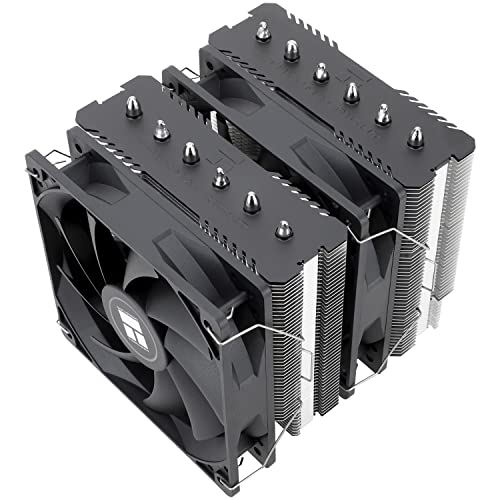
Thermalright Peerless Assassin 120 SE CPU Cooler, 6 Heat Pipes AGHP Technology, Dual 120mm PWM Fans, 1550RPM Speed, for AMD:AM4 AM5/Intel LGA 1700/1150/1151/1200/1851,PC Cooler
Included for 'Best CPU Air Coolers for Quiet Builds' because the listing specifies 6 Heat Pipes AGHP Technology and Dual 120mm PWM Fans, details this guide uses to compare options.
View on Amazon
Thermalright Assassin X120 Refined SE CPU Air Cooler, 4 Heat Pipes, TL-C12C PWM Fan, Aluminium Heatsink Cover, AGHP Technology, for AMD AM4/AM5/Intel LGA 1150/1151/1155/1200/1700/1851(AX120 R SE)
Included for 'Best CPU Air Coolers for Quiet Builds' because the listing specifies 4 Heat Pipes and TL-C12C PWM Fan, details this guide uses to compare options.
View on AmazonCompare the Main Options
| Cooler | Design and height | Best fit | Clearance and noise considerations |
|---|---|---|---|
| Noctua NH-D15 G2 | Dual tower; about 168 mm tall | High-power CPUs in roomy cases | Wide heatsink; check case limit and front-fan RAM clearance |
| be quiet! Dark Rock Pro 5 | Dual tower; about 168 mm tall | Quiet-focused builds with ample case space | Large footprint; its speed switch offers quiet and performance modes |
| Thermalright Peerless Assassin 120 SE | Dual tower; about 155 mm tall | Strong cooling value in mid-tower cases | Check memory height and fan position; acoustics vary with fan speed |
| Noctua NH-U12A | Single tower; about 158 mm tall | Cases or memory layouts that make wide towers awkward | Narrower layout helps around RAM; still verify the case’s cooler limit |
| Noctua NH-L9a-AM5 | Low-profile; about 37 mm tall | Very shallow small-form-factor cases | Compact clearance, but limited cooling headroom for sustained high loads |
Dimensions are manufacturer-listed nominal heights; confirm the exact model revision and case specifications before ordering. A dual tower generally has more fin area than a single tower, but that does not guarantee lower noise in every system. A cooler that runs its fans slowly under your workload can be quieter than a larger model pushed hard by a high-power processor.
Choose by Case, CPU, and Memory
| Your situation | Practical choice | What to verify |
|---|---|---|
| Roomy mid- or full-tower case; sustained rendering or heavy gaming | Premium dual tower | Case height limit, motherboard layout, and cooler clearance around the graphics card |
| Mid-tower with a tighter side-panel limit | Shorter dual tower, such as the Peerless Assassin 120 SE | Allow a few millimeters of margin rather than matching the listed limit exactly |
| Tall RAM modules or crowded socket area | Single tower, or dual tower with adjustable front fan | RAM height and the extra cooler height created when the fan is raised |
| Small-form-factor case with a low cooler limit | Low-profile cooler | CPU power limits, ventilation, and whether the case supports the cooler’s height |
| Basic office PC or light gaming with a moderate-power CPU | Single tower | Fan curve and whether the cooler includes the correct socket hardware |
For case fit, compare the manufacturer’s CPU-cooler clearance with the cooler’s full installed height, including its fan. If the case allows 160 mm, a cooler listed at 158 mm may fit, but manufacturing tolerances, a raised fan, or a side-panel brace can remove that margin.
For memory fit, check the RAM’s height against the cooler’s stated clearance, not just the fin-stack dimensions. A front fan can often slide upward to clear tall modules, but each millimeter raised adds to total cooler height. Low-profile RAM can simplify a dual-tower installation.
Heatsink Design, Noise, and Cooling Performance
Single-tower coolers are narrower and usually less cumbersome around the memory slots. They suit moderate heat loads and cases where a broad heatsink would crowd nearby components. Dual towers add fin area and commonly use two fans, giving them more capacity for sustained CPU loads—but they are heavier, wider, and more likely to complicate RAM access.
For quiet operation, consider fan size, fan bearings, and the speed needed to cool your actual processor. Larger fans can move useful airflow at lower rotational speeds, but the cooler’s shape and the case’s airflow matter too. A poorly ventilated case may force any cooler’s fans to ramp up. Set a gradual fan curve in the motherboard firmware: a short temperature spike need not trigger a sudden jump in fan speed.
Thermal performance depends on more than the cooler. CPU power limits, room temperature, case intake and exhaust, thermal-paste application, and the workload all affect temperatures. For a quiet build, a quality single tower is often enough for a moderate-power CPU; a dual tower provides more headroom for sustained workloads. For a high-power processor, check independent testing for the specific CPU and power settings you plan to use rather than assuming every air cooler can keep it quiet at unrestricted power.
Socket Compatibility and Installation
Before buying, confirm support for your motherboard socket—commonly AMD AM5 or AM4, and Intel LGA 1851 or LGA 1700 on current platforms—and verify that the required mounting kit is included. Support can differ by product revision; older stock may need an updated bracket. Also check motherboard component clearance and whether the cooler blocks access to the top PCIe slot or memory latches.
Installation is usually manageable with the motherboard outside the case, especially for large dual towers. In a built system, a cutout behind the CPU socket helps, but the case may still limit screwdriver access. Typical steps are:
- Fit the correct socket backplate and mounting bars using the cooler’s instructions.
- Apply thermal paste as directed, then seat and tighten the heatsink evenly.
- Attach the fan or fans without trapping cables or pressing against the RAM.
- Connect the CPU fan to the motherboard’s CPU_FAN header and check that every fan spins freely.
Large towers can obscure RAM slots and make later memory upgrades inconvenient. If you expect to change memory often, consider installing the RAM first and check whether the front fan can be removed without taking out the entire cooler.
What to Expect When Moving or Maintaining the Build
Large air coolers put leverage on the motherboard, so transport a tower PC upright where practical and secure it against sliding. For a long trip, follow the cooler or PC builder’s transport guidance; removing a very heavy heatsink can reduce stress on the board. Dust tends to collect between the fins and on the fan blades, reducing airflow and potentially increasing fan speed. Clean those areas periodically with the PC powered off, and hold fan blades still while using compressed air.
Fans are the moving parts most likely to need replacement over time. Check that a replacement fan matches the cooler’s mounting dimensions and can connect to the motherboard or fan controller. Heatsinks themselves have no motor to wear out, but bent fins and missing socket hardware can make handling or future upgrades less convenient.
Bottom Line
Pick a dual tower for sustained high CPU loads when the case has enough height and the RAM layout is compatible. Choose a single tower when easier fit and access matter more than maximum cooling capacity. For a compact system, use a low-profile model only when its height is necessary and the processor’s power limits are appropriate. The best CPU air cooler is the one that fits with clearance to spare and keeps your specific CPU cool without forcing its fans to run loudly.









