Key takeaways
- 120-150 watts (compact home models): Usually found on 7.5-inch slicers from brands like Chef’sChoice and Nesco. Adequate for thin deli cuts of cooked ham, turkey breast, and semi-hard cheese. Expect a 5-8 minute continuous run time followed by 15-20 minutes of cooling. Slicing semi-frozen beef for hot pot or jerky will strain these motors quickly.
- 150-200 watts (mid-range home models): Common on 9-inch to 10-inch models from BESWOOD and Cuisinart. Enough torque to slice a chilled roast beef or pork loin without stopping to let the blade catch up. Typical duty cycle is 10 minutes on, 15 minutes off.
- 240+ watts (prosumer/deli models): Found on 10-inch and 12-inch steel-bodied slicers. These use gear-driven or belt-driven transmissions that maintain blade speed under load. They can run 15-30 minutes continuously and slice semi-frozen meat at 1-2mm for bacon or bresaola without bogging down.
The best electric meat slicers for home use are 7.5-inch to 10-inch blade models with 120-200 watts of motor power and adjustable slice thickness from 0-15mm, while heavy deli-style use at home calls for a 10-12 inch blade and 240+ watts for continuous slicing without overheating.
How Blade Size Changes What You Can Slice
Blade diameter determines the maximum size of food you can process in a single pass, not just power. A larger blade gives you more cutting surface and a taller food carriage, which matters for roasts, hams, and larger loaves of bread.

VEVOR Meat Slicer, 8.6" Electric Deli Slicer with 2 SUS420 Blades
Included for 'Best Electric Meat Slicers for Home & Deli Use' because the listing specifies 8.6" Electric Deli Slicer with 2 SUS420 Blades, details this guide uses to compare options.
View on Amazon
Meat Slicer, 200W Electric Food Slicer with 2 Removable 7.5" Blades
Included for 'Best Electric Meat Slicers for Home & Deli Use' because the listing specifies 200W Electric Food Slicer with 2 Removable 7.5" Blades, details this guide uses to compare options.
View on Amazon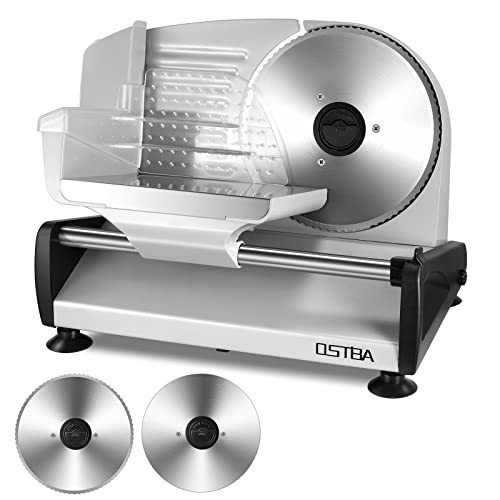
OSTBA Electric Meat Slicer with Two 7.5” Stainless Steel Blades, 200W
Included for 'Best Electric Meat Slicers for Home & Deli Use' because the listing specifies 200W, details this guide uses to compare options.
View on Amazon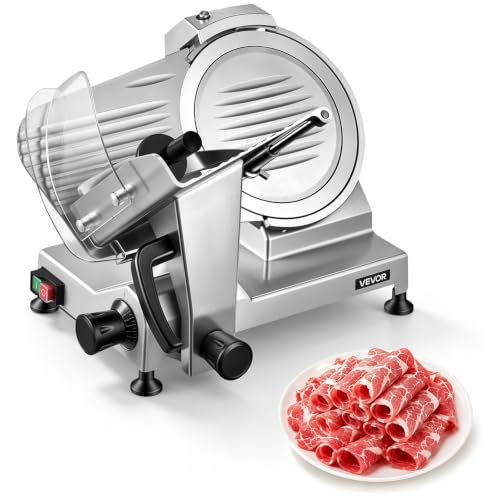
VEVOR Commercial Meat Slicer, 10 inch Electric Food Slicer, 240W Frozen Meat Deli Slicer, Premium Chromium-plated Steel Blade Semi-Auto Meat Slicer For Commercial and Home use
Included for 'Best Electric Meat Slicers for Home & Deli Use' because the listing specifies 10 inch Electric Food Slicer and 240W Frozen Meat Deli Slicer, details this guide uses to compare options.
View on Amazon| Blade Size | Typical Motor Power | Max Food Size (Approx.) | Footprint on Counter | Weight | Best For |
|---|---|---|---|---|---|
| 7.5 inch (190mm) | 120-150 watts | 5.5 x 4 inches | 13 x 10 inches | 8-11 lbs | Occasional deli meat, cheese, vegetables for 1-2 people |
| 9 inch (229mm) | 150-180 watts | 6.5 x 5 inches | 15 x 12 inches | 11-15 lbs | Weekly use, small roasts, bacon, jerky prep |
| 10 inch (254mm) | 180-240 watts | 7.5 x 6 inches | 18 x 14 inches | 16-22 lbs | Frequent use, larger hams, hunting/game processing |
| 12 inch (305mm) | 240-400 watts | 9 x 7.5 inches | 22 x 17 inches | 28-38 lbs | Deli-level volume, Prosciutto legs, bulk freezing |
For most home kitchens, a 9-inch or 10-inch blade hits the sweet spot. It handles a 3-4 lb eye of round or a half ham without you having to trim the meat to fit, yet it still stores in a standard 24-inch deep base cabinet. A 7.5-inch slicer saves space but will force you to quarter larger roasts, which creates uneven slices. A 12-inch slicer is faster and cooler-running, but its carriage and blade guard often won’t fit in cabinets and it needs a permanent spot on the counter or pantry shelf.
Motor Power and Duty Cycle: What Watts Actually Mean
Watts alone do not tell you cutting performance, but they correlate with torque and how long the motor can run before thermal protection kicks in.
- 120-150 watts (compact home models): Usually found on 7.5-inch slicers from brands like Chef’sChoice and Nesco. Adequate for thin deli cuts of cooked ham, turkey breast, and semi-hard cheese. Expect a 5-8 minute continuous run time followed by 15-20 minutes of cooling. Slicing semi-frozen beef for hot pot or jerky will strain these motors quickly.
- 150-200 watts (mid-range home models): Common on 9-inch to 10-inch models from BESWOOD and Cuisinart. Enough torque to slice a chilled roast beef or pork loin without stopping to let the blade catch up. Typical duty cycle is 10 minutes on, 15 minutes off.
- 240+ watts (prosumer/deli models): Found on 10-inch and 12-inch steel-bodied slicers. These use gear-driven or belt-driven transmissions that maintain blade speed under load. They can run 15-30 minutes continuously and slice semi-frozen meat at 1-2mm for bacon or bresaola without bogging down.
Look beyond the watt number to the motor type. A gear-driven 180-watt motor will outperform a belt-driven 200-watt motor when slicing dense foods because it transfers more torque directly to the blade. If you plan to slice raw, partially frozen meat, prioritize gear drive and a ventilated aluminum or cast-iron base that acts as a heat sink.
Slice-Thickness Control and Precision
Almost all electric slicers advertise 0-15mm thickness, but the useful range and adjustment mechanism vary.
What to Check Before You Buy
- Adjustment dial: A numbered dial with detents (often 0-15 or 0-20) is more repeatable than a smooth friction dial. You want to return to exactly 0.8mm for prosciutto or 1.5mm for sandwich ham without guessing.
- Thickness plate stability: On stamped steel models under $150, the plate that holds the meat can flex when you press a large roast against it, changing thickness mid-slice. Cast aluminum plates stay flat and produce uniform slices across the whole roast.
- Zero position: A true zero should fully close the gap between blade and plate for safe cleaning and storage. Some budget models stop at 0.5mm, leaving the blade edge exposed.
- Practical presets for home use: 0.5-1mm for carpaccio and lomo, 1-2mm for deli turkey and roast beef, 3-4mm for bacon, 8-12mm for steaks or thick-cut jerky. If you primarily want shaved meats, confirm the slicer can hold under 1mm without tearing.
Cleaning and Storage Realities in a Home Kitchen
A slicer is only useful if you will actually clean it after each use. This is where home kitchens differ most from delis.
Construction Trade-Offs
| Feature | Stamped Aluminum / Plastic Body | Die-Cast Aluminum / Stainless Hybrid | Full Cast Iron / Anodized Aluminum (Deli-Style) |
|---|---|---|---|
| Weight and Stability | 8-12 lbs, can walk on counter during slicing | 14-22 lbs, stays planted | 28-40 lbs, requires dedicated space |
| Food Contact Parts | Plastic carriage, stainless blade | Aluminum carriage, stainless blade, removable sharpener | Full stainless carriage, blade, ring guard, sharpener |
| Cleaning Time | 5-8 minutes, many parts hand-wash only | 8-12 minutes, carriage and food pusher dishwasher-safe on some models | 12-18 minutes, requires blade removal for deep clean |
| Corrosion Risk | Low, but screws and shafts can rust if soaked | Low-moderate, anodized parts resist acid from tomatoes/citrus | Very low, designed for daily sanitizing |
| Typical Price Range | usually $80–$150 | usually $150–$300 | usually $300–$600 |
Measurements That Matter for Storage
Before buying, measure your intended storage spot. A 9-inch slicer typically needs 15 inches wide x 12 inches deep x 11 inches tall with the carriage installed. A 10-inch deli-style model needs 18-20 inches wide x 15 inches deep x 15 inches tall. Standard upper cabinets are 12 inches deep and 30 inches tall, so most 10-inch and 12-inch slicers will not fit upright inside them. A 36-inch wide pantry shelf or a lower cabinet with a 14-inch door opening is usually required.
Also consider clearance for use. You need at least 24 inches of clear counter depth to slide the carriage fully back without hitting a backsplash, and 18 inches of clearance to the side for the food pusher handle. If your kitchen is a 10×12 ft galley, a compact 7.5-inch folding model that collapses to 13 x 9 inches may be the only option that does not monopolize prep space. Weight matters for moving: lifting a 32-lb deli slicer from a low cabinet to the counter is a two-hand lift and awkward for one person, while an 11-lb compact model can be carried one-handed.
For cleaning, look for these features that save time: a removable carriage that slides off without tools, a blade that can be safely removed with a blade guard lock, and a food pusher with no hollow crevices where meat juice collects. Models with an integrated two-stone sharpener built into the blade housing keep the blade keen without disassembly, but the sharpener itself must be wiped clean after each use or it traps fat.
Decision Matrix: Which Slicer Fits Your Situation
| Your Situation | Recommended Spec | Why |
|---|---|---|
| Small apartment, limited storage, 1-2 people, mostly deli meat and cheese | 7.5-9 inch blade, 120-150 watts, folding/food pusher design | Fits in cabinet, light enough to move, easy 5-minute cleanup encourages use |
| Family of 4, weekly roast for sandwiches, occasional cheese and bread | 9-10 inch blade, 150-200 watts, cast aluminum base | Handles 4-6 lb roasts in one go, stable enough for steady thin slices |
| Meal prep and batch freezing, jerky, bacon from pork belly | 10 inch blade, 180-240 watts, gear drive, 0-15mm range | Torque for semi-frozen meat, precise thin settings for jerky and bacon |
| Serious home charcuterie, hunting, or small market sales | 12 inch blade, 240+ watts, full metal, removable sharpener | Continuous duty cycle, large carriage for whole muscles, commercial sanitation |
| Kids and pets at home, safety priority | Any size with zero-position blade cover, recessed power switch, and blade guard interlock | Prevents accidental contact when stored within reach |
| Renter who moves often | Under 15 lbs, plastic/aluminum hybrid, compact footprint | Light to transport, no permanent installation, fits in moving box without disassembly |
What Wears First and How to Extend Life
The blade stays sharp for a long time if you only slice cooked meats and cheese, but slicing frozen food or hitting bone will dull or nick it quickly. Replace or professionally sharpen the hollow-ground stainless blade when it starts to tear rather than slice. The second part to wear is the carriage slide rod; wiping it dry after washing and applying a food-grade mineral oil keeps the action smooth. Plastic gears on budget models can strip after a year of heavy use on dense meats, which is why prosumer models use metal gears. Store the slicer covered or with a tea towel over the blade to prevent dust and nicks, and always set the thickness dial to zero so the cutting edge is protected by the plate.
Final Picks by Use Case
If you want the best all-around home slicer that balances size and capability, choose a 9-inch or 10-inch cast aluminum model in the 150-200 watt range with a removable carriage and built-in sharpener, usually $150–$300. It fits most kitchens, slices everything from pepperoni to roast turkey thinly and evenly, and cleans in under 12 minutes.
If counter and storage space is your main constraint, a compact 7.5-inch slicer, usually $80–$150, from established brands like Chef’sChoice, Nesco, or Cuisinart is the practical choice. You trade maximum roast size for easy storage and lighter weight.
If you regularly process large or semi-frozen cuts, invest in a 10-inch or 12-inch heavy-duty slicer, usually $300–$600, such as the BESWOOD 10-inch or 12-inch premium series. The added weight, larger footprint, and higher price buy you consistent thin cuts and a motor that will not overheat mid-batch.