Our Top Picks
Best Knee Scooters for Adults
The best knee scooters for adults are usually adjustable four-wheel models with a 300-pound weight limit, a padded knee platform at least 7 inches wide, reliable dual braking, and a folded length short enough to fit through your home’s narrowest doorway.
For most everyday mobility, choose a full-size steerable knee scooter with pneumatic or large solid tires. Compact travel models are easier to carry and store, but their smaller wheels can feel less stable over thresholds, cracked sidewalks, and thick carpet. If you need a scooter mainly indoors, a lightweight folding model may be the better choice.
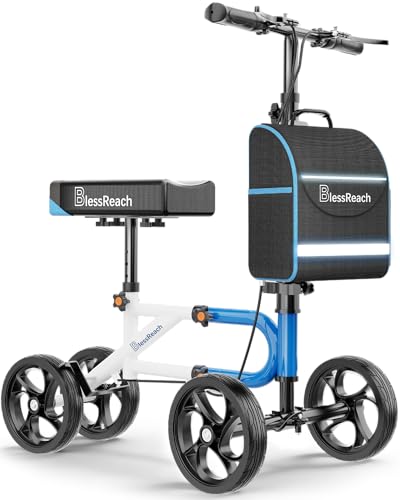
BlessReach Lightweight Knee Scooter for Adults for Foot Injuries,Knee Pad
Included for 'Best Knee Scooters for Adults' because the listing specifies Knee Pad, details this guide uses to compare options.
View on Amazon
BlessReach Foldable All Terrain Knee Scooter for Adults for Foot Injuries
Picked as a relevant option in this category; details come from the product listing.
View on Amazon
HOMLAND Knee Scooter Walker for Adults for Foot Injuries, 8'' Rubber Wheel
Included for 'Best Knee Scooters for Adults' because the listing specifies 8'' Rubber Wheel, details this guide uses to compare options.
View on Amazon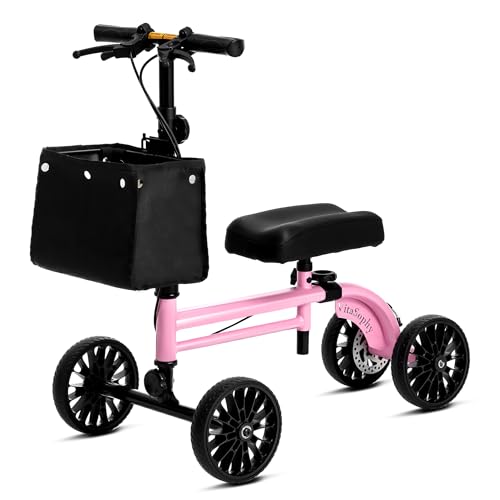
Vitasophy Steerable Knee Scooter Walker for Adults, Pink
Included for 'Best Knee Scooters for Adults' because the listing specifies Pink, details this guide uses to compare options.
View on AmazonQuick picks by situation
| Situation | Best scooter type | Specifications to prioritize | Why it fits |
|---|---|---|---|
| Everyday indoor and outdoor use | Full-size steerable knee scooter | 300 lb capacity, 8–12 inch wheels, dual rear brakes | Best balance of stability, comfort, and maneuverability |
| Small apartment or frequent car travel | Compact folding scooter | Under 25 lb, folded length under 30 inches, 250–300 lb capacity | Fits closets, trunks, and tighter hallways |
| Rough sidewalks and outdoor paths | All-terrain knee scooter | 12–13 inch pneumatic tires, 300 lb or higher capacity | Rolls more smoothly over uneven surfaces |
| Limited balance or fear of tipping | Wide-wheel, low-center-of-gravity model | Wide wheelbase, substantial frame, hand brakes on both sides | Feels steadier during turns and stops |
| Short-term recovery and occasional use | Basic adjustable four-wheel scooter | 250 lb capacity, padded knee platform, tool-free height adjustment | Provides necessary support without paying for specialized features |
What separates the best knee scooters for adults?
Weight limit: leave a useful safety margin
A scooter’s advertised capacity includes the rider, clothing, bags, and anything placed in a basket or attached to the handlebars. If you weigh 220 pounds and regularly carry a 15-pound bag, a 250-pound model leaves little reserve. A 300-pound capacity is a more practical minimum for many adults, while heavy-duty models rated around 350 pounds or more may offer a sturdier frame and wider platform.
Do not choose by capacity alone. A high-capacity scooter can be heavier and harder to lift into a vehicle. For car travel, compare the product’s actual assembled weight as well as its weight limit.
Knee-pad dimensions and alignment
The knee pad should support the shin and kneecap area without forcing your leg toward an edge. As a useful target, look for a pad approximately 7–8 inches wide and 14–16 inches long. A contoured cushion can help keep the leg centered, while a flat pad may provide more room for different leg shapes.
Measure from the floor to the center of your knee while standing naturally in the shoe you expect to wear. The platform should adjust high enough that your recovering leg stays slightly bent rather than hanging down, but it should not raise your hips so much that your lower back twists. A broad height range matters more than a large number of adjustment holes.
Check the distance between the knee pad and handlebars as well. If the handlebars are too close, you may hunch forward; if they are too far away, steering can become tiring. Riders with long legs often benefit from an adjustable steering column and a longer frame.
Turning radius: the overlooked indoor measurement
For an apartment, measure the narrowest route between your bedroom, bathroom, kitchen, and exit. Many full-size scooters need roughly 36–42 inches to make a comfortable U-turn, while compact designs may manage closer to 30–34 inches. A tight turning radius helps around kitchen islands and furniture, but a very short wheelbase can feel twitchier at speed.
In a 10-by-12-foot room, most scooters can cross the space easily, but turning between a bed and dresser may be difficult if the gap is under 36 inches. Allow at least 2 inches of clearance on each side of the scooter, and remember that your shoulders and hands extend beyond the wheels.
Braking and control
Look for hand-operated brakes that engage the rear wheels, with levers that can be reached without changing your grip. Dual braking is preferable because it keeps the scooter more predictable on sloped driveways and smooth floors. A parking lock is useful when transferring on or off the pad.
Test the lever position before buying if you have hand weakness, arthritis, or a wrist injury. Some brakes require more squeezing force than others. Avoid relying on a scooter’s hand brake as a substitute for a ramp or safe support on steep slopes.
Folding size and moving weight
“Folding” does not always mean easy to carry. A full-size scooter may fold at the steering column and still weigh 25–35 pounds. Compact models can be closer to 20–25 pounds, but usually sacrifice wheel size, padding, or frame rigidity.
Before choosing, measure your vehicle’s trunk opening, closet depth, and the narrowest doorway. A folded scooter around 28–32 inches long is easier to store in a hall closet; a model over 36 inches may need to stand in a corner. For lifting, a quick-release basket and removable steering column can make more difference than a one-inch reduction in folded length.
Head-to-head: full-size, compact, or all-terrain?
| Feature | Compact folding | Standard full-size | All-terrain |
|---|---|---|---|
| Typical weight | 20–25 lb | 25–35 lb | 30–40 lb |
| Common weight limit | 250–300 lb | 300–350 lb | 300–400 lb |
| Wheel size | 6–8 inches | 8–12 inches | 12–13 inches |
| Typical turning radius | 30–34 inches | 34–42 inches | 40–48 inches |
| Best surface | Hard indoor floors and smooth pavement | Indoor floors, sidewalks, and driveways | Uneven sidewalks, grass, and packed paths |
| Main compromise | Less forgiving over thresholds | Heavier to lift | Wider, bulkier, and more expensive |
Solid tires are convenient because they do not puncture and require little maintenance. However, they transmit more vibration through the frame. Pneumatic tires cushion cracks and uneven pavement, but they can lose pressure or develop punctures. For mostly indoor use, solid tires are generally adequate. For outdoor recovery, larger pneumatic tires usually provide the more comfortable ride.
Comfort details that matter over several hours
- Padding: A supportive, moderately firm pad is usually better than very soft foam that compresses and lets your knee sink to one side.
- Covering: Breathable fabric or perforated vinyl reduces heat buildup. Smooth vinyl is easier to wipe clean after outdoor use.
- Handlebars: Height adjustment and non-slip grips reduce shoulder and wrist strain.
- Frame width: A wider stance can improve stability but may not pass comfortably through narrow bathroom or closet doors.
- Basket position: A front basket should not block the brake cables or make the steering feel top-heavy. Keep heavy items low or in a backpack.
For back pain, prioritize a tall enough steering column, a knee pad that keeps your recovering leg centered, and handlebars that allow a mostly upright posture. Leaning heavily over the front wheel for long periods can fatigue your lower back even when the knee pad itself is comfortable.
Terrain and home-fit checklist
Measure these areas before ordering:
- Your narrowest doorway; 32 inches is common, but trim and furniture can reduce usable clearance.
- The gap between furniture; aim for at least 36 inches for comfortable steering.
- Door thresholds; wheels around 10 inches handle small transitions better than 6-inch wheels.
- Ramps and slopes; choose a route with a handrail or assistance rather than depending on the scooter brake alone.
- Vehicle storage space; check both the folded dimensions and the trunk or hatch opening.
Most knee scooters are intended for firm, reasonably level surfaces. Grass, gravel, wet leaves, and steep cross-slopes reduce traction and steering control. An all-terrain model improves rolling comfort but does not make every outdoor surface safe.
Price and durability expectations
Basic adult knee scooters usually cost about $100–$200, standard adjustable models commonly fall around $200–$350, and larger all-terrain or heavy-duty models often range from $300–$600. Replacement tires, brake cables, grips, and knee-pad covers are worth checking before purchase because these are the parts most likely to wear first.
Assembly typically involves attaching the handlebars, installing the basket, and setting the knee-pad and steering heights. Expect 15–30 minutes for a simple model, though some designs require more adjustment. Tighten the fasteners after the first few uses, inspect the brake cables regularly, and keep tire pressure within the manufacturer’s stated range.
Final buying recommendation
For most adults recovering from a foot, ankle, or lower-leg injury, choose a standard four-wheel scooter with a 300-pound capacity, an approximately 7–8 by 14–16-inch padded knee platform, dual rear brakes, adjustable handlebars, and wheels at least 8 inches in diameter. Choose a compact folding model when storage and lifting are the main concerns, and choose an all-terrain model when cracked sidewalks and outdoor paths are unavoidable. The right choice is the one that fits your doorway and turning space while keeping your knee aligned, your back upright, and your stopping control within easy reach.