Our Top Picks
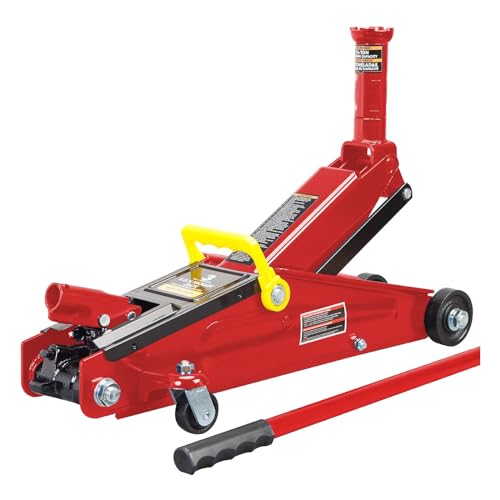 BIG RED Hydraulic Trolley Service/Floor Jack with ExtraStandard Pump With Extra Saddle0 x 0 x 0 Inches36 poundsCheck on Amazon
Best Floor Jacks for Trucks: Lift Height & Capacity
For most stock trucks, a 3-ton floor jack with a low entry height and roughly 18–21 inches of maximum lift is the safer all-around choice; a 2-ton jack is suitable only when its rated capacity comfortably exceeds the truck’s axle load and its reach matches the lift point. For lifted trucks, check maximum height first: many ordinary floor jacks cannot reach the frame or axle safely, even if their capacity is ample.
Capacity, minimum saddle height, maximum lift, and the jack’s physical footprint all matter. A jack that fits beneath a low-profile car may not roll under a truck, while a high-lift model may be too long to store in a crowded garage. Use a floor jack only to raise a vehicle, then support it with correctly rated jack stands on a firm, level surface.
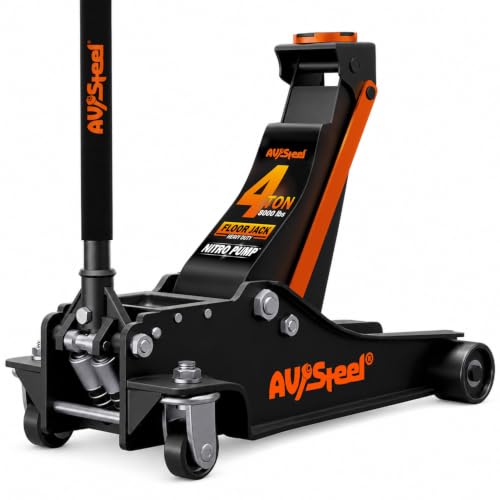
AV Steel Heavy-Duty Floor Jack 4 Ton (8,000 lbs), Lift Range 4-1/4" to 19-3/4" for Cars, Vans, SUVs & Pickup Trucks, Hydraulic Steel Floor Jack with Dual Piston Pump - Not for Sports Cars or RVs
Included for 'Best Floor Jacks for Trucks: Lift Height & Capacity' because the listing specifies 000 lbs) and Lift Range 4-1/4" to 19-3/4" for Cars, details this guide uses to compare options.
View on AmazonBIG RED Hydraulic Trolley Service/Floor Jack with Extra Saddle (Fits: SUVs and Extended Height Trucks): 3 Ton (6,000 lb) Capacity, Red, T83006
Included for 'Best Floor Jacks for Trucks: Lift Height & Capacity' because the listing specifies 000 lb) Capacity and Red, details this guide uses to compare options.
View on Amazon
AV Steel 3 Ton Floor Jack (6000 lbs), Single Piston Steel Hydraulic Floor Jack, Lift Range 5.5" to 18.5", Fits Cars, SUVs & Standard Trucks - Not for Lifted Vehicles or Heavy-Duty Trucks
Included for 'Best Floor Jacks for Trucks: Lift Height & Capacity' because the listing specifies Single Piston Steel Hydraulic Floor Jack and Lift Range 5.5" to 18.5", details this guide uses to compare options.
View on Amazon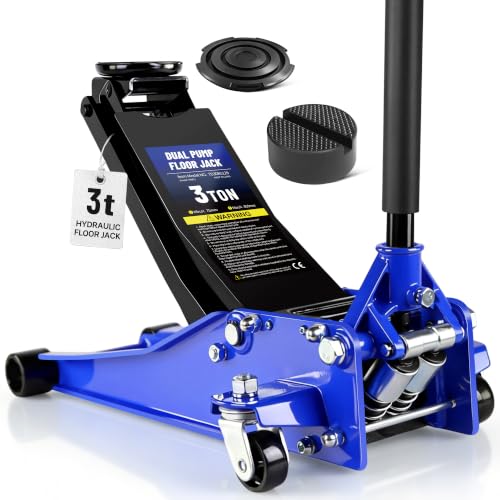
3 Ton Low Profile Floor Jack Heavy Duty Hydraulic Car Truck Jack
Picked as a relevant option in this category; details come from the product listing.
View on AmazonStart with capacity—not the truck’s advertised curb weight
A 2-ton jack is rated for 4,000 pounds; a 3-ton jack is rated for 6,000 pounds. Those numbers do not mean the jack should support a vehicle of the same total weight while lifting one end. The jack carries only part of the vehicle’s weight, but the share varies by axle, load, lifting point, and accessories. A loaded pickup, heavy front-end accessories, or cargo can change the calculation.
Check the truck’s door-jamb information or owner’s manual for weight and approved lifting points. If you know the axle weight, choose a jack whose capacity exceeds the load it will actually support, with margin. If you do not know the axle load, a 3-ton jack is a more prudent general-purpose starting point than a 2-ton model. Never use capacity as a substitute for a suitable lift point or jack stands.
Compare capacity and lift range
| Jack type | Rated capacity | Typical minimum height | Typical maximum height | Best fit |
|---|---|---|---|---|
| Compact 2-ton floor jack | 4,000 lb | About 5–6 in | About 13–16 in | Stock trucks with accessible lift points and a verified load within rating |
| Standard 3-ton floor jack | 6,000 lb | About 5–6.5 in | About 18–21 in | Most stock pickups and SUVs; better capacity and reach for general garage use |
| High-lift floor jack | Commonly 3 tons or more | Often about 6–8 in | About 23–28 in or more | Lifted trucks, provided the jack fits beneath the vehicle and suits the lift point |
These are common market ranges, not specifications for every jack. Always confirm the exact model’s manual: saddle height, maximum lift, and capacity can differ substantially within the same category. Maximum lift is also not the same as usable tire-changing height. Suspension droop, tire size, and the location of the lift point determine how high the frame or axle needs to rise before a wheel clears the ground.
Choose by truck and garage situation
| Your situation | What to look for | Likely choice |
|---|---|---|
| Stock pickup, occasional tire or brake work | At least 3-ton capacity, minimum height below the truck’s lift point, and enough maximum height for the planned job | Standard 3-ton jack |
| Small or low-clearance garage approach | Measure clearance at the exact approved lift point, including any obstruction along the jack’s rolling path | Low-profile 3-ton jack if its maximum height is sufficient |
| Lifted pickup | Maximum saddle height that reaches the approved point, plus a handle and body that can operate under the truck | High-lift jack; verify dimensions before buying |
| Heavy-duty or frequently loaded truck | Axle-load information, an appropriate capacity margin, and stands rated for the supported load | Capacity selected from actual load—not engine size or appearance |
| Tight garage with limited storage | Jack length, width, handle removal or storage, and turning room—not just the lifting range | Compact model that still meets the truck’s capacity and height needs |
Measure chassis clearance before buying
Measure vertically from the floor to the truck’s intended, manual-approved lift point—not just to the lowest visible body panel. A jack’s minimum saddle height must be lower than that measurement, with room to roll and position the saddle. Also check the entire approach: a low frame may be reachable only after the jack passes beneath a bumper, side step, skid plate, or suspension component.
For a lifted truck, measure the distance from the floor to the approved lift point and compare it with the jack’s maximum saddle height. Then account for how much lift is needed to place a stand or remove a wheel. A jack near its limit may not give enough useful travel, so allow margin. If no floor jack can both fit underneath and reach the lift point, use a suitable alternative setup specified for the vehicle rather than stacking blocks or improvised extensions.
Low-profile, standard, or high-lift?
Low-profile 3-ton
Choose this when the truck’s lift point sits relatively low or the jack must pass beneath a low obstruction. The trade-off is that a low entry height does not guarantee adequate maximum lift. Check both ends of the range before choosing.
Standard 3-ton
This is the sensible starting point for many stock trucks. It usually offers more lift than compact 2-ton designs while remaining easier to store than long-reach or high-lift models. Confirm that its minimum height clears the truck’s access path.
High-lift jack
Consider one when a lifted chassis needs more saddle height. The taller range can mean a larger, heavier jack that occupies more floor space and may be difficult to maneuver in a narrow garage. A high-lift jack is not automatically the right choice for a stock truck: it still needs to fit beneath the vehicle and must be used at an approved lifting point.
Garage fit, moving, and upkeep
Floor jacks are heavy tools, and a 3-ton model can be awkward to move even when its listed weight is manageable. Before purchase, compare the jack’s overall length and width with the open floor area and storage location. Leave enough clearance to position it and pump the handle without hitting a wall, vehicle, or cabinet. For a garage with limited room, the jack’s footprint and maneuverability can matter as much as its maximum height.
Keep the jack on a clean, level surface and follow the manufacturer’s instructions for hydraulic fluid, inspection, and storage. Check for leaks, damaged wheels, a slipping saddle, or irregular lowering before use. Hydraulic seals and wheels are common wear points; a jack that will not hold pressure or lower smoothly should be taken out of service until repaired or replaced.
Safe lifting basics
- Park on firm, level ground, apply the parking brake, and secure wheels that remain on the ground.
- Use only the lifting points specified by the truck manufacturer.
- Raise the vehicle with the floor jack, then lower it onto correctly rated jack stands placed at approved support points.
- Never work beneath a vehicle supported only by a floor jack, and never exceed the jack’s rated capacity.
Bottom line: For a stock truck, start by comparing 3-ton models and verify both minimum and maximum saddle height against the approved lift point. Choose a 2-ton jack only when the truck’s supported axle load is known to be within its rating. For a lifted truck, prioritize usable maximum height and access under the chassis, then make sure the jack’s size and weight are practical for your garage.