Our Top Picks
 VEVOR Jack Stands 6t/13000lbs Capacity Car Jack Stands10.8 x 9.3 x 15 in16.9 x 11.8 x 9.8 inches18.9 PoundsCheck on Amazon
The best heavy duty jack stands for trucks and SUVs are usually 6-ton stands with a broad welded-steel base and a positive pin-lock adjustment; choose 3-ton models for lighter vehicles and 12-ton stands only when their extra height and capacity match a real need.
Jack stands are safety equipment, not lifting equipment. A floor jack raises the vehicle, while stands support it after the lifting points have been reached. Always use stands on a firm, level surface, place them at the vehicle manufacturer’s approved support points, chock the wheels, and lower the vehicle gently onto the stands. Never work beneath a vehicle supported only by a jack.
VEVOR Jack Stands 6t/13000lbs Capacity Car Jack Stands Double Locking 2 pcs
Picked as a relevant option in this category; details come from the product listing.
View on Amazon
SUNEX TOOLS 1522A 22-Ton Jack Stands, Pair
Included for 'Best Heavy Duty Jack Stands: Capacity & Height Guide' because the listing specifies Pair, details this guide uses to compare options.
View on Amazon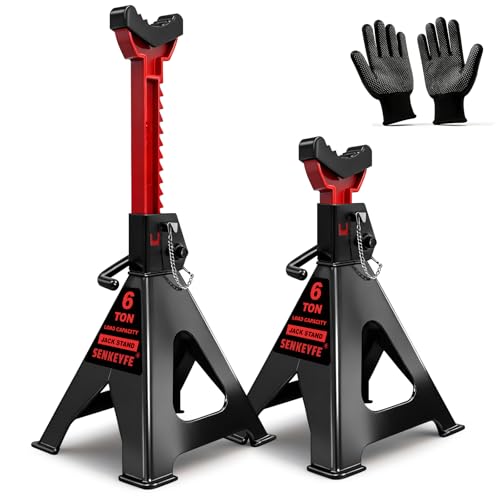
SENKEYFE 6 Ton (13,200 LBs) Jack Stands with Double Pin Locking,Rubber Cover and Large Foot Base,15"-23" Adjustable Height,Heavy Duty Car Jack Stands,Lifting Bus,RV,SUV,MPV,Pickup Truck,ATV/UTV,1 Pair
Included for 'Best Heavy Duty Jack Stands: Capacity & Height Guide' because the listing specifies 200 LBs) Jack Stands with Double Pin Locking and Rubber Cover and Large Foot Base, details this guide uses to compare options.
View on Amazon
Amazon Basics Steel Jack Auto Stands, 3 Ton (2.7 metric Ton) Capacity, Easy to Use, Adjustable Height, 6,000 lb, 1 Pair, Black and Red(For Sedans and Urban SUVs)
Included for 'Best Heavy Duty Jack Stands: Capacity & Height Guide' because the listing specifies 3 Ton (2.7 metric Ton) Capacity and Easy to Use, details this guide uses to compare options.
View on AmazonQuick picks by vehicle and working situation
| Situation | Most suitable stand | Why | Watch for |
|---|---|---|---|
| Passenger car or crossover | 3-ton pair | Usually offers adequate capacity without excessive size or weight | Check that the minimum height fits beneath the vehicle |
| Half-ton pickup or large SUV | 6-ton pair | Good balance of capacity, height, stability and portability | Confirm the rating is per stand, not only for the pair |
| Full-size truck with a high frame | 6-ton high-height pair | Often reaches the frame without stacking blocks or other unsafe extensions | Measure the support point before buying |
| Heavy-duty pickup, commercial van or frequent repair work | 12-ton pair | Maximum margin and a large support footprint | May be too tall, wide and heavy for ordinary home garages |
| Limited storage or occasional use | Compact 3-ton or 6-ton ratchet type | Easier to carry and store | Inspect the ratchet, pawl and welds before every use |
How 3-ton, 6-ton and 12-ton ratings differ
A “ton” rating is a capacity designation, but the label can be confusing. Some manufacturers state the capacity of one stand, while others prominently describe the combined capacity of a pair. Read the complete specification and use the lower interpretation if the wording is unclear. For a pair of stands, the load must also be distributed properly; one stand should not be expected to carry the vehicle by itself.
3-ton jack stands
Three-ton stands are commonly suitable for cars, crossovers and lighter SUVs. Their smaller bases are easier to position on a residential garage floor, and they generally weigh less than higher-capacity models. They can work for some pickups, but only after checking the vehicle’s actual weight, the manufacturer’s support-point instructions and the stand’s per-unit rating.
The limitation is not only capacity. Many 3-ton stands have a shorter maximum height, which may leave a truck’s frame too close to the floor for comfortable access. A compact stand can also provide less resistance to tipping if the floor is uneven or the support point is far from the stand’s center.
6-ton jack stands
Six-ton stands are the practical middle choice for many truck and SUV owners. They typically have a wider base, thicker steel and a taller adjustment range than compact stands, while remaining manageable for one person. For a half-ton pickup, large SUV or regular underbody maintenance, this rating often supplies useful capacity without the awkward size of a commercial stand.
Do not treat “6-ton” as permission to lift any 12,000-pound vehicle. The stand must still match the vehicle’s loaded weight, the number of stands being used and the manufacturer’s instructions. Cargo, accessories and towing equipment can materially change the load.
12-ton jack stands
Twelve-ton stands are intended for very heavy vehicles, high-clearance work and demanding shop use. Their broad bases and heavy adjustment columns can feel more planted, but they are not automatically safer in every garage. A stand that is too tall may not fit under the vehicle when the tires are on the ground, and a large base can interfere with suspension components or prevent correct placement at the frame.
They are also difficult to move. A single heavy-duty stand may be awkward to lift over a threshold or position beneath a truck without help. Buy this capacity for a measured requirement, not simply because the number is larger.
Height range matters more than the capacity number
Before choosing the best heavy duty jack stands, measure three points: the clearance beneath the approved support point with the vehicle parked normally, the height of that point after lifting, and the maximum height needed for the work. Include the saddle height and adjustment increments in the comparison.
| Stand type | Typical minimum height | Typical maximum height | Typical base width | Best fit |
|---|---|---|---|---|
| Compact 3-ton | 10–12 inches | 16–19 inches | 7–9 inches | Cars and crossovers |
| Tall 3-ton | 12–15 inches | 19–24 inches | 8–10 inches | Higher cars and light SUVs |
| 6-ton heavy-duty | 15–17 inches | 23–29 inches | 10–12 inches | Pickups and large SUVs |
| 12-ton commercial | 19–22 inches | 29–35 inches | 12–15 inches | High-clearance and very heavy vehicles |
These are common market ranges rather than a specification for every model. A 10-by-12-foot garage bay can have enough floor area for a vehicle but still feel crowded with 12-ton stands, a floor jack and tools. Measure the stand’s fully opened footprint and leave room to walk around it without bumping the vehicle.
Base width and saddle design: the stability details
A broad, three-sided or four-sided base spreads force over more floor area and is generally preferable to a narrow footprint. Look for legs that sit flat, fully welded joints, evenly formed steel and a saddle that contacts the vehicle’s approved support area without slipping. A wide base does not correct a cracked floor, loose gravel or an incorrectly positioned stand.
Check the saddle shape as well. A flat saddle may suit a solid frame rail, while a notched saddle may better locate on a specific seam or axle housing. Never place a stand under thin body sheet metal, plastic components, steering parts or an unsupported suspension arm unless the vehicle instructions specifically allow it.
Steel ratchet versus pin-lock adjustment
| Construction | Advantages | Trade-offs | Best use |
|---|---|---|---|
| Ratchet or tooth-lock steel stand | Fast height adjustment; convenient for repeated setup; many intermediate positions | Teeth and pawl can wear, bend or fail to engage fully if dirty or damaged | Routine home maintenance when the locking mechanism is easy to inspect |
| Pin-lock steel stand | Visible positive lock; simple design; strong resistance to gradual lowering when correctly pinned | Fewer height positions; slower adjustment; pin can be lost or damaged | Heavy trucks, long-duration support and users prioritizing a mechanical through-pin |
| Welded fixed-height support | Few moving parts; durable once the correct height is selected | Limited flexibility; may not fit different vehicles | Dedicated work bays with predictable vehicle height |
For durability, the adjustment system matters as much as the steel thickness. With a ratchet model, inspect the pawl, teeth, handle pivot and retaining hardware. With a pin-lock model, inspect the pin for bending and ensure it passes completely through the column and outer body. Surface rust can be cleaned and treated, but deep pitting, bent legs, cracked welds or distorted teeth are reasons to replace the stand.
Buying checklist for trucks and SUVs
- Confirm the capacity is stated per stand and exceeds the expected supported load.
- Measure the lowest and highest support-point heights before selecting a range.
- Choose a base wide enough for your floor and vehicle access, commonly about 10–12 inches for a 6-ton stand.
- Prefer a clearly visible lock, retained hardware and complete welds over decorative paint or a large capacity label.
- Check the saddle width and shape against the truck’s frame or approved support location.
- Buy a matched pair, and use additional stands only as directed by the vehicle and equipment manufacturers.
- Plan storage: heavy 6-ton and 12-ton stands can weigh several dozen pounds per pair and may not fit neatly on a shallow shelf.
- Keep stands dry, inspect them before each use and retire any stand that has been overloaded, dropped or exposed to severe corrosion.
Final recommendation
For most pickup and SUV owners, the best heavy duty jack stands are a matched pair of 6-ton steel stands with a broad base, a height range roughly around 15–29 inches and either a robust pin lock or a well-protected ratchet mechanism. Choose 3-ton stands when compact size and lower clearance are the priorities. Choose 12-ton stands only after confirming that their minimum height, footprint and weight suit both the vehicle and the workspace. Capacity, height and locking quality must all fit the job; the biggest rating alone is not the best choice.