Our Top Picks
 42 pcs Brazing Rods AWS BCuP-5 15% Silver10 x 0.13 x 0.05 inches9.84 x 0.13 x 0.05 inchesCheck on Amazon
 12 pcs Brazing Rods AWS BCuP-5 15% Silver10 x 0.13 x 0.05 inches9.84 x 0.13 x 0.05 inchesCheck on Amazon
The best brazing rod for refrigeration is usually a phosphorus-copper rod for clean copper-to-copper tubing, while copper-to-steel joints need a cadmium-free silver alloy with flux; rod diameter should match the tube size and joint clearance rather than simply being as large as possible.
Quick picks by refrigeration joint
| Situation | Recommended alloy | Typical melting range | Useful rod diameter | Why choose it |
|---|---|---|---|---|
| Copper tube to copper fitting | BCuP-2, approximately 7% phosphorus | About 1,310–1,450°F (710–788°C) | 1/16 in for small tubing; 3/32 in for common service work | Good capillary flow and generally self-fluxing on copper-to-copper joints |
| Copper tube to copper tube where easier flow is wanted | BCuP-5, approximately 15% silver | About 1,190–1,500°F (645–815°C) | 1/16 or 3/32 in | Lower working temperature and improved flow, at a higher material cost |
| Copper to steel, brass, or a compressor connection | Cadmium-free silver brazing alloy, commonly 30–45% silver | Roughly 1,150–1,370°F (620–745°C), depending on alloy | 1/16 in for small joints; 3/32 in for heavier fittings | Wets ferrous metals; use the manufacturer-specified flux |
| Large copper pipe or broad fitting | BCuP or silver alloy selected for the base metals | Depends on the alloy | 3/32 or 1/8 in | Deposits metal faster, but requires more heat control |
Phosphorus versus silver: the important trade-off
Phosphorus-copper rods for copper-to-copper
Phosphorus-copper alloys are the practical first choice for many refrigeration copper joints. The phosphorus acts as a reducing agent on copper, so a separate flux is often unnecessary when both parts are clean copper. These alloys flow into a properly fitted joint and are widely used for copper tubing, couplings, elbows, and branch connections.

15pcs Brazing Rods AWS BCuP-5 15% Silver Solder Phos Copper Brazing Alloy Flat Welding Rods 0.050"x1/8"x10" for HVAC, Refrigeration, and Industrial Applications
Included for 'Best Brazing Rod for Refrigeration: Alloy & Size Guide' because the listing specifies Refrigeration and and Industrial Applications, details this guide uses to compare options.
View on Amazon42 pcs Brazing Rods AWS BCuP-5 15% Silver Solder Phos Copper Brazing Alloy Flat Welding Rods 0.050"x1/8"x10" for HVAC, Refrigeration, and Industrial Applications
Included for 'Best Brazing Rod for Refrigeration: Alloy & Size Guide' because the listing specifies Refrigeration and and Industrial Applications, details this guide uses to compare options.
View on Amazon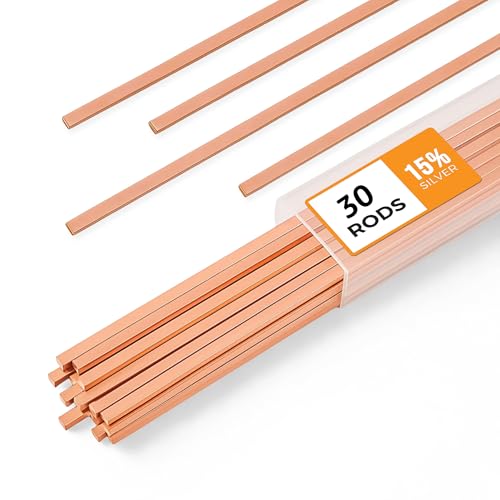
30pcs Brazing Rods AWS BCuP-5 15% Silver Solder Phos Copper Brazing Alloy Flat Welding Rods 0.050"x1/8"x10" for HVAC, Refrigeration, and Industrial Applications
Included for 'Best Brazing Rod for Refrigeration: Alloy & Size Guide' because the listing specifies Refrigeration and and Industrial Applications, details this guide uses to compare options.
View on Amazon12 pcs Brazing Rods AWS BCuP-5 15% Silver Solder Phos Copper Brazing Alloy Flat Welding Rods 0.050"x1/8"x10" for HVAC, Refrigeration, and Industrial Applications
Included for 'Best Brazing Rod for Refrigeration: Alloy & Size Guide' because the listing specifies Refrigeration and and Industrial Applications, details this guide uses to compare options.
View on AmazonBCuP-2 is a useful general-purpose specification. A higher-phosphorus or silver-bearing BCuP alloy may flow at a lower temperature and produce a more forgiving fillet, but the exact liquidus and working temperature depend on the product. Always follow the rod manufacturer’s data rather than treating the alloy name as an exact torch setting.
The main limitation is compatibility. Phosphorus-copper rods are not the right general choice for copper-to-steel, copper-to-iron, or many copper-to-nickel joints. Phosphorus can form brittle compounds with iron and may create a weak or cracked connection. It also does not replace the need for suitable flux on non-copper metals.
Silver-bearing rods for lower heat and mixed metals
Silver brazing alloys are preferred when one side of the joint is steel, stainless steel, brass, or another metal that phosphorus-copper does not reliably wet. A cadmium-free alloy in the 30–45% silver range is a common balance between flow, joint strength, working temperature, and cost. Higher-silver formulations generally flow more readily at lower temperatures but are substantially more expensive.
Silver alloys require the correct flux unless the product is specifically labeled as flux-cored or self-fluxing for the metals involved. Flux must be compatible with refrigeration service and removed after brazing where the manufacturer requires it. Avoid cadmium-bearing rods: heating cadmium can create hazardous fumes, and cadmium is not an appropriate choice for routine refrigeration repair.
Choose the rod diameter from the tubing and joint
A large rod does not make a leak-resistant joint. Brazing filler metal should be drawn through the narrow, uniform clearance by capillary action. The surfaces need to be clean, round, and accurately fitted; the rod only supplies enough alloy to fill that space.
| Approximate outside diameter of copper tube | Starting rod diameter | Practical use |
|---|---|---|
| 1/4–3/8 in | 1/16 in | Small capillary and liquid lines; helps avoid overheating |
| 1/2–5/8 in | 1/16 or 3/32 in | Use 3/32 in when the fitting is substantial or the joint is long |
| 3/4–1 in | 3/32 in | Good general size for larger service connections |
| Over 1 in or heavy steel fittings | 3/32 or 1/8 in | Faster deposition, but only with a torch that can heat the assembly evenly |
For many copper refrigeration joints, aim for a close, even clearance of approximately 0.001–0.003 in at brazing temperature, subject to the fitting and alloy manufacturer’s instructions. Copper expands as it heats, so a joint that appears tight when cold may develop the intended capillary space during heating. A gap that is too wide can consume excessive filler and may leave voids; a joint with no clearance may prevent the alloy from entering at all.
Which rod is best for each buying situation?
- Mostly copper tubing and copper fittings: Choose BCuP-2 or a comparable phosphorus-copper rod. Buy 1/16 in for small lines and 3/32 in for general service work.
- Copper-to-copper with limited heat access: Choose a silver-bearing phosphorus-copper alloy with a lower working range, provided its specification suits the tubing and pressure system.
- Copper-to-steel compressor stub or service fitting: Choose a cadmium-free silver brazing alloy and the matching flux. Do not substitute ordinary phosphorus-copper rod.
- Frequent mixed-metal repairs: A 30–45% silver alloy is more versatile, though its higher price is difficult to justify if every joint is copper-to-copper.
- Small tubing and delicate components: Use 1/16 in rod. It gives finer control and reduces the temptation to overheat a narrow tube.
- Large fittings or long joints: Use 3/32 in, or 1/8 in only when the torch can bring the complete joint to temperature without prolonged heating.
How alloy choice affects leak resistance
A leak-resistant braze depends more on joint preparation and heat control than on silver percentage alone. Cut tubing squarely, remove the internal and external burrs, and clean both mating surfaces to bright metal. Keep abrasive dust and oil out of the tubing. The fitting should bottom correctly and remain stable while heating.
Heat the fitting and tube broadly and evenly, not just the rod. Touch the rod to the joint only when the base metal is hot enough to melt it. If the filler balls up, the joint is too cold or contaminated. If the copper becomes excessively oxidized, soft, or visibly damaged, the torch is too hot or concentrated in one place.
For refrigeration systems, maintain a gentle flow of dry nitrogen through the tubing while brazing, using the pressure recommended for the equipment and procedure. This limits internal oxide scale that can later circulate through valves, strainers, capillary tubes, or expansion devices. Do not braze a charged system: recover refrigerant, isolate the section, and verify that no flammable gas or pressure remains.
Common buying mistakes
- Choosing by silver percentage alone: Base-metal compatibility and working temperature matter more than a large silver number.
- Using phosphorus-copper on steel: This can produce a brittle, unreliable joint.
- Buying oversized rod for a small tube: A 1/8 in rod can add filler too quickly and encourage overheating.
- Ignoring flux: Silver alloys generally need the specified flux on steel and other non-copper metals.
- Filling a visibly wide gap with extra rod: Excess filler does not compensate for poor fit and may conceal a void.
- Using plumbing solder instead of brazing filler: Soft solder operates at much lower temperatures and is not an interchangeable choice for many refrigeration pressure joints.
Bottom line
For standard copper-to-copper refrigeration work, buy a quality BCuP-2-type rod in 1/16 or 3/32 in. For copper-to-steel or other mixed-metal joints, select a cadmium-free silver brazing alloy with its specified flux. Match the diameter to the tube size, keep the clearance narrow and uniform, purge with nitrogen, and prioritize correct cleaning and heating over maximum silver content.