Key takeaways
- Deck rigidity: Press the center of the surface with your thumb. Any give telegraphs straight into your pen line. Hardboard, bamboo, or thick MDF holds up for handwriting; thin plastic shells do not.
- Storage silhouette: Measure your actual stash spot before you buy. Folding-leg models tuck into a 2-inch gap beside a dresser, while cushion-bottom desks need shelf depth or a wall hook and will not lie flat under a bed frame.
- Writing height and tilt: A slight incline of 10 to 15 degrees eases neck strain for reading, but handwriting wants near-flat. Adjustable-leg desks let you switch between the two; fixed cushion models are flat only.
- Surface width versus lap width: Anything past 23 inches gives you room for a notebook plus a reference page, but it also means the desk overhangs your thighs and needs a stable underside to stay put on a couch.
- Edge containment: Pen trays, ledges, side pockets, and cup cutouts stop the small-item avalanche that plagues small-space work. Without them, your desk surface becomes the only staging area in the room.
What's inside
Handwriting demands something a laptop never does: a surface that stays level while you press down on it. Most people shopping for a lap desk are actually solving a storage problem first — there is no room for a proper desk in a 400-square-foot studio, a shared bedroom, or a dorm with one shallow closet — and only later discover that the cushioned tray they bought flexes under a pen nib, tilts toward their knee, or sits too low to keep a wrist neutral through a journaling session. The result is cramped handwriting and a sore shoulder within twenty minutes.
This guide approaches lap desks the way I approach any piece of furniture in a tight floor plan: it has to earn its footprint. Below are the models that genuinely support writing by hand — firm decks, honest dimensions, and shapes that slide behind a nightstand or hang on a hook when the workday ends. I’ve flagged which ones fold flat, which ones store upright in a gap you already have, and which ones work double duty for a laptop so you only need to own one.
As an Amazon Associate we earn from qualifying purchases.




How to Choose a Lap Desk For Writing (2026)
- Deck rigidity: Press the center of the surface with your thumb. Any give telegraphs straight into your pen line. Hardboard, bamboo, or thick MDF holds up for handwriting; thin plastic shells do not.
- Storage silhouette: Measure your actual stash spot before you buy. Folding-leg models tuck into a 2-inch gap beside a dresser, while cushion-bottom desks need shelf depth or a wall hook and will not lie flat under a bed frame.
- Writing height and tilt: A slight incline of 10 to 15 degrees eases neck strain for reading, but handwriting wants near-flat. Adjustable-leg desks let you switch between the two; fixed cushion models are flat only.
- Surface width versus lap width: Anything past 23 inches gives you room for a notebook plus a reference page, but it also means the desk overhangs your thighs and needs a stable underside to stay put on a couch.
- Edge containment: Pen trays, ledges, side pockets, and cup cutouts stop the small-item avalanche that plagues small-space work. Without them, your desk surface becomes the only staging area in the room.
The Best Lap Desks for Writing (2026) Reviewed
LAPGEAR Home Office Pro
The wide cushioned wrist rest is the reason this one works for long writing sessions — it keeps your forearm supported instead of resting on a hard edge, and the dual-bolster microbead base keeps the deck level rather than rolling toward one knee. It stores upright behind a door or on a closet shelf, and the carry handle makes it easy to move between bed and sofa.
BUYIFY 23″ Foldable Lap Desk
At 23 inches with folding legs and no assembly, this is my default recommendation for renters and dorm residents: it collapses to a flat panel that slides between a mattress and wall or behind a bookcase. The tablet slot and cup holder keep your writing surface clear, which matters when the desk is also your only table.
OPTIXCELL Wooden Lap Desk Pillow
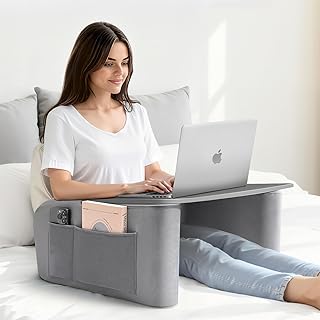
The 23.7-inch wooden deck and 44-pound capacity give you the firmest writing platform in this group, and the built-in arm rests genuinely reduce shoulder fatigue when you’re handwriting for an hour. Side pockets swallow pens, sticky notes, and a phone, so a single piece of furniture handles both work and small-item storage.
LAPGEAR The Original
Still the simplest answer for people who mainly write: a flat 17-inch-capable deck, a microbead cushion that conforms to your legs, and a built-in pencil tray so your pen never rolls onto the floor. It’s the lightest and cheapest way to add a stable writing surface to a room with nowhere left to put one.
HUANUO Lap Desk
The wood-grain deck stays firm under pen pressure, and the integrated mouse pad, wrist pad, tablet slot, and pen holder make it the best pick if your writing and computer work happen in the same sitting. Its slim profile stands upright in a narrow gap or hangs from a sturdy hook.
Frequently Asked Questions
Are cushioned lap desks stable enough for handwriting?
Yes, provided the top deck is rigid and the cushion is dense microbead rather than loose foam. Dual-bolster designs resist side-to-side rocking better than a single flat pad.
Which type stores best in a small apartment?
Folding-leg desks win on storage because they compress to a flat panel roughly 1 to 2 inches thick. Cushion-bottom models are more comfortable but need shelf or hook space.
Do I need a tilting surface?
Only if you also read or type on it. Handwriting is most comfortable within a few degrees of flat, so a fixed-flat desk is fine if writing is your primary use.
What surface size should I look for?
Around 20 inches handles a single notebook comfortably. Step up to 23 inches or wider if you spread out reference material or work with a laptop alongside your notes.
Final Thoughts
For most small-space writers, the BUYIFY 23″ Foldable Lap Desk offers the best balance of rigid surface and near-invisible storage footprint. Choose the OPTIXCELL Wooden Lap Desk Pillow if you want the firmest deck with built-in arm support, or the LAPGEAR Home Office Pro if a cushioned wrist rest and easy portability matter more than folding flat.