Key takeaways
- Measure your recline arc, not your floor space: A 135-degree tilt pushes the headrest roughly 12 to 18 inches behind the upright position. Tape that distance on the floor before buying, and leave a few inches of buffer so you’re not tapping the baseboard every time you lean back.
- Flip-up arms are a storage feature: Armrests that fold vertically let the chair tuck fully beneath a desk or table, reclaiming aisle space when you’re not seated. In rooms where the chair shares a path with a doorway or closet, this single hinge does more for livability than any other adjustment.
- Prefer a footrest that disappears: Retractable footrests slide back under the seat pan and add nothing to the standing footprint. Fixed or permanently extended versions become a shin hazard in narrow rooms, so verify the rest actually stows flush.
- Match the base diameter to your clearance: Big-and-tall chairs typically ride on a wider five-star base for stability, which eats floor area and limits how close you can park against a wall. If your desk sits in an alcove, a standard-width base with a 300 to 400 lb rating is usually the smarter trade.
- Choose upholstery for the room’s other jobs: Mesh backs read visually lighter and keep sightlines open in cramped spaces, while leather and velvet look intentional if the chair doubles as guest seating or lives in a shared living area.
What's inside
A reclining office chair asks something unusual of a small room: it needs to occupy one footprint while you’re working and a noticeably larger one the moment you tip back. Most buyers discover this after delivery, when the headrest meets the wall at 120 degrees and the footrest lands squarely in the walkway. In a 10×10 bedroom-turned-office or a corner carved out of a living room, that hidden second footprint matters more than the seat width printed on the listing.
This guide looks at reclining chairs through a spatial lens: how far each one travels backward, whether the arms fold flat to let the chair slide under a desk, and how a retractable footrest changes clearance in a tight room. I’ve focused on models that recline meaningfully without demanding a dedicated corner, plus a few big-and-tall options for those who need the seat volume and are willing to plan around it.
As an Amazon Associate we earn from qualifying purchases.


How to Choose a Reclining Office Chair (2026)
- Measure your recline arc, not your floor space: A 135-degree tilt pushes the headrest roughly 12 to 18 inches behind the upright position. Tape that distance on the floor before buying, and leave a few inches of buffer so you’re not tapping the baseboard every time you lean back.
- Flip-up arms are a storage feature: Armrests that fold vertically let the chair tuck fully beneath a desk or table, reclaiming aisle space when you’re not seated. In rooms where the chair shares a path with a doorway or closet, this single hinge does more for livability than any other adjustment.
- Prefer a footrest that disappears: Retractable footrests slide back under the seat pan and add nothing to the standing footprint. Fixed or permanently extended versions become a shin hazard in narrow rooms, so verify the rest actually stows flush.
- Match the base diameter to your clearance: Big-and-tall chairs typically ride on a wider five-star base for stability, which eats floor area and limits how close you can park against a wall. If your desk sits in an alcove, a standard-width base with a 300 to 400 lb rating is usually the smarter trade.
- Choose upholstery for the room’s other jobs: Mesh backs read visually lighter and keep sightlines open in cramped spaces, while leather and velvet look intentional if the chair doubles as guest seating or lives in a shared living area.
The Best Reclining Office Chair (2026)s Reviewed
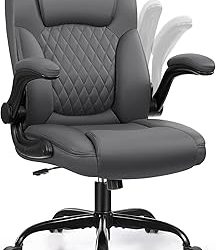
Executive Office Chair with Adjustable Lumbar Support and Flip-Up Arms
The combination of a breathable mesh back and arms that fold clear makes this the most space-efficient pick here — it slides under a standard 29-inch desk and visually recedes into the room. The 400 lb capacity and adjustable lumbar block are unusually robust for a chair with this modest a footprint.
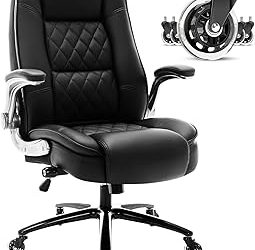
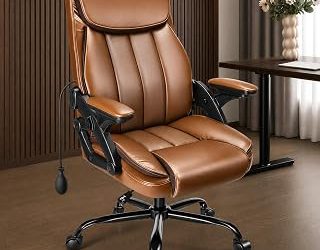
FelixKing PU Leather Office Chair with Flip-Up Armrests
A tidy, low-profile leather option for rooms where the chair has to look presentable outside work hours, with flip-up arms that let it tuck away completely. The recline is gentler than the deep-tilt models, which is actually an advantage if your desk sits close to a wall.
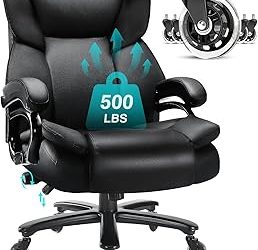
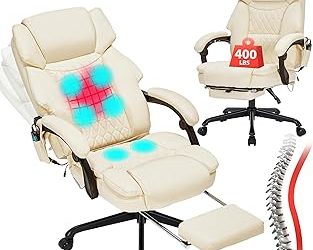
Ergonomic Office Chair with Footrest and 3D Massage Lumbar Support
This is the fully loaded option: 4D headrest and armrests, adjustable seat depth, and a massage lumbar unit, all rated to 400 lbs. Plan for real clearance behind it, since the adjustability that makes it comfortable also means it occupies the largest recline arc in this group.
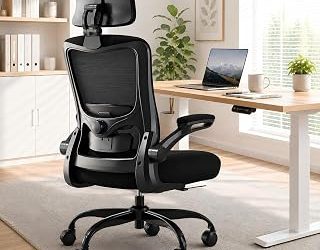
Ergonomic Office Chair with Footrest and High Mesh Back
A well-judged middle ground — 135-degree recline and a retractable footrest paired with an airy mesh back that doesn’t visually crowd a small room. The thickened cushion holds up for long sessions without the bulk of a padded executive shell.
Big and Tall Office Chair with Flip Armrests for Cross-Legged Sitting
The wide crystal velvet seat genuinely accommodates cross-legged sitting, and the flip arms mean the extra width doesn’t permanently block a walkway. Best in rooms where you can commit a corner to it rather than squeezing it into a shared path.
Frequently Asked Questions
How much clearance does a reclining office chair actually need?
Budget 18 to 24 inches behind the chair’s upright position for a chair that reclines to 135 degrees, and add another 20 inches ahead of the seat if you’ll use an extended footrest. Measuring before ordering saves a return.
Do flip-up armrests weaken the chair?
Not on well-built models — the hinge sits at the arm mount, not in the load path of the seat or base. Chairs rated to 300 to 400 lbs with flip arms are engineered for that capacity with the hinge included.
Is a big-and-tall chair a bad idea in a small room?
It’s workable if the chair has a fixed home in a corner, but the wider base limits how close you can park to walls and how easily the chair clears a desk. If floor space is genuinely tight, a standard-width chair with a high weight rating is the better compromise.
Mesh or upholstery for a small home office?
Mesh, in most cases. An open back keeps sightlines clear and makes a compact room feel less occupied, and it runs cooler in rooms with limited airflow. Choose leather or velvet when the chair has to look at home in a shared living space.
Final Thoughts
For most small-space setups, the Executive Office Chair with Flip-Up Arms is the pick that respects your floor plan — mesh back, folding arms, serious weight rating, minimal visual bulk. If you want a deeper recline with a stowable footrest and can spare the clearance, the Ergonomic Office Chair with Footrest and High Mesh Back strikes the best balance, while the 3D Massage Lumbar model is worth the extra space for anyone who wants full adjustability in a dedicated corner.