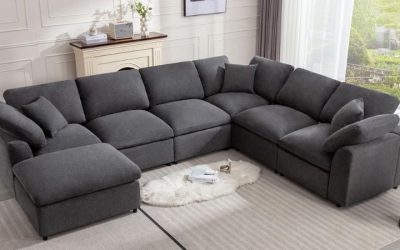
Key takeaways
- Two stated wall runs, 129 7/8 in and 98 in, for asymmetric rooms
- Ordinary seat depth 21 5/8 in, separate from the deeper chaise projection
- Removable covers are machine washable per the maker’s listing
Mapping an L-shaped seat onto two wall runs is where most living-room plans go wrong, since one overall width hides uneven legs. This guide compares six models on their published specs so you can match a real corner sectional to your space; the main trade-off is footprint against the deeper corner seat you want.
As an Amazon Associate we earn from qualifying purchases.
By KK Home Furnishings Editorial Team
How to Choose a Corner Sectional
Choosing well starts with treating the piece as two separate wall measurements rather than one number on a spec sheet. The three criteria below focus on what actually determines fit and daily comfort: how the corner is really built and sized leg by leg, how deep the seats sit, and how the whole thing ships and reconfigures.
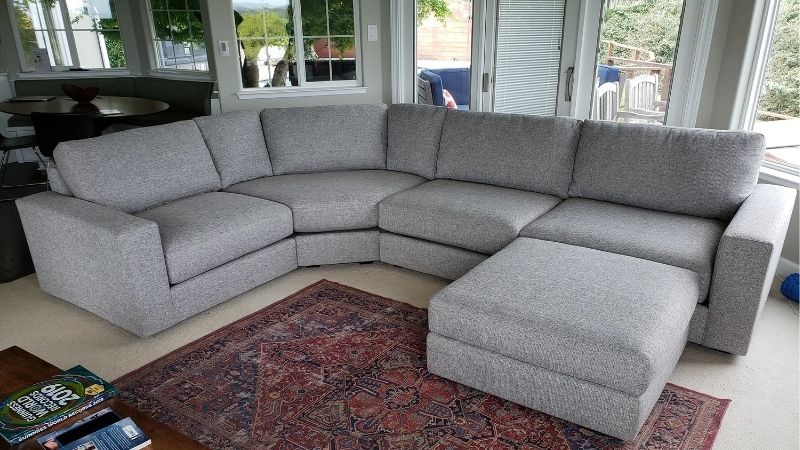
True corner or wedge construction, leg-by-leg assembled footprint
A true corner build has a dedicated corner or wedge module that ties two runs together, not just a reversible chaise bolted to a sofa. Read the two leg extents separately: the IKEA FINNALA lists 129 7/8 in on one run and 98 in on the other, so each wall needs checking on its own. This matters most in rooms where one wall is noticeably shorter.
Trust a single overall width and you can order a piece whose long return blocks a doorway or traffic path, a mistake that surfaces only on delivery day. Carton dimensions compound it: Albany Park’s Kova corner box runs 43.5 by 43.5 by 15 in, which is not the installed footprint, so plan both the assembled runs and the path the boxes must travel.
Seat depth of ordinary seating versus corner configuration
Seat depth decides whether you sit upright or sink back, and these L-shaped builds often mix two depths in one piece. An ordinary seat depth near 21 to 23 in measured on the seat, like the FINNALA’s 21 5/8 in or Burrow Mercer’s 23 in, keeps you upright; a lounge-depth seat around 28 to 29 in, like Albany Park’s 29 in, invites reclining. Taller sitters and small-room buyers feel this most.
Pick a depth that fights your body and the sofa becomes a daily annoyance: too deep and shorter sitters lose back support, too shallow and tall users perch. Deep seats also demand large back cushions that need regular fluffing to avoid sagging, a recurring care cost over the years that a shallower upright seat largely avoids.
Largest package and modular reconfiguration method
How a piece ships and comes apart governs both move-in and future rearranging. Component systems like Burrow’s latch-and-catch Nomad or the Mercer’s modular frames arrive as separate cartons you join in the room, while IKEA kits combine loveseat, corner and chaise frames. Burrow’s Nomad ships as sections about 35 in deep each, and the Russet is built to reconfigure, which suits renters who expect to move.
Underestimate the largest single box and it may not clear a stairwell or elevator, forcing a return. Modularity cuts both ways: more seams and connectors mean more points that can loosen with use, so factor in occasional tightening, and confirm the heaviest carton against your access before buying rather than after.
Top Picks
Each pick below leads with the job it does best, then the documented numbers behind it; all six are current, named configurations rather than generic categories. Because brands measure differently, we flag the exact convention for every figure. Prices sit in relative tiers, since comparable same-material, same-module quotes with shipping to your ZIP are not published.
| Product | Best For | Key Spec | Watch Out For |
|---|---|---|---|
| IKEA FINNALA Corner Sectional 5-Seat with Chaise | Asymmetric L plus storage chaise | Width left 129 7/8 in; width right 98 in (manufacturer orientation) | Large 129 7/8 in return may overwhelm short walls |
| IKEA SODERHAMN Corner Sleeper Sofa 6-Seat | Guest bedding with a true corner seat | Left 114 5/8 in by right 125 5/8 in (leg runs) | Sleeper use adds operating clearance and mechanical parts |
| Burrow Mercer 6-Piece Corner Sectional | A defined medium corner footprint | 116.5 W by 91.25 D by 34.5 H in | 91.25 in projection still needs a long adjacent wall |
| Burrow Nomad 4-Seat Corner Sectional | The shorter corner run | 88 in long leg by 63 in short leg by 35 in section depth | Four-seat is maker naming, not a width-per-person rating |
| Albany Park Kova Box Corner Sectional | An intentionally expansive square footprint | 122 W by 122 D by 39 H in | 122 in on both walls is a major space commitment |
| Burrow Russet 4-Piece Corner Sectional | Deep informal lounging | 120 W by 83 D by 34 H in | Maker rates it roomy for three or cozy for four |
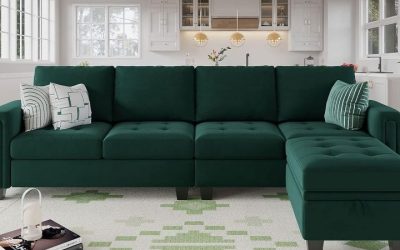
IKEA FINNALA Corner Sectional 5-Seat with Chaise — Best for an Asymmetric L Plus Storage Chaise
Best For: Households with one short wall and one long wall who want a chaise plus washable covers for daily family use.
Among these six, the FINNALA is the one openly built for an uneven L: its two runs differ by more than 30 inches, so it fits a room where a long wall meets a much shorter one. It also pairs a true corner frame with a storage chaise, a combination the tighter Burrow sets in this roundup don’t offer.
IKEA lists the two assembled runs as 129 7/8 in and 98 in (manufacturer orientation, measured wall to wall, not seat width), with an ordinary seat depth of 21 5/8 in distinct from the much deeper chaise. It sits in the premium tier; the $2,499 shown on the product page is a displayed figure, not a delivered checkout total.
That 129 7/8 in return can overwhelm a short wall, so measure doorways and the final path before ordering. The removable covers are machine washable, but the inner seat cushions are not, so spills reach a core you can only spot-clean. On any upholstered SKU, confirm the California TB 117-2013 flammability label on the actual listing.
Pros:
- Two stated wall runs, 129 7/8 in and 98 in, for asymmetric rooms
- Ordinary seat depth 21 5/8 in, separate from the deeper chaise projection
- Removable covers are machine washable per the maker’s listing
Cons:
- Long 129 7/8 in return can overwhelm a short wall
- Inner seat cushions are not machine washable, only the covers
Who Should Buy It: Buyers with a genuinely asymmetric room and a washable-cover priority; those needing a sleeper should choose the SODERHAMN instead.
IKEA SODERHAMN Corner Sleeper Sofa 6-Seat — Best for Guest Bedding with a True Corner Seat
Best For: Hosts who need occasional guest bedding but refuse to give up a real corner seat in sofa mode.
The SODERHAMN is the only pick here that folds out to a sleeping surface while keeping a genuine corner seat for everyday use, so a spare room isn’t a prerequisite for hosting. That dual role is what sets it apart from the fixed Burrow and Albany Park builds, which seat guests but never sleep them.
IKEA gives the two leg runs as 114 5/8 in and 125 5/8 in (wall-to-wall runs, not a single overall width) and a bed of 76 3/4 by 61 3/8 in. The seat depth is a lounge-deep 36 5/8 in, measured on the seat. Treat it as premium tier and check the current price, as the exact kit isn’t quoted comparably.
A sleeper needs room to open, so leave operating clearance in front and keep the path clear of a coffee table. The folding mechanism adds parts that can wear, which a fixed sofa avoids, so test the action on arrival. Its 36 5/8 in seat is far deeper than a standard 20 to 23 in upright seat, better for lounging than desk-straight sitting.
Pros:
- Two leg runs stated, 114 5/8 in and 125 5/8 in
- Disclosed bed size 76 3/4 by 61 3/8 in for guest planning
- Corner seat remains usable in sofa mode, not sleeper-only
Cons:
- Sleeper action adds operating clearance and more parts to wear
- Deep 36 5/8 in seat sits well below an upright default
Who Should Buy It: Occasional hosts without a guest room; buyers wanting upright everyday seating should take the FINNALA or Burrow Mercer instead.
Burrow Mercer 6-Piece Corner Sectional — Best for a Defined Medium Corner Footprint
Best For: Medium living rooms wanting an upright-seat corner build with room to add modules later without starting over.
The Mercer hits the middle of this group: a defined corner footprint that isn’t as sprawling as the Albany Park Kova yet seats more than the compact Nomad. Its appeal is an upright 23 in seat paired with a maker modular system you can extend, so the piece can grow with the room rather than forcing a full replacement.
Burrow publishes the assembled envelope as 116.5 W by 91.25 D by 34.5 H in (overall bounding box, not seat width) with a 23 in seat depth and 18.5 in seat height, both measured on the seat. Direct-to-consumer modular sets like this typically land in the mid-to-premium band; check the current price, since the ZIP-specific total varies by fabric.
That 91.25 in side still needs a long adjacent wall, so confirm the shorter run clears windows and doors. It ships as separate components you assemble in the room, which eases narrow doorways but adds connectors to seat and keep snug over time. Final fabric and your ZIP change the total, so there’s no fixed value claim to lean on.
Pros:
- Assembled envelope 116.5 by 91.25 in, a defined medium footprint
- Upright 23 in seat depth, measured on the seat
- Modular system accepts optional extensions from the maker
Cons:
- 91.25 in projection still requires a long adjacent wall
- Fabric and ZIP swing the total; no firm value claim
Who Should Buy It: Mid-size rooms set on upright seating; buyers chasing a deep lounge seat should pick the Russet or Kova instead.
Burrow Nomad 4-Seat Corner Sectional — Best for the Shorter Corner Run
Best For: Smaller rooms or apartments where the shorter of the two walls is the real constraint on seating.
When the limiting wall is short, the Nomad is the pick: its long leg is the most compact among these corner builds, so it tucks into tighter plans the FINNALA or Kova would swamp. It’s a genuine corner set rather than a chaise sofa, trading overall seat count for a footprint that fits a modest room.
Burrow lists an 88 in long leg, a 63 in short leg and a 35 in section depth (per-module depth, not the installed L boundary), with a 22 in seat depth and 17 in seat height measured on the seat. These direct-to-consumer kits generally fall mid-tier; check the current price because fabric and leg choices shift it.
The latch-and-catch construction snaps together without tools, friendly for walk-ups and frequent moves. Note the four-seat label is maker naming, not a standardized width-per-person rating, so don’t assume four adults sit comfortably. And a 35 in module depth isn’t the finished corner boundary, so still map both runs on the floor with tape before you commit.
Pros:
- Compact 88 in long leg and 63 in short leg stated
- Upright 22 in seat depth, measured on the seat
- Tool-free latch-and-catch assembly suits walk-ups and moves
Cons:
- Four-seat is maker naming, not a width-per-person standard
- 35 in module depth isn’t the installed L boundary
Who Should Buy It: Small-space buyers prioritizing the short wall; anyone needing more seats or depth should move up to the Mercer.
Albany Park Kova Box Corner Sectional — Best for an Intentionally Expansive Square Footprint
Best For: Large open rooms where a symmetrical, deep-seated square anchor is the goal rather than a space-saving fit.
The Kova is the big, symmetrical option here, matching its two runs at the same length for a square corner that commands an open room. Where the Nomad shrinks to fit, the Kova deliberately expands, pairing that footprint with the deepest standard-style seat in the group for lounging rather than upright perching.
Albany Park gives 122 W by 122 D by 39 H in (overall bounding box with both runs equal) and a 29 in seat depth measured on the seat, with a 19 in seat height. The corner carton alone is 43.5 by 43.5 by 15 in, separate from armless boxes. Treat it as premium tier and check the current price for your exact cover.
At 122 in on both walls, this is a major commitment, so confirm both runs and the door path first. The retailer discloses a 20% return fee and threshold delivery by default, a real cost if the fit fails. On the live SKU, look for the California SB 1019 upholstery disclosure label to confirm what’s inside the cushions.
Pros:
- Symmetrical 122 by 122 in runs for a square footprint
- Deep 29 in seat depth, measured on the seat
- Corner carton stated at 43.5 by 43.5 by 15 in
Cons:
- 122 in on both walls is a major space commitment
- 20% return fee and threshold delivery add cost
Who Should Buy It: Big-room buyers wanting a deep square anchor; tight floor plans should choose the Nomad or FINNALA instead.
Burrow Russet 4-Piece Corner Sectional — Best for Deep Informal Lounging
Best For: Casual households who prize deep, sink-in lounging for a few people over maximum upright seat count.
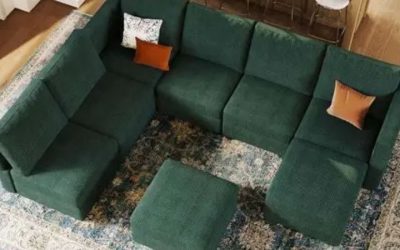
The Russet is the laid-back pick, tuned for deep informal lounging rather than a full house of upright seats. Its draw is a soft, reconfigurable foam-frame system the maker frames as spacious for three or cozy for four, so it rewards households that value sprawl over seat tally, unlike the upright Mercer or sleeper-focused SODERHAMN.
Burrow names the envelope as 120 W by 83 D by 34 H in (overall bounding box, not seat width) with a deep 28 in seat depth and 19 in seat height measured on the seat. As a direct-to-consumer modular family it generally sits mid-tier; check the current price, since fabric selection and your delivery ZIP move the final number.
Because the maker itself calls it roomy for three or cozy for four, don’t plan on seating four adults at full comfort. The reconfigurable modules suit renters who rearrange often, but a soft-feel build can’t be assumed durable without long-term use, so weigh how hard your household will sit on it daily.
Pros:
- Named envelope 120 by 83 in with a 28 in deep seat
- Seat height 19 in, measured on the seat
- Reconfigurable foam-frame modules suit frequent rearranging
Cons:
- Maker rates it roomy for three, cozy for four
- Soft-feel build’s durability unproven without long-term use
Who Should Buy It: Lounge-first buyers with a casual routine; those needing four firm upright seats should choose the Mercer instead.
Frequently Asked Questions
These answers cover the questions buyers ask after they’ve narrowed the field but before they commit a measurement to an order. Each one leans on the specific builds above so the guidance is concrete, not generic, and each points to the condition that would change the answer for your particular room, floor and doorway.
What is the difference between a corner sectional and a chaise sectional?
The difference is a dedicated corner or wedge module that joins two seating runs at the angle, where a chaise sectional only extends one end with a long seat. On the FINNALA, that shows up as two measured runs of 129 7/8 in and 98 in, rather than a single sofa with a 64 5/8 in chaise projection hanging off it.
Which you need depends on whether you’re wrapping seating around two walls or just stretching along one. If only one wall is in play, a chaise build may serve you better and cost less; if the room turns a corner, look for a named wedge or corner frame on the listing before assuming the angle is real.
How do I measure both walls for an L-shaped sectional?
Measure each wall run separately, in inches, and never rely on one overall width, because legs are often unequal, such as the SODERHAMN’s 114 5/8 in on one side and 125 5/8 in on the other. Mark both runs on the floor with painter’s tape, then add a few inches of breathing room at the outer end of each.
Doorways, radiators and window trim change the usable length, so measure to the nearest fixed obstacle, not just corner to corner. Also map the route the delivery boxes travel, since the largest carton must clear every turn; if a stairwell is tight, favor a component build you carry in and assemble in pieces.
Can a corner sectional be converted from left-facing to right-facing?
Sometimes, but not always, and it depends entirely on the design: modular, reconfigurable systems like Burrow’s Russet or Nomad let you swap which run holds the longer leg, while a fixed-orientation kit does not. IKEA lists runs in a set manufacturer orientation, so confirm the facing on the specific article before you count on flipping it.
If a particular facing is essential, check whether the listing sells left and right versions as separate SKUs or markets one reconfigurable set. For a latch-and-catch piece you can rearrange at home; for a sewn-in corner, order the exact facing your room needs and verify it against your floor plan first.
What is the safest way to check delivery-box clearance?
Work from the largest single carton, not the assembled size, since the biggest box dictates what fits through your door: the Albany Park Kova corner carton is listed at 43.5 by 43.5 by 15 in, separate from its armless boxes. Compare that to your narrowest doorway, stairwell turn and elevator before ordering anything.
Older buildings with tight landings or 90-degree turns are where deliveries fail, so measure diagonals, not just door width. If the largest carton won’t clear, a component system such as Burrow’s that ships in several smaller boxes is the safer route than a single bulky crate you can’t maneuver.
Final Thoughts
The right choice comes down to measuring two walls honestly and matching the deeper trade-offs to how you live: a corner sectional earns its space when both runs, the seat depth and the largest carton all clear your room. Decide whether upright seating, a guest bed, a compact footprint or deep lounging leads, then let the published numbers, not the showroom photo, settle it.