Key takeaways
- A desk chair pad for hardwood floors must have a smooth or textured non-gripping back, not the spikes a carpet mat uses. Those carpet cleats scratch hardwood, so the backing is the spec that matters most, alongside the mat size…
A desk chair pad for hardwood floors must have a smooth or textured non-gripping back, not the spikes a carpet mat uses. Those carpet cleats scratch hardwood, so the backing is the spec that matters most, alongside the mat size and the material it is made from.
How to Choose a Chair Pad for Hardwood
Choose a hardwood chair mat by confirming it is made for hard floors with a smooth or textured non-cleated back, then size it to your caster travel, and weigh the material and shape. A carpet mat on hardwood scratches the floor, so the floor-specific backing is the first and most important check.
Choose Hard-Floor Backing, No Carpet Cleats
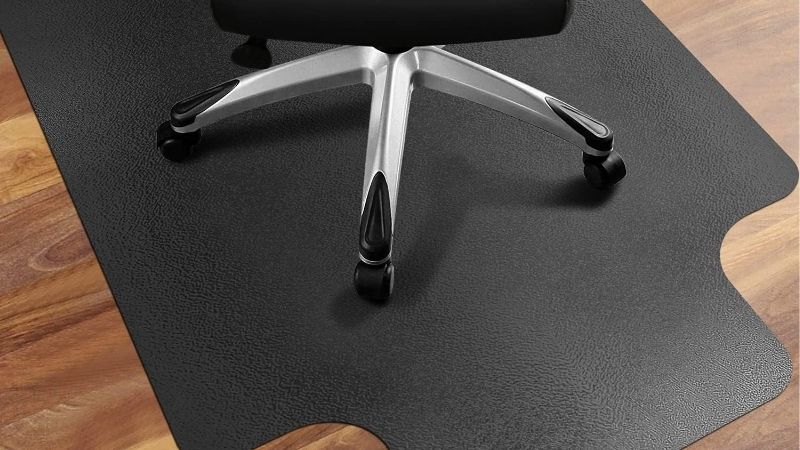
The spec that defines this category is a hard-floor backing, because carpet mats and hard-floor mats grip the floor in opposite ways. Carpet mats use gripper cleats, small spikes that dig into carpet pile, while hard-floor mats like the Staples STP-15987 use a textured underside designed to stay put without damaging the floor.
Putting a carpet mat on hardwood is the classic mistake, since those cleats scratch and dent the finish, which is exactly what the mat was meant to prevent. Confirm each mat is explicitly for hard floors, as the Staples, TrafficMaster, Floortex, and Dimex mats are, and check that the underside is smooth or textured, not cleated.
A hard-floor mat relies on a non-slip but non-damaging back and on its own weight and shape to stay in place. Read the underside description rather than assuming, since a mat sold for both floor types may still carry cleats, and the backing is what protects the hardwood you are trying to shield from chair casters.
Measure the Caster Travel Zone
Size the mat to where your chair actually rolls, so the casters stay on the mat and off the floor. These mats run in a 36-by-48-inch class, which covers a typical desk and the chair’s roll-back zone, but a larger desk or a chair that rolls widely may need you to confirm the mat reaches the full travel area.
Measure how far your chair rolls back from the desk and side to side, then compare that to the 36-by-48-inch footprint, since casters that run off the edge both scratch the floor and chew the mat edge. The mat only protects the area it covers, so the travel zone, not just the desk footprint, sets the size you need.
If your chair ranges widely, you may need the mat oriented lengthwise or a larger size than the standard class offers. Plan the mat position so the chair stays on it through its normal movement, because a mat too small for your caster travel leaves gaps where the floor takes the wear the mat was bought to prevent.
Vinyl Versus Polycarbonate or PVC
Mat material affects durability, clarity, and feel, so weigh the options. Floortex lists the Advantagemat as vinyl and Staples lists a thin textured mat at 0.085 inches, while others use clear plastic, so the material ranges from flexible vinyl to more rigid plastics, each with different wear and appearance.
Vinyl mats are flexible and often quieter underfoot, while more rigid plastics can be clearer and resist dents from heavy chairs, so match the material to your chair weight and your preference for look and feel. A thinner mat is less obtrusive but may show wear sooner under a heavy chair than a thicker one.
Thickness also affects how the mat lies and how casters roll, so consider it alongside material. A thin 0.085-inch mat is subtle and budget-friendly, while a thicker mat may lie flatter and last longer, so weigh the material and thickness together against how much your chair rolls and how heavy it is.
Lip Versus Rectangle
Mats come as plain rectangles or with a lip, a tongue that extends under the desk, so choose the shape for your setup. Staples and Dimex list lipped mats, where the lip protects the floor under the desk where feet and a chair’s forward roll reach, while a plain rectangle like others here covers the open roll zone.
A lip suits a desk where you roll forward under it and want that area protected too, extending coverage into the kneehole. A plain rectangle is simpler and fits where the desk sits against a wall or where you do not roll underneath, so match the shape to how you use the space beneath and around the desk.
Consider whether a lip fits your desk’s kneehole width, since a lip too wide or narrow sits awkwardly. Measure the under-desk opening if you want a lipped mat, since the shape only helps when it fits, and a plain rectangle is the safer choice where the lip would not match your desk’s dimensions.
Best Hardwood Chair Mats
Each pick below leads with its hard-floor backing, size, and material, the specs that protect your floor and chair travel. All are the 36-by-48-inch class and made for hard floors; check the current price and that the size covers your full caster travel before you buy any of these mats.
| Product | Best For | Key Spec | Watch Out For |
|---|---|---|---|
| Staples STP-15987 Hard Floor Mat | Best budget | 36×48 in; 0.085 in thick; textured underside; lip | Thin mat may wear under heavy chairs |
| Dimex Evolve 15150630 | Best low-cost alternative | 36×48 in; for hard floors; modern shape with lip | Underside grip is the detail to confirm |
| Floortex Advantagemat | Best branded vinyl | 36×48 in; vinyl; hard-floor rectangle | Rectangle has no under-desk lip |
| TrafficMaster 05120600HD-4RF | Best basic clear mat | 36×48 in; clear plastic; for hard floors | Grip and thickness only partly stated |
Staples STP-15987 – Best Budget
The Staples STP-15987 is the budget pick, a 36-by-48-inch hard-floor mat at 0.085 inches thick with a textured underside and a lip. For protecting hardwood under a standard desk at a low price, its floor-safe textured back and lipped shape cover both the roll zone and the area under the desk.
The textured underside grips without the cleats that would scratch hardwood, and the lip extends protection into the kneehole where you roll forward. At a budget price in the 36-by-48-inch class, it covers the essentials of a hardwood chair mat without paying for a heavier-duty or branded option.
The trade-off is that at 0.085 inches it is thin, so a heavy chair may wear it sooner than a thicker mat. Confirm the size covers your caster travel, keep grit swept from beneath it to protect the floor, and check the current price at the retailer before buying this budget lipped mat.
Dimex Evolve 15150630 – Best Low-Cost Alternative
The Dimex Evolve is the low-cost alternative, a 36-by-48-inch hard-floor mat with a modern shape and a lip. As another budget-friendly, floor-safe option, it covers the same core job as the Staples with a slightly different contemporary shape and the same lip for under-desk protection.
The for-hard-floors design and lipped shape suit a standard desk on hardwood, protecting both the open roll area and the kneehole. For a buyer who wants an inexpensive, properly floor-safe mat with a slightly more styled profile, the Dimex is a sensible pick in the same class as the Staples.
The detail to confirm is the underside grip, since a hard-floor mat must stay put without cleats, so check that its back is smooth or textured rather than gripping. Confirm the size covers your caster travel, keep the floor beneath it clean, and check the current price at the retailer before buying.
Floortex Advantagemat – Best Branded Vinyl
The Floortex Advantagemat is the branded vinyl pick, a 36-by-48-inch hard-floor rectangle in vinyl. For a buyer who wants a recognized brand and a flexible vinyl mat, it offers floor-safe protection in a plain rectangular shape well suited to the open caster roll zone in front of a desk.
Vinyl is flexible and tends to lie flat, and the Floortex name brings an established brand’s consistency to a hard-floor mat. The rectangular shape suits a desk against a wall or a setup where you do not roll under the desk, covering the main caster travel area cleanly without a lip under the desk.
The consideration is that a plain rectangle has no under-desk lip, so it does not protect the kneehole where you roll forward. If you need that coverage, a lipped mat suits better; otherwise confirm the rectangle covers your travel zone, and check the current price at the retailer before buying this branded vinyl mat.
TrafficMaster 05120600HD-4RF – Best Basic Clear Mat
The TrafficMaster 05120600HD-4RF is the basic clear-mat pick, a 36-by-48-inch clear plastic mat made for hard floors. For a straightforward, see-through mat that lets the hardwood show through, it covers the roll zone in the standard 36-by-48-inch class as a home-improvement-store option.
The clear plastic suits anyone who wants the floor visible beneath the mat, keeping the look of the hardwood while still protecting it from casters. As a basic hard-floor mat in the 36-by-48-inch class, it handles the core job of shielding the hardwood floor under a standard desk chair.
The caveat is that its grip and thickness are only partly stated, so confirm the underside is floor-safe and the thickness suits your chair before relying on it. Verify those details with the seller, confirm the size covers your travel, and check the current price at the retailer before buying this clear mat.
Protect Your Hardwood Correctly
A mat only protects hardwood if you use it correctly, so a few habits matter. Clearing grit under the mat, avoiding cleated carpet mats, letting the mat lie flat, and checking finish compatibility keep both the mat and the floor in good shape rather than causing the damage you meant to prevent.
Clean Grit Under the Mat
Grit trapped under a mat is a hidden scratch risk, so sweep the floor before laying the mat and clean under it periodically. Dust and small debris caught between the mat and the hardwood can grind into the finish as the mat shifts under chair movement, quietly scratching the very floor the mat is meant to protect.
Lift the mat occasionally and clean both the floor and the mat’s underside, especially in a busy home office where grit accumulates. This simple habit prevents the trapped-debris scratching that can otherwise undo the mat’s protection, which is easy to overlook because the damage happens out of sight beneath the mat.
Keeping the area clean also helps the mat lie flat and grip properly, since debris can lift edges and reduce the non-slip contact. Treating the space under the mat as part of regular cleaning is a small step that keeps a hardwood chair mat doing its job rather than slowly abrading the floor.
Avoid Cleated Carpet Mats
The single biggest mistake is using a carpet mat on hardwood, since its gripper cleats are made to dig into carpet pile and will scratch and dent a wood floor. Always confirm a mat is designed for hard floors, as the mats here are, and that its underside is smooth or textured rather than studded with cleats.
A mat sold as universal or for both floor types may still carry cleats, so read the backing description carefully rather than trusting the label alone. The whole mechanism differs: carpet mats grip by digging in, while hard-floor mats grip by texture and weight, and only the latter is safe on hardwood.
If you are unsure what a mat’s underside is, do not place it on hardwood until you confirm it is cleat-free. This is the mechanism that matters most, since a well-meaning mat with the wrong backing causes exactly the caster-and-grit damage you were trying to avoid, often worse because the cleats are constant.
Let the Mat Lie Flat
A rolled or creased mat does not protect well and can trip casters, so let a new mat acclimate flat before heavy use. Mats shipped rolled often need time laid flat, sometimes weighted at the corners, to relax and sit properly, since a curled edge lifts off the floor and defeats both protection and grip.
Give the mat a day or two flat, or follow the maker’s guidance on flattening, before judging how it lies. A mat that lies flat stays put, rolls smoothly under the chair, and keeps its full footprint on the floor, which is what delivers the protection across the whole caster travel zone.
A thinner mat may relax faster than a thicker one, but either benefits from a flat start rather than immediate heavy use. Taking the time to let the mat settle flat is a small step that prevents curled edges and uneven lie, both of which reduce how well a hardwood mat shields the floor.
Check Finish Compatibility
Finally, do not assume a mat is safe for every hardwood finish, since finishes vary and some can react to certain mat materials over time. Follow both the mat maker’s guidance and your floor manufacturer’s care instructions, since the safe choice depends on your specific finish, not a blanket claim on the mat’s packaging.
Some finishes can be marked by prolonged contact with certain plastics or by trapped moisture, so a mat that is fine on one floor may not suit another. Rather than relying on a universal safety claim, check what your floor’s manufacturer recommends and how the mat material interacts with that finish before committing to long-term use.
If in doubt, test a mat on an inconspicuous area and monitor for any marking, and keep the floor clean beneath it. Matching the mat to your specific finish, rather than assuming a desk chair pad for hardwood floors is safe everywhere, is the final step that protects both the mat’s performance and your floor.
Final Thoughts
The best desk chair pad for hardwood floors has a smooth or textured non-cleated back, covers your full caster travel, and suits your floor’s finish. Compare the Staples, Dimex, Floortex, and TrafficMaster mats on backing, size, and material, never use a cleated carpet mat on wood, keep grit swept from underneath, and check the current price first.