Key takeaways
- Choosing a heated blanket or heated mattress pad comes down to where you want warmth: over your body or beneath you. Choose a blanket for a removable upper layer; choose a fitted pad to warm the sleeping surface. Neither is…
Choosing a heated blanket or heated mattress pad comes down to where you want warmth: over your body or beneath you. Choose a blanket for a removable upper layer; choose a fitted pad to warm the sleeping surface. Neither is automatically safer or cheaper. Check model instructions, especially if a user cannot sense heat.
As an Amazon Associate we earn from qualifying purchases.
By KK Home Furnishings Editorial Team
Heated Blanket vs Heated Mattress Pad: Key Differences
An electric blanket lies above the sleeper, while a heated mattress pad lies over the mattress, usually under a fitted sheet. Sunbeam describes this as the direction of heat, not a universal difference in temperature or efficiency. The choice also changes how the fabric moves, where cords are routed, and which layers you can remove.
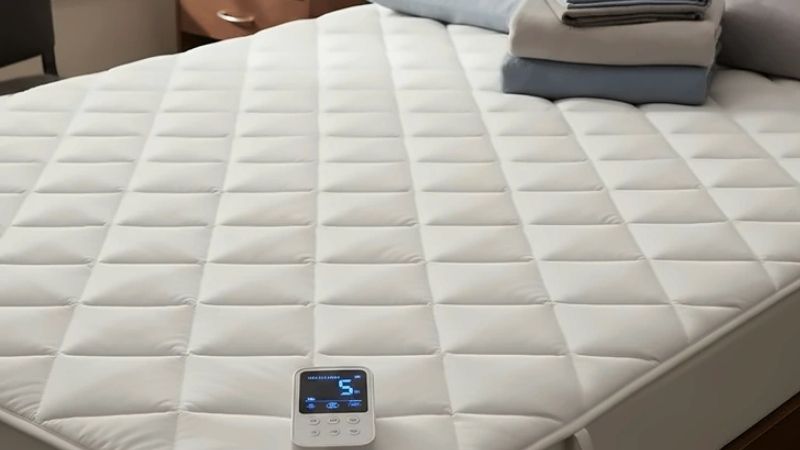
This comparison draws on Sunbeam product guidance and manuals, Electrical Safety Foundation International advice, UL 964 scope, and U.S. Consumer Product Safety Commission recalls reviewed in October 2026. It evaluates published instructions rather than hands-on performance. Features and overnight-use permissions differ by exact model.
| Decision Factor | Heated Blanket | Heated Mattress Pad | Better Fit When |
|---|---|---|---|
| Where heat comes from | Upper bedding layer, over sleeper | Below sleeper, over mattress | Choose based on which side feels cold |
| Movement and positioning | Can be lifted or repositioned; do not bunch while powered | Fitted designs stay aligned with the mattress | Pad for fixed bed warming; blanket for removable coverage |
| Bedtime preheating | Warms the space below the blanket | Warms the mattress-side sleeping surface | Pad for cold sheets beneath the body |
| Using it outside bed | Only if model allows; a heated throw is a distinct product type | Not designed for sofa use | Look for a separately rated heated throw for seating |
| Couples and controls | Some bed-size models offer dual zones | Some queen or king models offer dual zones | Read exact SKU and control diagram |
| Cleaning and fabric wear | Upper layer may need washing more often depending on use | Often protected under a fitted sheet; fitted skirt must fit | Compare actual care label and fit, not category alone |
| Power and safe use | Rated watts and shutoff vary by model | Rated watts and shutoff vary by model | Check label, manual, listing and cord route |
Where the Warmth Reaches You
A blanket puts its heated wiring on the upper side of your bedding. This can make the top of the bed feel more inviting while you read or settle down, provided the model permits that use. A mattress pad spreads warmth from below. It can be appealing when the sheet and mattress surface feel especially cold as you get into bed.
The placement does not establish a temperature winner. Heat settings, insulation above or below the product, room temperature, and the specific controller all affect how warm each feels. Sunbeam notes that certain mattress-pad lines have a warmer foot zone, but that brand-specific feature should not be assumed for other makes or every Sunbeam model.
Fabric Movement, Bed Fit, and Pressure
A full-size heated blanket can be lifted when you get up and stored separately when winter ends. The trade-off is that loose bedding can gather around shoulders or feet. Heated wiring must stay flat during operation; folding, tucking, or trapping powered sections creates a different risk from normal use of a non-electric comforter.
A fitted warming pad generally stays on the bed, but its skirt must accommodate the actual mattress depth. Measure from top to bottom at the edge, including any topper the pad is meant to cover, and compare that with the exact product fit range. Do not force a tight pad over a thick bed or route the controller lead under load-bearing mattress layers.
Controls, Power Use, and Practical Limits
Both categories can offer several heat settings, automatic switch-off, or two independent sides; none of those features is universal. A queen or king label does not prove dual control, and a timer is not proof that unattended or sleeping use is appropriate. Check the model number, control arrangement, and user instructions before paying for additional features.
Energy cost cannot be determined simply from blanket versus pad. Compare each item’s stated electrical rating, heating cycle, intended running time, and local electricity price. Real consumption may vary as thermostatic controls cycle. If your goal is to heat the bed without heating the whole bedroom, either product may help, but neither guarantees a particular saving.
Which Option Works Better in Six Real-Life Situations?
A useful decision starts with the part of the bed that feels uncomfortable and what the household allows you to operate safely. These six situations cover fixed bed warming, flexible coverage, different temperature preferences, changing bedding layers, special bed frames, and households where electric bedding is a poor fit.
1. You Get Into Bed and the Sheets Feel Cold
Lean toward a fitted heated mattress pad if cold sheets and the mattress-facing side of the bed bother you most. Positioning the heat source under the sleeper addresses that specific sensation more directly than relying on warmth radiating downward from an upper layer. This is an editorial use-case distinction, not a claim that one unit heats faster.
Follow its prescribed placement relative to the fitted sheet and any protector. Confirm whether the manufacturer allows preheating before you get in and whether it should be switched off before sleep. A pad does not replace ordinary mattress protection, and an incompatible moisture barrier can change the approved setup, so the manual is decisive.
2. You Want a Removable Warm Layer on the Bed
A heated blanket is the more natural choice when you want to pull an upper layer over yourself and remove it when no longer needed. Its portable feel is useful while sitting upright in bed, but only within the manufacturer’s approved use. The blanket must remain spread out and must not be folded or trapped under body weight while energized.
If you actually want warmth on the sofa, look for a heated throw explicitly designed for that purpose instead of assuming every bed blanket is a couch accessory. Throws may have different cord routing and furniture restrictions. Manufacturer instructions can specifically bar powered use in recliners or moving chairs, so check before extending the use case.
3. Two Adults Prefer Different Amounts of Warmth
Either category can work if you select a particular queen or king model with independently adjustable heating zones. Sunbeam documents two zones on specified connected bedding, but the presence and orientation of individual controllers vary. Before buying, find the control diagram and verify that each sleeper can adjust a distinct side of the actual item.
Dual controls do not override basic safety instructions. Avoid letting the cable cross a walking route or become crushed by the frame. Also consider whether one person wants no powered bedding at all: a separate non-electric blanket on that side may be a better compromise than buying an electrically heated shared-bed product neither person can use as intended.
4. You Change Bedding Layers During the Night
If you frequently remove the comforter or kick off upper layers, a fitted mattress pad may stay in place more consistently than a movable blanket. If instead you prefer taking the warm product off the bed entirely once comfortable, the blanket is easier to lift away. Neither pattern justifies continuing to heat through the night without model-specific authorization.
Do not use a second powered blanket over an active pad to chase stronger warmth. Sunbeam manuals prohibit combining electrically heated products, and the safety risk may change when heat is trapped between layers. If a single device still feels inadequate, first consider ordinary room temperature, dry bedding, and the fit of unpowered sheets rather than stacking electrical heat.
5. You Have an Adjustable Bed or a Thick Foam Mattress
Neither option is automatically compatible with an adjustable base. A Sunbeam connected-bedding manual excludes mechanically adjustable beds, among other special bed types. Moving joints can bend a pad or trap wiring; a blanket can also be pinched during articulation. Buy only when instructions for the exact product explicitly permit your frame and intended positioning.
Foam mattresses and toppers add another compatibility check because they can change heat retention and the distance between the sleeper and the wiring. Do not treat a general retail claim such as “works with any mattress” as proof. Check both the heated-product manual and the mattress or topper manufacturer’s warranty and heat-use guidance.
6. Children, Pets, or Limited Heat Sensitivity Are Involved
The right answer may be neither product. Sunbeam’s heated-bedding instructions warn against use by infants, children, people unable to move or operate controls, those insensitive to heat, and people with diabetes. These are manufacturer safety restrictions, not a statement that a person’s diagnosis can be managed by changing the heat setting.
Pets can chew cables or damage fabric, and ESFI advises keeping them off active electric blankets. If a household cannot reliably keep the device flat, dry, supervised, and away from vulnerable users, choose ordinary insulating bedding instead. Comfort does not outweigh the consequences of overheating, damaged insulation, or an unnoticed hot spot.
Frequently Asked Questions
Safety labels and care instructions matter more than a generic promise of “safe heat.” The following questions cover combinations, certification, laundering, and what to do when a unit begins behaving abnormally. Check the exact model number and product label before applying any guidance to an existing blanket or pad.
Can You Use a Heated Blanket and a Heated Mattress Pad Together?
No, not unless both manufacturers expressly authorize that exact combination, and standard Sunbeam instructions explicitly say not to combine electrically heated products. Stacking active heating elements can trap heat, create pressure on wiring, or defeat the conditions assumed by the controls. A higher heat setting is not a safe substitute for missing warmth.
If neither one alone makes your bed comfortable, address non-electric factors first, such as room drafts, a dry base layer, or heavier bedding used separately from active electric blankets where prohibited. Do not cover a powered electric blanket with another comforter or tuck it tightly; ESFI warns that covering and bunching can contribute to overheating.
Does UL 964 Mean Any Heated Blanket or Pad Is Safe?
No. UL 964 is the safety standard covering electrically heated blankets and mattress pads, but its existence does not certify every item for sale. Check for a genuine third-party UL or ETL mark tied to the exact model, consult the listing or certification database when available, and do not rely solely on an unverified marketplace badge.
Recall checks must also be model-specific. The CPSC recalled particular MaxKare blanket models on June 18, 2025, including HB18A-7284-1, HB18A-8490-2, and HB18A-6284-1. That does not mean every MaxKare or all electrically heated bedding was recalled. Before use or purchase, search the complete model number in the CPSC database.
Which One Is Easier to Wash and Maintain?
Neither product category is universally easier to clean. A blanket may be removed and laundered more frequently; a fitted pad generally remains beneath a sheet, but its elastic skirt can complicate handling. Read the sewn label and product manual because permitted washing cycles, dryer temperatures, and controller removal steps differ by style and production run.
Sunbeam connected-bedding instructions describe cold-water gentle washing and low or air drying for covered models after unplugging and disconnecting the control. That is not blanket permission for every brand. Never immerse a controller, reconnect damp connectors, use dry cleaning against instructions, or operate a product with exposed wiring.
Is It Okay to Sleep with Either Product Switched On?
Do not assume so. ESFI’s conservative guidance says heating pads and electric blankets should not be used while sleeping or left unattended. Some manufacturers sell bedding with timed controls intended for extended use, but the exact operating instructions and user restrictions still apply. A shutoff timer alone is not a safety clearance.
For a cautious household routine, use only a model-approved preheat mode while awake and turn the product off or unplug it before sleep. If you notice an unusual smell, a hot patch, a flashing fault, or a damaged lead, disconnect it and stop using it. Do not bypass the controller, substitute an incompatible control, or resume use merely because it powers on.
Final Thoughts
When choosing a heated blanket or heated mattress pad, decide whether you need warmth above your body or on the sleeping surface beneath it. If the bed or user conflicts with the manufacturer’s safety directions, skip electric bedding entirely. The decisive final check is the exact model manual, certification record, and any CPSC recall, not the category name.