Key takeaways
- Published 70-pound top rating supports a clear television-weight check.
- Separate 35-pound middle-shelf rating helps allocate AV equipment sensibly.
- Under 44 inches wide, it leaves wall space for adjacent furniture.
An industrial tv stand should do more than look like warehouse furniture. Its metal-and-wood construction needs the right television footprint, verified support and practical equipment storage. These six specific consoles range from a compact laminated stand to wide solid-wood cabinets. The best choice depends on your television feet, room depth and whether you prefer exposed or hidden media components.
As an Amazon Associate we earn from qualifying purchases.
By KK Home Furnishings Editorial Team
How to Choose an Industrial TV Stand
Start by deciding whether the industrial look means exposed steel shelving, a wooden cabinet on black metal legs, or a blend of both. Each layout changes the space available for a soundbar, gaming equipment and cable runs. Then compare the assembled cabinet size with the television feet and manufacturer-supported weight, not merely a screen-size label.
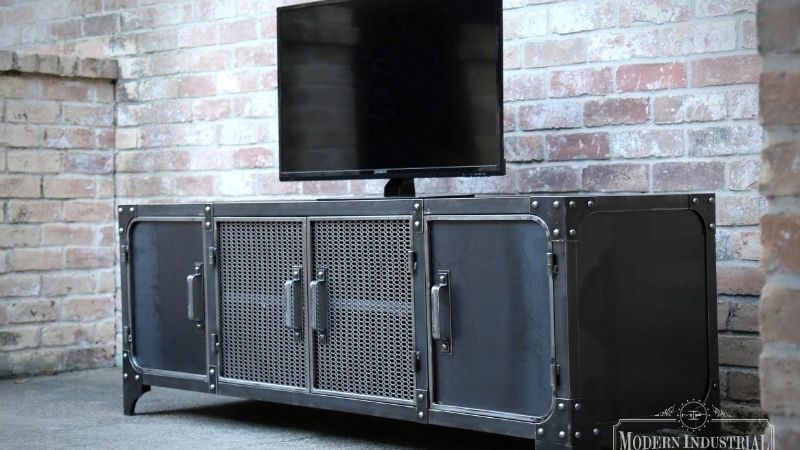
Measure TV Feet Separately From Screen Size
A television described as 65 inches is measured diagonally across its screen. It may use wide-set feet, one pedestal, or a support bracket that occupies a deeper area than the picture suggests. Measure the actual distance between contact points and the footprint of each foot, then check that the assembled top can support them without overhang.
Weight ratings require a second check. Sauder identifies a 70-pound top limit for its 422313, while the Winthrop TV0283 listing separates a 75-pound top from 40-pound lower shelves. Other cabinets may quote a single overall capacity without assigning it to the TV surface; do not treat those figures as interchangeable.
Choose Open Shelves or Concealed Compartments
Exposed metal racks simplify remote-control access and make cable swapping easier, but they also display adapters, dust and loose leads. Cabinets with doors hide that clutter while introducing a different issue: a receiver or game console needs enough internal clearance and ventilation with the door in its normal position.
A full-depth receiver also needs space behind its plugs, which is why overall cabinet depth cannot serve as usable shelf depth. Check the inside opening, the shelf height and the location of cable cutouts in the assembly drawing. Open equipment areas are often easier to cool, but they still must follow the device maker’s ventilation rules.
Check Materials, Assembly and Anti-Tip Safety
Industrial styling is not proof of an all-steel or solid-wood build. The Sauder North Avenue uses a dark metal frame and laminated wood-look surfaces; the Hunter uses solid mango wood on metal legs. Those constructions have different care needs, and an unfinished-looking grain print should not be sold as authentic reclaimed lumber.
Check the full assembly footprint, level the stand as instructed and fit anti-tip hardware recommended for that model. A tabletop TV can require a separate restraint even when the furniture itself is attached. The U.S. Consumer Product Safety Commission advises securing both televisions and furniture to reduce tip-over risks [CPSC, 2025].
Top Picks
The six selections below represent different industrial furniture layouts rather than six finishes of one cabinet. Dimensions are assembled measurements, and a stated TV-size claim is not a guarantee that every television’s feet or weight will fit. Where a maker has not clearly published a top-only load, the table says so instead of inventing a safe capacity.
| Product | Best For | Key Spec | Watch Out For |
|---|---|---|---|
| Sauder North Avenue 422313 | Compact industrial shelving | 43.75 W; 17.625 D; 23.875 H in; 70 lb top | TV claim up to 42 in; laminated surfaces |
| Meyer&Cross Winthrop TV0283 | Exposed all-metal display | 55 W; 15.75 D; 24 H in; 75 lb top | Lower shelves rated separately at 40 lb |
| Laurel Foundry Isakson W004336537 | Open wood-and-metal X-frame | 60 W; 17 D; 25 H in; 80 lb listed capacity | 80 lb not explicitly identified as top-only |
| VECELO THD-TV01-BRN-180 | Long, shallow open console | About 70.86 in long; about 16.22 in high | Seller reverses W/D fields; verify drawing and top load |
| Simpli Home Hunter AXCHUN-68 | Wide solid-wood media display | 68 W; 15 D; 20 H in; 200 lb published capacity | 200 lb scope not separately assigned to top |
| Simpli Home Lowry AXCLRY72-DCB | Wide cabinet with hidden storage | 72 W; 17 D; 20 H in; 220 lb published capacity | Top-only load must be confirmed before placing TV |
Sauder North Avenue 422313 – Best For Compact Industrial Shelving
Best For: Owners of smaller televisions who want the workshop look without a floor-spanning media cabinet.
This is the practical place to start when a bedroom or apartment has room for a short media stand but not a six-foot console. The exposed metal framework expresses the industrial theme without bulky cabinet doors. The trade-off is a modest television-size claim, so it is not a substitute for the larger furniture farther down this list.
Sauder support specifies an assembled footprint of 43.75 inches wide and 17.625 inches deep, with a height of 23.875 inches. The top is rated at 70 pounds; the middle and bottom shelves are separately rated at 35 and 50 pounds. This budget-tier model is advertised for TVs up to 42 inches, subject to actual feet and weight.
The surfaces use laminate over a wood-derived substrate rather than solid reclaimed timber. That distinction matters when cleaning spills or moving the unit: protect the edges from moisture, avoid dragging assembled joints and keep the metal frame level. An owner seeking real hardwood should consider the Hunter instead of paying for the appearance of wood grain.
Pros:
- Published 70-pound top rating supports a clear television-weight check.
- Separate 35-pound middle-shelf rating helps allocate AV equipment sensibly.
- Under 44 inches wide, it leaves wall space for adjacent furniture.
Cons:
- TV-size recommendation stops at 42 inches despite the broad top.
- Laminate cannot be refinished like solid mango or acacia wood.
Who Should Buy It: Choose Sauder for a smaller TV; choose the Winthrop if you prefer actual metal shelves.
Meyer&Cross Winthrop TV0283 – Best For Exposed Metal Shelves
Best For: Households that prefer a blackened-bronze metal frame with no cabinet doors or wood-grain panels.
The Winthrop is the clearest contrast to wood-dominated industrial furniture here. Its steel construction and open lower tiers create a lighter visual outline, especially against a dark feature wall. It is easy to reach components, but the cables and accessories remain visible, so it suits organized AV setups more than rooms needing hidden storage.
For model TV0283, the Home Depot gives an assembled size of 55 inches wide, 15.75 inches deep and 24 inches high. A Lowe’s listing of the same model specifies 75 pounds on top and 40 pounds for each lower shelf. That more precise allocation is useful; some retailer fields inconsistently label the TV diagonal, so stay with the 60-inch written recommendation.
Blackened bronze is a finish, not a claim that the frame is solid bronze. Wipe metal surfaces with a soft dry cloth as the listing advises, and confirm fasteners remain tight after assembly or relocation. This mid-tier open rack has no doors to conceal a router or console, unlike the Lowry, so cable clips and careful device placement may be needed.
Pros:
- Verified 75-pound top rating is distinct from lower-shelf allowances.
- Two 40-pound lower tiers suit clearly bounded equipment loads.
- Fifty-five-inch width works where a 72-inch cabinet would dominate.
Cons:
- All cables and electronic accessories remain visible from the room.
- TV-size data conflicts across retailer fields; verify actual feet first.
Who Should Buy It: Choose the Winthrop for open steel storage; switch to Lowry if concealed shelves matter.
Laurel Foundry Isakson W004336537 – Best For Wood-and-Metal X-Frame
Best For: People seeking a warm, distressed wood-and-metal rack with extra open space for books and media.
The Isakson has an X-braced silhouette that brings stronger workshop character than a plain rectangular steel shelf. Two open wooden shelves make books, baskets and equipment part of the design rather than objects to hide. That flexibility is attractive in a mixed-use living room, although exposed storage also demands regular dusting.
Wayfair gives this specific model an assembled size of 60 inches wide, 17 inches deep and 25 inches high, plus a TV-size claim up to 65 inches. It publishes an 80-pound furniture capacity but does not clearly identify it as a top-only limit. The mix of pine, manufactured wood and metal also differs from an all-solid-wood description.
The powder-coated frame and angled legs require careful leveling on an uneven floor. The retailer lists anti-tip hardware and assembly with two people recommended, but listings and individual color variants may be unavailable when searched. It occupies a mid-tier position; budget for delivery or assembly help rather than assuming that the distressed finish arrives fully built.
Pros:
- Two accessible open shelves accommodate baskets and different media devices.
- Twenty-five-inch cabinet height raises a screen above very low consoles.
- Metal X-bracing creates a distinct look beside plain slab-front cabinets.
Cons:
- Advertised 80-pound capacity lacks an explicit TV-top loading definition.
- Some finishes show unavailable inventory; selection can vary by retailer.
Who Should Buy It: Pick Isakson for decorative open storage; choose Sauder for documented top and shelf weights.
VECELO THD-TV01-BRN-180 – Best For Long Open Shelving
Best For: Owners needing a long, visually lightweight console with room to reach streaming boxes and gaming devices.
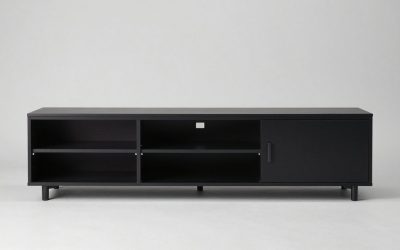
The VECELO is designed around extended open shelving rather than a deep closed cabinet. That matters beneath a wide wall-mounted screen, where a substantial wood cabinet might feel crowded. Two exposed storage tiers make a soundbar and media equipment accessible, although the long open run gives no protection against pets, dust or visible cable clutter.
Home Depot identifies the brown THD-TV01-BRN-180 as a roughly 70-inch-class three-tier unit marketed for TVs up to 80 inches. The listing reports 70.86 inches along one dimension and 16.22 inches in height but appears to swap its width and depth field labels. Treat the plan diagram as the authority before ordering or fitting it into a recess.
The metal-and-wood-look styling suits a loft-like space while keeping the assembled height relatively low. Non-slip floor pads are described in the listing; they do not replace a wall restraint for a tip-prone television. This budget-tier choice also lacks a verified top-only load for the brown variant, so confirm manufacturer documentation before a tabletop installation.
Pros:
- Open three-tier construction exposes cables for straightforward changes and servicing.
- Approximately 71-inch span suits long walls beneath a mounted screen.
- Published floor pads may reduce minor movement on suitable level surfaces.
Cons:
- Retailer reverses dimension labels, requiring a manual drawing check.
- Brown model lacks a verified separate television-top weight limit.
Who Should Buy It: Choose VECELO for open length; choose Hunter when solid wood and a named maker matter.
Simpli Home Hunter AXCHUN-68 – Best For Wide Solid-Wood Display
Best For: Buyers who want real mango wood, exposed metal legs and a low wide profile beneath the screen.
The Hunter offers a restrained industrial look that reads less like utility shelving and more like finished living-room furniture. Its solid mango wood supplies natural grain variation while thin black metal legs keep the cabinet lifted from the floor. The open central section can house devices, but the compact depth may be limiting for bulky receivers.
Simpli Home lists the AXCHUN-68 at 68 inches wide, 15 inches deep and 20 inches high, with a 200-pound published furniture capacity and a TV-size recommendation up to 75 inches. Those figures come from the named 68-inch model; the capacity is not clearly broken out as a tabletop-only rating. The solid-wood design falls in the premium tier.
Its manufacturer lists anti-tip hardware and a one-year warranty. Because the maker’s description mixes drawer terminology with hinge language, inspect the current installation drawing before counting on a specific door movement or organizer shape. Care for the lacquered wood surface as directed; it is not a substitute for waterproof storage beneath frequent drinks.
Pros:
- Solid mango construction gives natural grain rather than a printed effect.
- At 20 inches high, the cabinet stays visually low beneath large TVs.
- Manufacturer specifies 68-inch width and 15-inch depth for planning.
Cons:
- Fifteen-inch depth may not accommodate unusually deep home-theater receivers.
- Storage hardware description needs checking against the current assembly document.
Who Should Buy It: Choose Hunter for low solid-wood styling; pick Lowry for more enclosed storage and depth.
Simpli Home Lowry AXCLRY72-DCB – Best For Hidden Media Storage
Best For: Larger households wanting an industrial wood-and-metal cabinet that conceals games, accessories and remote-control clutter.
The Lowry is the clearest choice for people who like the industrial finish but dislike seeing everything beneath the screen. Two hinged side doors hide smaller possessions, while the open central section remains accessible for electronics. Its main compromise against the Winthrop is that enclosed sections need more planning for warm devices and cable access.
For distressed charcoal acacia model AXCLRY72-DCB, Simpli Home specifies 72 inches wide, 17 inches deep and 20 inches high. It recommends TVs up to 80 inches and lists a 220-pound cabinet capacity; the listing does not allocate that number explicitly to the TV top. Solid acacia, metal angled legs and adjustable side shelves distinguish this premium-tier unit.
Precut cable openings help route leads from the central shelf, while the hinged doors mean an unobstructed front swing must be kept clear. The brand provides assembly instructions, tip-resistant hardware and a one-year warranty. Unlike an open metal rack, its finished wood can be scratched by hard equipment feet, so use appropriate pads without blocking vents.
Pros:
- Two enclosed side areas separate stored accessories from active electronics.
- Seventy-two-inch width offers a broad visual base for large screens.
- Seventeen-inch depth provides more furniture depth than the Hunter model.
Cons:
- Hinged doors require swing clearance unavailable beside some adjacent furniture.
- Published 220-pound general capacity needs top-specific confirmation for tabletop TVs.
Who Should Buy It: Buy Lowry for hidden side storage; switch to Winthrop for a lighter all-metal open design.
Frequently Asked Questions
The questions below deal with choices that are easy to overlook after selecting a finish: how a cabinet interacts with a particular television support, the floor beneath a narrow steel leg, actual sightline height and the care differences between metal and wood. These details are often more consequential than a product title.
Can a 72-Inch Stand Hold Every 80-Inch Television?
No. A manufacturer saying a 72-inch-wide cabinet suits an 80-inch screen does not mean every 80-inch model is supported. Screen size is diagonal and the foot spread, foot depth and actual television weight vary. A narrow central pedestal may fit where widely spaced legs do not; check the exact television specification before ordering.
A model-specific limit for the stand’s top is also necessary when the TV rests on the furniture. One whole-unit capacity printed beside the assembled width may cover the cabinet structure rather than an individual panel. If that point cannot be verified, a correctly designed independent wall mount may be the safer way to support the television.
Do Industrial TV Stands Need Adjustable Feet?
Not all of them, but a leveling solution can be helpful when a metal frame rests on an uneven floor. A rocking corner can loosen joints over time and makes the television harder to stabilize. Check whether the chosen stand offers adjustable levelers, fixed pads or neither, because a non-slip pad does not automatically make a unit level.
Put the assembled stand on a firm, level surface before final tightening, following its own instructions. If it rocks, correct the floor contact before adding a screen; do not force the cabinet square with a heavy television. Protective pads should be compatible with the floor finish and must not defeat required anchoring or stability measures.
What Height Works for a Seated TV Viewing Position?
The useful measurement is the height of the screen center when you sit in your normal chair, not the cabinet height alone. A 20-inch stand plus television feet can put the picture substantially lower than a 25-inch stand using the same TV. Measure your own seated eye line, screen dimensions and stand height together before committing.
Some people prefer the picture center close to seated eye level, but furniture depth, sofa recline and room distance alter a comfortable result. A wall mount gives more control than forcing an otherwise unsuitable cabinet to lift the screen. Leave space for speakers or a soundbar without blocking the display or its sensors.
How Should Steel Shelves and Wood Finishes Be Maintained?
Start with the care sheet for the exact material and coating. A soft dry cloth is suitable for routine dust removal on many finished metal frames, while harsh abrasives can mark lacquer or powder coating. Moisture trapped against laminated board edges can be particularly damaging, so wipe spills promptly and avoid soaking the surfaces.
Solid mango or acacia can show natural grain variation rather than the uniform pattern of laminate. Neither material should be used as a workbench for hot electronics or sharp hardware without suitable protection. Recheck fasteners after moving a cabinet, and remove the TV and loose equipment first as directed by its manufacturer.
Final Thoughts
The strongest industrial tv stand is the one whose documented top can carry your specific screen and whose storage matches the equipment you actually own. Choose Sauder or Winthrop when separate loading figures matter; use VECELO primarily as an open base after checking its drawing, or consider Hunter and Lowry for solid wood. Before checkout, verify feet placement, internal device clearance and the anti-tip plan for your room.