Key takeaways
- A throw blanket measuring 50 inches wide and 60 inches long is a practical starting point for one person on a sofa. But what size should a throw blanket be for a nap, a shared couch, or the foot of…
A throw blanket measuring 50 inches wide and 60 inches long is a practical starting point for one person on a sofa. But what size should a throw blanket be for a nap, a shared couch, or the foot of a bed? Choose by the coverage you need, not just the label “standard.”
As an Amazon Associate we earn from qualifying purchases.
By KK Home Furnishings Editorial Team
Throw Blanket Sizes: What the Measurements Tell You
Retailers use throw, large throw, and oversized throw for noticeably different dimensions. Pottery Barn lists a 50-inch-wide by 60-inch-long standard faux-fur throw and a 60-inch-wide by 80-inch-long oversized version; Brooklinen also sells a 50-inch-wide by 70-inch-long throw [Pottery Barn; Brooklinen, accessed October 2026].
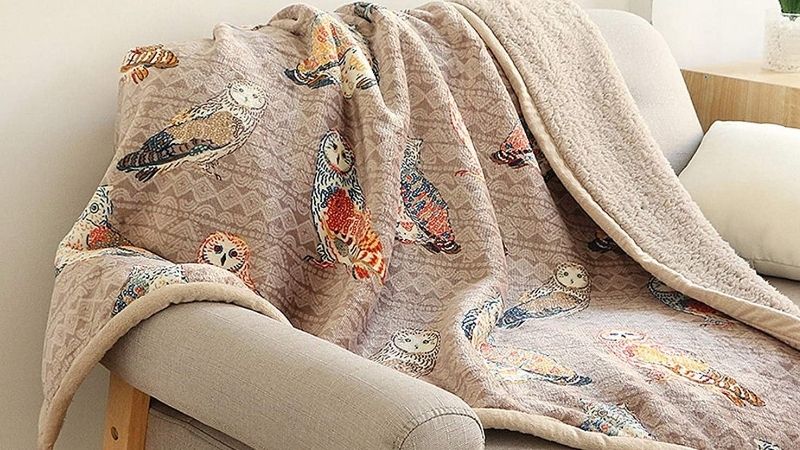
The size examples below come from product dimensions published by Pottery Barn, Brooklinen, The Company Store, and IKEA, checked in October 2026. They show real retail options rather than official universal size classes. The fit recommendations are editorial judgments based on those stated measurements, not detailed research.
| Example Listed Size | Published Product Example | Practical Use | Main Limitation |
|---|---|---|---|
| 47 in. wide by 63 in. long | IKEA HOLMVI | A reading chair or light sofa layer | Less width for wrapping around the sides |
| 50 in. wide by 60 in. long | Pottery Barn Luxe Faux Fur, standard | A compact throw for one seated adult | May leave feet exposed during a full nap |
| 51 in. wide by 67 in. long | IKEA HUMLEMOTT | A little more length for lounging | Still primarily a single-person layer |
| 50 in. wide by 70 in. long | Brooklinen Dreamweave Waffle | Longer sofa naps without a much wider throw | Limited shared shoulder-to-shoulder coverage |
| 59 in. wide by 79 in. long | IKEA VALLKRASSING | More generous lounging and bed-end styling | Takes more room to fold or drape neatly |
| 60 in. wide by 80 in. long | Pottery Barn Luxe Faux Fur, oversized | Shared sofa lounging or a broader bed accent | Not automatically a full-bed blanket |
Choose Length for Sitting Versus Stretching Out
Start by picturing your posture. Someone sitting upright can tuck a short throw over the lap and knees, while a person reclining across a sofa needs fabric running from shoulders toward the feet. The common 50-by-60-inch retail option is handy for the first job; a 70- or 80-inch length offers more room for the second.
Length is not a promise of head-to-toe coverage. The throw bends over your knees, bunches under your ankles, and may sit diagonally across your body. For a tall sleeper who wants to tuck the feet inside, favor a longer published length rather than assuming that “oversized” always means longer in the direction you need.
Compare Width With Your Furniture and Intended Drape
Width matters differently on an armchair and on a wide sofa. For a chair, a narrower throw avoids thick fabric piling onto the floor. On a couch, enough width helps cover your sides when you move or share the blanket. A decorative fold can look balanced even when it does not span an entire seat cushion or mattress.
When shopping for the foot of a bed, decide whether you want a folded accent or an edge-to-edge covering. The first needs only a visually pleasing strip; the second requires actual bed-blanket dimensions. Measure the visible area of your furniture and check the retailer’s stated width rather than making the word “queen” or “king” your throw-size rule.
Check Fabric, Edges, and the Listed Finished Size
A chunky knit, lightweight cotton weave, and thick faux fur can all have the same listed dimensions yet occupy very different amounts of space when folded. Heavy pile can make a large throw feel bulky on a small chair. An open weave may drape more softly, but that does not change the number of inches the brand publishes.
Fringe, tassels, and stretch can complicate visual comparisons. Check whether a product page defines dimensions across the textile body or includes trim; do not assume every brand measures the same way. For example, The Company Store lists its Textured Bouclé Throw at 50 inches by 70 inches and separately notes fringe trim [The Company Store, accessed October 2026].
Adjust the Throw Size to the Way You Use It
Use the actual activity to select a size, then compare two retailers’ dimensions before ordering. The situations below give starting directions without treating a size name as a guarantee. For this article, “throw” means a conventional non-electric accent blanket, not a heated throw or a weighted blanket with separate use considerations.
For an Armchair, Reading Nook, or Small Accent Chair
A modest throw keeps the chair inviting without covering its whole silhouette. IKEA’s HOLMVI is listed at 47 inches wide and 63 inches long, demonstrating that a practical chair throw can be narrower than the familiar 50-inch width [IKEA, accessed October 2026]. Drape it over an arm or keep it folded in a nearby basket.
If you use a footstool, think about where the blanket will end when your legs are extended. A chair accent and a leg-covering layer solve different problems. Choose the smaller option for visual texture and quick warmth; move toward a longer throw if you routinely put your feet up for an entire movie.
For One Person Curling Up on a Standard Sofa
A throw around 50 inches wide by 60 inches long is a strong default for sitting or curling up, not a universal requirement. Pottery Barn publishes those dimensions for its standard Luxe Faux Fur Throw [Pottery Barn, accessed October 2026]. You can wrap it across the lap, pull it around the shoulders, and return it to the sofa arm afterward.
Check your own habits before buying several matching throws. Someone who sits upright with a drink needs less fabric than someone who pulls the blanket beneath the feet. If a compact throw feels convenient but slightly short, an intermediate length, such as IKEA’s 51-by-67-inch HUMLEMOTT, may be a better compromise than a much bulkier oversized blanket.
For a Tall Adult Who Wants to Nap on the Couch
Prioritize a longer edge instead of merely searching for the word “large.” Brooklinen publishes 50 inches wide by 70 inches long for its Dreamweave Waffle Throw, giving a concrete alternative to the shorter 50-by-60-inch format [Brooklinen, accessed October 2026]. That difference is most useful when you lie along the sofa rather than sit.
For a person who stretches out fully, a near-80-inch length may be more accommodating. IKEA lists VALLKRASSING at 59 inches wide by 79 inches long [IKEA, accessed October 2026]. Neither measurement guarantees complete coverage for everyone, since height, sleeping position, and how much fabric you tuck under your feet all change the result.
For Two People Sharing the Same Couch
Choose greater width and length when two people will sit under one blanket, especially if they want separate coverage over their knees. Pottery Barn’s oversized Luxe Faux Fur option measures 60 inches wide by 80 inches long [Pottery Barn, accessed October 2026]. That gives more fabric to distribute than its standard version, though two adults may still need to sit close together.
One oversized throw is convenient for occasional sharing. Two individual throws are often more flexible if one person gets up, one wants more warmth, or both prefer to tuck their feet in separately. Do not mistake 60 inches of throw width for enough to cover the full width of a multi-seat couch or both people lying flat.
For a Folded Accent Across a Twin or Full Bed
A regular throw can be an attractive bed-end accent when you fold it lengthwise and place it across the lower section. The point is color or texture, not replacing a blanket designed to cover the sleeping surface. IKEA’s 51-by-67-inch and Brooklinen’s 50-by-70-inch options provide two realistic lengths for trying different folds [IKEA; Brooklinen, accessed October 2026].
Before ordering, lay a towel or piece of fabric over the area where you plan to display the throw. Use that visual mock-up to judge how much of the coverlet will remain visible. The same throw might reach farther across a twin bed than a full bed, but neither placement guarantees side drop without measuring the finished fabric.
For a Decorative Layer on a Queen or King Bed
Treat a throw on a large bed as a finishing layer, not a substitute for a queen- or king-size blanket. An oversized design such as Pottery Barn’s 60-by-80-inch option can form a broad folded band, while IKEA’s 59-by-79-inch VALLKRASSING provides a similarly generous decorating scale [Pottery Barn; IKEA, accessed October 2026].
If you want a throw to hang over both mattress sides and cover the sleepers all night, shop for a blanket sized for the bed instead. A throw that looks luxurious in a styled photo may cover only part of a king-size surface. For a narrower accent, fold a standard throw and position it off-center rather than stretching it to imply full coverage.
Frequently Asked Questions
Throw dimensions are easier to use once you know what a retailer is measuring. These answers address purchasing details and maintenance questions that can affect the finished size, rather than repeating which throw belongs on a particular piece of furniture.
How Do You Measure a Throw Blanket You Already Own?
Lay the throw on a clean, flat surface without stretching it. Smooth the fabric gently and measure straight across the textile for width, then from the upper to lower fabric edge for length. For a loosely knitted throw, use its relaxed shape rather than pulling it taut to match a number on a label.
If the blanket has tassels or long fringe, make a separate note of that decorative extension instead of silently treating it as usable fabric. Measure the throw as it normally rests, especially if you are checking whether it will fit a basket, chair back, or folded display area. These are at-home measurements, not a replacement for a maker’s official specifications.
Does Fringe or a Tassel Edge Count Toward Throw Length?
It depends on how the brand reports the finished dimensions. A listed length does not tell you whether decorative fringe was measured from its outer tip or whether only the woven body was counted. The Company Store specifically describes fringe on its 50-by-70-inch Textured Bouclé Throw but does not establish a universal measuring convention [The Company Store, accessed October 2026].
If you need an exact fit for a chair or bed display, ask the seller for the fabric-body measurements and trim length. Fringe adds visual movement, but it does not provide the same continuous coverage as a woven or knitted edge. This distinction matters most when you are selecting a throw for a precise furniture opening.
Will the Size of a Throw Change After Washing?
It can, depending on the fibers, construction, and care method. Some fabrics may shrink if exposed to an unsuitable wash or dryer setting; loosely constructed knits may change shape when handled or dried incorrectly. There is no safe universal shrinkage percentage to apply to every cotton, polyester, wool, or mixed-fiber throw.
Follow the sewn-in care label and any product-specific instructions. For example, The Company Store specifies a cold delicate wash and low tumble drying for its Textured Bouclé Throw, while Pottery Barn lists line drying for its Luxe Faux Fur Throw [The Company Store; Pottery Barn, accessed October 2026]. Do not substitute one brand’s method for another’s.
Is a Bigger Throw Always Warmer or More Comfortable?
No. More fabric can provide more potential coverage, but warmth also depends on fiber, weave, thickness, room temperature, and how you use the blanket. A lightweight oversized cotton throw can feel less insulating than a smaller, dense plush option. The dimensional label alone is not a warmth rating or a promise of comfort.
If temperature matters more than appearance, compare the materials and construction after choosing a size that covers the areas you want. A breathable layer may work better for warm evenings; a fuller pile may suit a chilly sitting room. Consider storage and laundry space too, since extra fabric can be less convenient even when you enjoy its coverage.
Final Thoughts
For most people, the answer to what size should a throw blanket be starts with a 50-by-60-inch sofa throw, then shifts toward a longer or wider option for napping and sharing. Check the retailer’s actual dimensions, decide whether you need body coverage or decorative drape, and buy for that job instead of the size label.