Key takeaways
- Measure sleeves, box sets and usable cabinet interiors, then verify load limits and retrieval space before storing vinyl records upright.
What's inside
To check whether records will fit a cabinet, measure the largest sleeved item and the cabinet’s usable interior, including its opening. A “12-inch record” describes the disc format, not the outside size of every jacket, protective sleeve or box set. Fit also does not establish that a shelf can carry the collection’s weight.
Measure the collection you will actually store
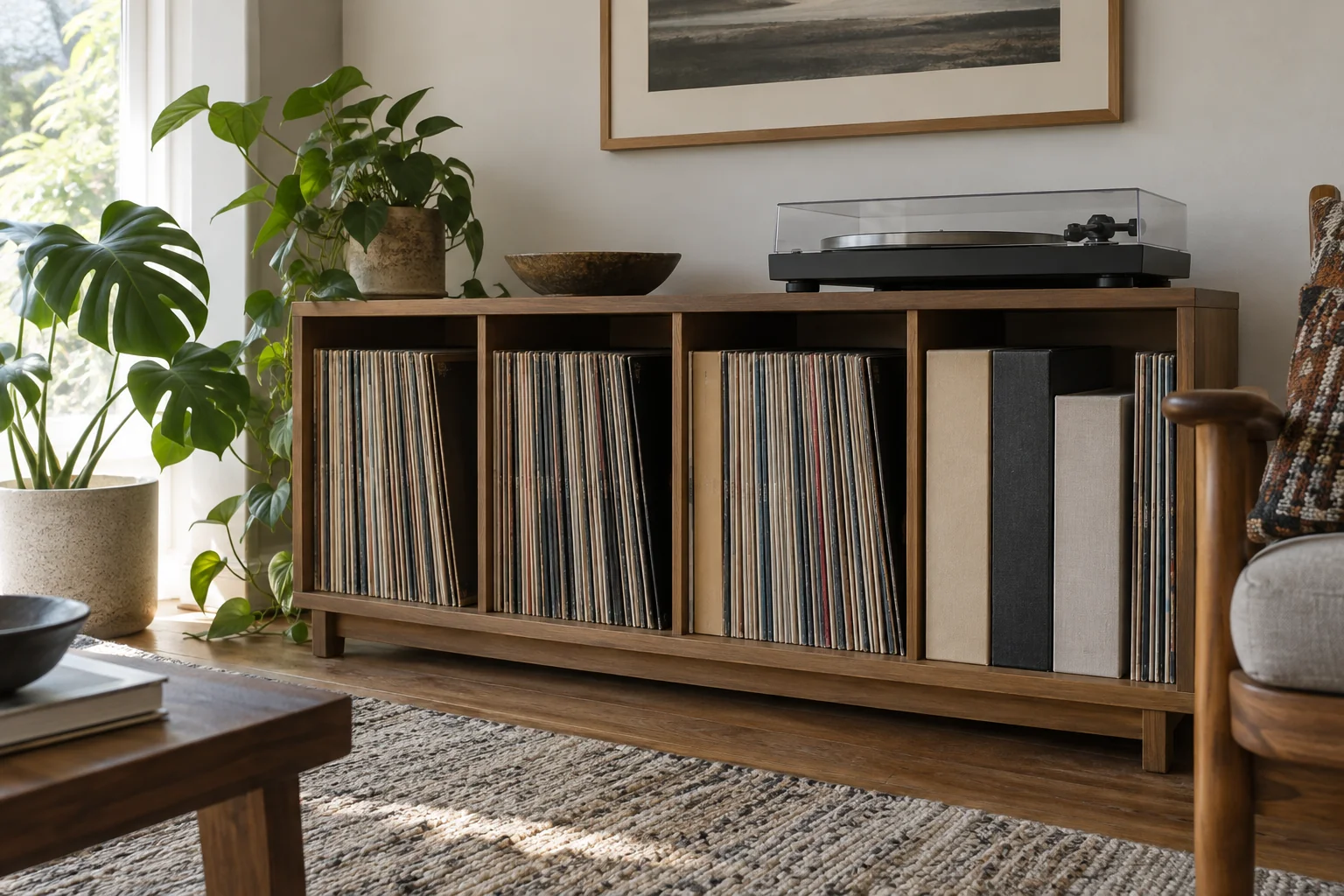
Choose a representative group: a regular sleeve, a gatefold, the tallest protective outer sleeve and the largest box set you intend to use in this cabinet. Measure each closed item as stored. Record its height, front-to-back depth and thickness. Keep oversize items on a separate line rather than assuming the most common album controls every dimension.
The Library of Congress audiovisual storage guidance recommends upright storage for discs and emphasizes shelving strong enough for their concentrated weight. This is why the worksheet treats support and load as separate checks from opening size. It is not enough for one record to slide into an empty compartment.
Record clear dimensions, not overall furniture size
Measure the opening at its narrowest usable point, then the space behind it. A face frame, hinge, door catch or shelf lip may make those measurements different. For a closed cabinet, check depth with the door in its closed position without trapping a record inside. Include the space occupied by any planned insert or divider.
As a specific reference, IKEA Denmark lists KALLAX compartment dimensions as 33 by 33 by 39 centimeters, in width, height and depth order. That is a documented example, not a standard for every cube organizer. Check the exact article, configuration and any added insert before using the dimensions for your purchase.
| Check | Collection measurement | Cabinet measurement or evidence |
|---|---|---|
| Upright height | Tallest item with its outer sleeve | Clear opening and interior height |
| Depth | Deepest closed sleeve or box | Usable depth with doors and fittings considered |
| Row width | Measured group of albums as stored | Width remaining after suitable supports or dividers |
| Retrieval | Room needed to grip and remove an item | Door swing and access at the front |
| Weight | Actual planned contents, including inserts | Manufacturer’s applicable shelf and total load limits |
| Support | Which groups need upright support | Compatible stable supports and correct assembly |
An illustrative clearance calculation
Imagine a fictional cabinet with a clear opening 34 centimeters high and 35 centimeters deep. The largest measured sleeved record is 32 centimeters high and 33 centimeters deep. Subtracting gives two centimeters of vertical clearance and two centimeters of depth clearance. Those figures establish a geometric gap only; they do not prove comfortable access, protection from a door fitting or sufficient shelf strength.
Now add a box set that is 35 centimeters high. It fails the upright-height check even though ordinary albums fit. The useful response is to give that set a different suitable location or choose another cabinet, rather than force it in diagonally and call the whole collection compatible. These invented dimensions illustrate the method and are not a recommended universal clearance.
Estimate rows from a real sample, then check weight
Count a manageable group of records and measure the width it occupies without squeezing sleeves. Note whether the group includes many gatefolds or unusually thick packages. Use that observation for a provisional layout, but keep space for retrieval and suitable support. A fixed “albums per cube” number hides the variation between collections.
For example, if a fictional sample of twenty albums occupies nine centimeters, three similar groups would occupy about twenty-seven centimeters before allowing for supports and access. This is a planning estimate, not a capacity promise. Replace the estimate with the actual assembled group when checking a cabinet you already own.
Weigh the proposed contents in manageable groups if you can do so safely, then compare their combined weight with the exact furniture instructions. Include dividers and other stored objects. Do not borrow a load rating from another shelf width or cabinet orientation, and do not conduct a homemade overload test. An unknown rating remains a reason to ask the manufacturer.
Consider the cabinet as installed
Follow the furniture maker’s assembly, orientation and wall-restraint requirements. An empty cabinet that seems steady is not evidence that its loaded configuration is suitable. Keep heavy storage decisions separate from decorative styling, and avoid adding improvised casters or changing the support arrangement without the manufacturer’s approval.
Check the room position too. The Library of Congress recommends a stable storage environment away from direct or intense light and heat sources. Rather than declaring a universal safe distance from a radiator or window, inspect the proposed location and choose one consistent with the collection’s preservation needs and the furniture instructions.
Make the purchase decision in three stages
Mark the worksheet “fits geometrically,” “load and installation verified,” and “usable for retrieval.” A cabinet needs all three before it becomes a convincing choice. If a showroom sample is available, ask permission to use a sleeved representative item or a correctly sized paper template to check access without scratching furniture.
Save the measurements and source of the load information. When the collection grows, revisit the weight and row layout rather than packing the original compartment ever more tightly. The aim is a cabinet that holds the actual collection upright, within its documented limits, and lets you remove an album without a struggle.