Key takeaways
- The right pad is less about brand than about matching its material and size to how far your chair actually rolls on a wood floor. This guide to a desk chair pad for wood floors walks through four hard-floor-safe formats,…
The right pad is less about brand than about matching its material and size to how far your chair actually rolls on a wood floor. This guide to a desk chair pad for wood floors walks through four hard-floor-safe formats, from compact polycarbonate to extra-large glass, so you choose by coverage and build rather than by the product name.
As an Amazon Associate we earn from qualifying purchases.
By KK Home Furnishings Editorial Team
Choose the Pad by Your Workspace, Not Just the Product Name
The four formats below are organized by what fits a workspace: compact polycarbonate, larger polycarbonate, rigid tempered glass and extra-large coverage. Each is hard-floor compatible, so the decision is which size and material suit your rolling zone, not whether a listing says pad or mat, which are not inherently different products.
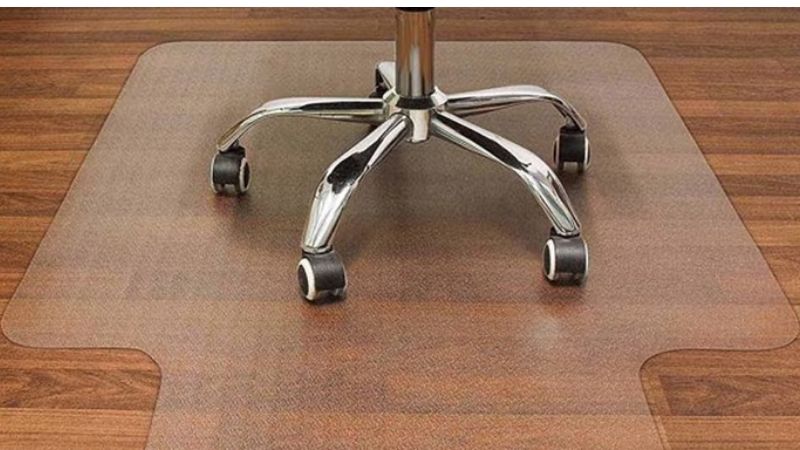
Compact 36×48 polycarbonate
The smallest common format is a 36-by-48-inch polycarbonate pad, about 12 square feet, like the Staples ST63679 labeled explicitly for hard floors. It suits a standard desk where the chair rolls within a tight zone, covering the seated area and a modest push-back without consuming much room.
This size works for most single-monitor desks and rooms where the chair stays close to the work surface. A lipped version extends under the desk to protect the floor where your feet and the chair base sit, which a plain rectangle leaves bare, so the lip is worth having at this footprint.
The limit is rolling range: if you push far back or move between a desk and a credenza, 12 square feet runs out and the casters hit bare wood at the edge. For a compact, stationary rolling zone it is ideal and economical, but a larger travel pattern needs one of the bigger formats below.
Larger 48×60 polycarbonate
Stepping up to a 48-by-60-inch polycarbonate pad, about 20 square feet, like the Floortex Ultimat, suits a desk chair pad for wood floors where the chair ranges wider. The extra width and depth keep the casters on the pad when you push back fully or shift between parts of a larger workstation.
That coverage matters for L-shaped desks, dual-monitor setups where you roll side to side, or anyone who reaches a printer stand without standing. It keeps polycarbonate’s lower cost and easy handling while solving the main weakness of the compact size, which is running out of pad at the edges of normal movement.
The trade-off is simply footprint and a higher price than the 36-by-48, plus the same polycarbonate caveat that it can dish over years under a heavy chair. For a mid-size rolling zone it hits the balance of coverage and cost, sitting between the compact budget pad and the premium glass options.
Rigid tempered glass
Tempered glass is the rigid, long-term format, represented by the 48-by-48-inch Vitrazza Sola Terra on a hard-surface bumper system rather than carpet cleats. It never dishes or indents, rolls effortlessly and resists surface scratching, which is why it suits a prized floor and a chair used all day.
Glass is heavy, with a large pad weighing around 50 pounds, and that weight keeps it firmly in place without gripping the floor, a plus for hardwood since it needs no cleats. The smooth, firm surface also makes rolling easier than flexible polycarbonate, a subtle daily difference over a shift at the desk.
The costs are price and portability, since glass sits at the premium tier and is not something you reposition casually. For a dedicated, long-term setup on a floor worth protecting, it is the format that will not wear out or deform, where polycarbonate is the sensible choice for moderate use and easier handling.
Extra-large coverage
When the rolling zone is genuinely large, an extra-large pad like the 48-by-84-inch Vitrazza glass, about 28 square feet, covers travel that smaller formats cannot. That is roughly 2.33 times the nominal area of a 36-by-48 pad, a geometric coverage comparison, not a claim of better protection per square foot.
This format suits a long desk run, a standing-desk base that moves, or a workspace where the chair travels between zones without the user rising. Keeping every caster on the pad across that whole range is what prevents bare-wood contact at the extremes of movement, which is where scratches concentrate.
The practical costs are size, weight and price, since an extra-large glass pad is heavy and premium and demands the floor space to match. It is overkill for a compact desk, so this format earns its place only when your taped travel area genuinely approaches its dimensions rather than as a default upgrade.
Four Options
These four options map the format choices above to real products, from a budget polycarbonate pad to extra-large glass. Specs are manufacturer-stated and promotional prices shift, so use the tiers and confirm stock; each declares hard-floor compatibility, and the right pick is the one whose size matches your measured rolling zone.
| Product | Best For | Key Spec | Watch Out For |
|---|---|---|---|
| Staples ST63679 | Best Budget | 36 x 48 in polycarbonate; lip; hard-floor-specific | Smallest zone; polycarbonate can dish |
| Floortex Ultimat 1215219ER | Best Larger Polycarbonate | 48 x 60 in (20 sq ft) hard-floor polycarbonate | Larger footprint; higher price than 36 x 48 |
| Vitrazza Sola Terra | Best Glass | 48 x 48 in; 1/4 in tempered glass; hard-surface bumpers | Heavy (~50 lb); premium tier |
| Vitrazza Extra Large | Best Extra-Large | 48 x 84 in (28 sq ft); tempered glass; 100 lb | Very heavy; needs a large rolling zone |
Staples ST63679 — Best Budget
The Staples ST63679 is the budget desk chair pad for wood floors, a 36-by-48-inch hard-floor-specific polycarbonate pad with a lip that slides under the desk. It is the economical choice for a compact rolling zone where the chair stays close to the work surface rather than ranging across the room.
The lip is the practical feature, extending coverage to where the chair base and feet sit beneath the desk, which a plain rectangle leaves exposed. At about 12 square feet it covers a standard single-monitor setup, and its light polycarbonate build is easy to lift for cleaning the floor underneath.
Polycarbonate can dish or crack over years under a heavy chair, so it suits moderate use more than an all-day heavy roller, and promotional pricing on it comes and goes. Keep the floor clean beneath it, since trapped grit abrades regardless of the pad, and confirm the size matches your actual travel before buying.
Floortex Ultimat — Best Larger Polycarbonate
The Floortex Ultimat is the larger polycarbonate option at 48 by 60 inches, about 20 square feet, for a chair that ranges wider than a compact pad allows. It keeps polycarbonate’s lower cost and easy handling while covering an L-shaped desk or a side-to-side rolling pattern that a smaller pad would leave exposed.
That extra coverage is the reason to choose it: push-back and lateral movement stay on the pad, so the casters do not stray onto bare wood at the edges. For a dual-monitor desk or a workstation with a nearby printer stand, it solves the main limitation of the 36-by-48 without moving to heavy glass.
It costs more than the compact pad and takes more floor space, and it shares polycarbonate’s tendency to dish over years under heavy use. For a mid-size rolling zone on a wood floor, though, it is the balanced pick, giving generous coverage at a friendlier price and weight than the glass formats.
Vitrazza Sola Terra — Best Glass
The Vitrazza Sola Terra is the glass option, a 48-by-48-inch quarter-inch tempered pad on hard-surface bumpers rather than carpet cleats. It is the long-term pick for a wood floor, never dishing or indenting, rolling smoothly and resisting surface scratching where polycarbonate eventually shows wear.
Its roughly 50-pound weight keeps it firmly in place without gripping the floor, which suits hardwood since it needs no cleats, and the rigid surface makes rolling noticeably easier than flexible plastic. For a chair used all day on a floor you intend to keep, that durability and feel justify the premium.
The trade-offs are cost and weight, since it sits at the premium tier and is not something to reposition often. As with any pad, keep the floor clean underneath, because trapped grit is a separate abrasion risk, and glass protects the finish rather than guaranteeing it can never be marked under all conditions.
Vitrazza 48×84 — Best Extra-Large
The Vitrazza 48-by-84-inch glass pad is the extra-large option at about 28 square feet, roughly 2.33 times the nominal area of a 36-by-48 pad. It is the choice for a genuinely large rolling zone, such as a long desk run or a moving standing-desk base, where smaller formats leave travel uncovered.
Covering that full range keeps every caster on the pad across wide movement, which is where bare-wood contact and scratches otherwise occur. It brings the same tempered-glass durability and smooth rolling as the Sola Terra, scaled up for a workspace where the chair travels between zones without the user standing.
At about 100 pounds it is very heavy and premium-priced, and it demands the floor space to match, so it is overkill for a compact desk. Choose it only when your taped travel area genuinely approaches its dimensions, since paying for coverage you never roll onto adds weight and cost without protecting more floor.
Frequently Asked Questions
These answers address what buyers ask about a desk chair pad for wood floors, from whether polycarbonate is safe to what size makes sense. The guidance is practical, and no pad makes hardwood scratch-proof, so treat these as ways to match coverage to your chair rather than guarantees against every mark.
Is polycarbonate safe for wood floors?
Polycarbonate is safe for wood floors when the pad is declared hard-floor compatible with a smooth, non-cleated backing, like the Staples and Floortex options here. The material itself does not react with varnished or lacquered wood under correct use, and its smooth underside protects the finish rather than gripping it.
The risk with any pad is not the plastic but a carpet-style cleated backing, which bites into wood, so always confirm the hard-floor label. Clear polycarbonate also keeps the floor visible and is light enough to lift for cleaning, which helps you remove the grit that is the real abrasion source under any pad.
Over years a heavy chair can dish or crack polycarbonate, especially at edges, so it suits moderate use more than constant heavy rolling, where glass holds up better. Used on a clean floor with the correct hard-floor backing, polycarbonate is a safe, economical choice for most home offices on wood flooring.
Is a glass chair pad worth it?
A glass pad is worth it for a long-term setup on a floor you want to protect, because it never dishes or indents, rolls smoothly and resists surface scratching in ways polycarbonate cannot over time. Its weight also holds it in place without cleats, which suits hardwood that needs a non-gripping base.
The case against it is cost and weight: a large glass pad is premium-priced and heavy, so it is not something you reposition casually or need for a compact, light-use desk. For a chair used all day or a prized floor, that durability earns the price, while a moderate setup is well served by polycarbonate.
If you choose glass, confirm it uses a hard-surface bumper system rather than carpet cleats, keep the floor clean beneath it, and size it to your travel. Under those conditions it is a durable, hardwood-safe investment, where for lighter use the extra cost and weight are harder to justify over a good polycarbonate pad.
Is 36×48 large enough?
A 36-by-48-inch pad, about 12 square feet, is large enough for a compact rolling zone where the chair stays near the desk, which is the common single-monitor setup. A lipped version extends coverage under the desk, so for a stationary workstation it usually covers the seated area and a modest push-back.
It becomes too small when you roll far back, move side to side across a wide desk, or travel to a nearby stand without standing, since the casters then reach bare wood at the edges. That is the point at which the 48-by-60 polycarbonate or a larger glass pad earns its extra footprint on the floor.
The reliable way to decide is to tape your actual travel and measure it rather than guessing from desk width. If the taped rectangle fits within 36 by 48 with margin, the compact pad is enough; if the chair strays past it in normal use, size up so that every caster stays on the pad throughout.
Should the chair remain completely on the mat?
Yes, the goal is to keep all four casters on the pad throughout normal movement, because the moment a wheel rolls off, it contacts bare wood and can scratch or wear the finish at that spot. Sizing the pad to your real travel is how you achieve that across push-back and side-to-side motion.
This is why area alone does not confirm fit and why a round pad can fall short: a circle narrows at the back, so the rear casters can roll off when you push away from the desk. A rectangle generally keeps more front-to-back room for the same footprint, which better suits a chair that reverses often.
If the chair occasionally rolls off at one edge, either size up or reposition the pad to center your travel on it, so every caster stays on the pad through normal use. Keeping every caster on a clean, correctly sized pad is the whole point of the purchase, so match the format to how the chair actually moves.
Final Thoughts
A desk chair pad for wood floors is a choice of material and coverage once the backing is hard-floor safe: the Staples pad suits a tight zone, the Floortex Ultimat a wider range, the Vitrazza Sola Terra durable glass, and the extra-large Vitrazza a long travel area. Tape your chair’s travel, then pick the format that keeps every caster on the pad.