Key takeaways
- Light framing helps a substantial cabinet read less heavily against pale walls.
- Warm door panels connect a painted console with natural textures nearby.
- Closed side compartments can hide accessories while open bays serve electronics.
The best barn door style tv cabinet ideas pair a distinctive sliding-door look with storage that works when the doors are open or closed. Start with a bright two-tone console for an airy room, choose darker X-braced fronts for contrast, or use a corner-fitting cabinet when the TV wall is tight. The right layout matters more than the rustic label.
As an Amazon Associate we earn from qualifying purchases.
By KK Home Furnishings Editorial Team
Barn Door Style TV Cabinet Ideas for Lighter Living Rooms
These first three ideas suit rooms where the cabinet needs to feel integrated rather than dominate the wall. Sliding doors change which compartments are visible, so think about the arrangement of everyday electronics before picking a color. The comparison below gives design-oriented starting points, not guaranteed measurements or prices for every model.
| Idea | Space or Size Needed | Cost Tier | Effort and Time |
|---|---|---|---|
| White and wood two-tone cottage console | Open wall with room for a medium or wide cabinet | Mid-range design tier | Furniture selection plus simple styling |
| Compact barn doors with an open electronics bay | Short wall or multipurpose family room; check actual width | Entry to mid-range tier | Measure equipment before furniture assembly |
| Charcoal X-braced fronts with dark metal accents | Wall with enough visual space for a darker focal piece | Mid-range design tier | Furniture selection and color coordination |
| Corner-fitting sliding barn-door cabinet | Usable corner with clearance on both walls | Mid-range design tier | Check wall angles, outlets, door travel |
| Wide sliding-door media sideboard | Long, uninterrupted TV wall; verify doorway access | Mid to upper design tier | Room planning and careful assembly |
| Rustic oak and black-rail industrial farmhouse | Open wall with visible cable path and stable floor | Mid-range design tier | Finish coordination and media setup |
1. White-and-Wood Cottage Console With Sliding Barn Doors
Best For: Bright living rooms with neutral upholstery, woven rugs, and a need to hide games or media accessories.
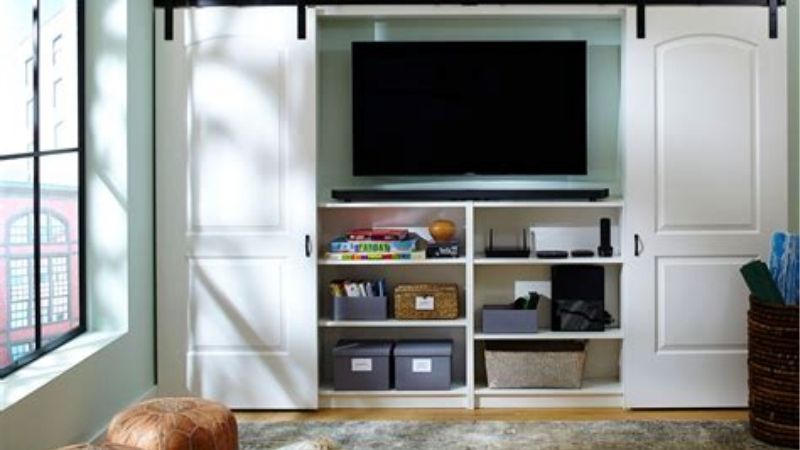
A pale frame and wood-grain doors give farmhouse character without turning the whole TV wall into a dark wood feature. This is an approachable option for a room with cream, beige, or soft gray upholstery. Keep the cabinet surface mostly clear so the contrast between painted framing and textured fronts remains the main decorative detail.
Look for a layout with accessible open shelves in the middle and enclosed compartments behind the sliding panels. Walker Edison’s 70-inch sliding barn-door console provides a documented two-tone example with adjustable shelves and steel sliding hardware; the listed finish and cabinet dimensions are examples of that model, not a sizing rule for every room. Measure the actual TV base and weight separately.
Use a muted oak or weathered-wood shade beside warm floors, then repeat that tone once in a picture frame or coffee table. A white painted finish shows scuffs and fingerprints more readily than a busy grain pattern, so choose a surface that matches the household’s cleaning habits. Keep frequently used electronics outside closed areas if their controls or airflow require open access.
Pros:
- Light framing helps a substantial cabinet read less heavily against pale walls.
- Warm door panels connect a painted console with natural textures nearby.
- Closed side compartments can hide accessories while open bays serve electronics.
Cons:
- Pale finishes make everyday marks more visible around frequently handled doors.
- Busy reclaimed-wood prints can compete with patterned rugs and wall art.
Who Should Skip It: Choose the charcoal X-brace concept instead if your room needs darker contrast rather than a soft cottage mood.
2. Compact Sliding Doors With an Open Electronics Center
Best For: Apartment dwellers with a shorter TV wall and equipment that should remain reachable from the sofa.
A compact barn-door cabinet works best when its moving fronts conceal secondary storage while a center bay stays ready for the devices used every day. That arrangement gives a small room some farmhouse texture without hiding every receiver or streaming box behind wood. It is especially useful when the cabinet must share the wall with a doorway or bookcase.
For a real scale reference, Walker Edison’s Cottonwood model measures 54 inches wide, 15.5 inches deep, and 32 inches high, and its manufacturer specifies a TV limit of 60 inches and 50 pounds. These are model-specific limits, not permission to place every 60-inch screen on it. Compare the television’s actual feet or pedestal, weight, and the cabinet’s rated top before deciding.
Choose a version with cord cutouts and adjustable shelves if you move equipment between rooms. Test the door positions conceptually: a panel that uncovers the right-hand cabinet may cover the middle bay at the same moment. Plan a permanent position for equipment that needs ventilation or an unobstructed remote signal, rather than expecting the door to stay in one convenient position forever.
Pros:
- A shorter cabinet preserves breathing room on an already crowded wall.
- Open center shelving keeps frequently accessed controls easier to reach.
- Adjustable storage can accommodate accessories with different shelf heights.
Cons:
- Limited top width may rule out televisions with widely spaced feet.
- A moving panel may temporarily block another compartment or device.
Who Should Skip It: Choose the wide sideboard look when a larger room needs more closed storage and stronger horizontal balance.
3. Charcoal X-Braced Doors for a Modern Farmhouse Contrast
Best For: Transitional rooms with light walls, black hardware, and furniture that already uses charcoal or walnut accents.
A charcoal cabinet with diagonal X-bracing gives barn-door styling a sharper outline than distressed white furniture. The diagonal detail reads from across the room, while dark rails tie in with black window frames, lamps, or door hardware. Use this version as one deliberate focal piece; repeating the X motif on every side table can make the room feel themed rather than considered.
Design references for barn-door entertainment centers include charcoal fronts, dark brown bodies, and visible X-panel detailing, but the exact door material varies by product. Some pieces use laminated engineered wood rather than solid reclaimed boards. Read the material description before expecting to sand, refinish, or repair the surface as though it were thick natural timber.
Pair charcoal with warmer cushions and a light rug to keep the seating area from becoming visually heavy. If a dark cabinet stands against a dark wall, add contrast through art or lighting around the furniture rather than placing a lamp directly in front of a sliding door. Check handles and rail placement so adjacent cabinets, baskets, and plants do not obstruct the panel’s path.
Pros:
- Distinct X-bracing creates a farmhouse cue without extra decorative pieces.
- Dark tones coordinate easily with existing black metal home hardware.
- High-contrast styling can define a TV wall within an open-plan room.
Cons:
- A dark cabinet may visually shrink a narrow, poorly lit alcove.
- Pronounced diagonal patterns can clash with already busy furniture fronts.
Who Should Skip It: Prefer the light two-tone cottage version when the room needs softness instead of a strong graphic feature.
Statement Barn Door Cabinets for Tricky or Larger Walls
The next three arrangements are useful when the room shape, rather than the finish alone, drives the decision. A corner cabinet solves a different problem from a long, low media sideboard, even when both have sliding barn doors. The final look balances rustic texture with metal hardware. Treat named manufacturer examples as references to inspect, not a ranked shopping list.
4. Corner-Fitting Barn Door Stand for an Awkward Room
Best For: Small living rooms where windows, circulation paths, or a fireplace prevent a straight-on media wall.
A corner-fitting cabinet brings the barn-door detail into a layout that cannot spare one long uninterrupted wall. It can turn a television toward the main seating position while releasing a straight wall for shelving or a sofa. The practical test is whether the cabinet’s rear shape truly fits the corner, not whether the store image happens to show it set diagonally.
Walker Edison lists a 52-inch sliding barn-door corner stand at 52 inches long, 15.5 inches deep, and 28 inches high, with adjustable shelves and rear cable openings. The stated TV suitability is up to 60 inches for that particular model; verify the complete product rating, foot placement, and actual screen weight. A standard rectangular console placed across a corner is not necessarily an equivalent substitute.
Measure from the corner along both walls, then identify the outlet, baseboard, heat source, and route for viewing cables. A corner footprint can leave a triangular gap behind furniture, but that space should not become a place to crush connectors or trap heat-producing components. Also check the full sliding-door travel with the cabinet near curtains, floor lamps, or side furniture.
Pros:
- Corner geometry can free a straight wall for other living-room functions.
- Sliding access avoids the forward swing needed by hinged cabinet doors.
- Adjustable shelves help organize small accessories behind decorative fronts.
Cons:
- An awkward wall angle can leave gaps even with corner-labeled furniture.
- Rear cable access may be difficult after furniture occupies the corner.
Who Should Skip It: Use the compact straight-wall option if a normal wall position gives better viewing angles and cable access.
5. Wide Sliding-Door Sideboard Beneath a Large Screen
Best For: Long living-room walls where a broad, low furniture silhouette is more balanced than a narrow cabinet.
A sideboard-style cabinet uses the length of the wall to calm the visual impact of a large television. Two sliding doors can reveal one set of shelves while concealing another, letting the owner decide how much media gear remains on display. Keep ornaments low and sparse on the top; a crowded display beside a screen weakens the clean horizontal line that makes this design work.
As a documented design example, Walker Edison has listed a 70-inch-wide sliding barn-door console measuring 28 inches high and 15.75 inches deep, with three adjustable shelves and cord ports. Its listed 70 inches describes the cabinet width, not an automatic approval for a 70-inch television. Check a prospective cabinet’s supported load and the TV manufacturer’s base dimensions before pairing them.
Before committing to a long piece, mark the width on the wall and verify that delivery can pass through halls, turns, and doorways. Decide whether you want the center shelves visible all the time, because a sliding panel can alternate between areas rather than uncover everything simultaneously. Storing heavier objects low and installing the specified restraints matters more than arranging books symmetrically.
Pros:
- Long furniture can visually anchor an expansive television wall without tall shelving.
- Several bays separate media electronics from board games and decorative storage.
- Door movement lets visible shelving change with the room’s daily use.
Cons:
- Long flat-pack pieces can be cumbersome through narrow hallways or stairs.
- A wide cabinet overwhelms short walls and may crowd door clearances.
Who Should Skip It: Choose the corner concept or compact open-center cabinet if the room cannot accommodate a long media wall.
6. Rustic Oak Texture With Exposed Black Sliding Rails
Best For: Casual modern rooms mixing warm timber, matte-black metal, and simple, low-profile storage.
Exposed black rails can make a cabinet feel more industrial than traditional farmhouse, especially when paired with an oak-look grain rather than distressed white paint. This works well beside metal-frame coffee tables and leather or woven seating. Let the rail read as the detail: smooth walls and restrained artwork prevent the TV area from looking like a collection of competing textures.
Walker Edison’s 58-inch sliding-door stand has been offered in rustic oak and gray-wash finishes, with adjustable shelves, cord management, and a laminated engineered-wood body. Its manufacturer lists overall dimensions of 58 by 16 by 28 inches for a specific version. A wood-grain appearance does not establish solid oak construction, so check the product sheet before planning future refinishing.
Style the upper surface with one shallow tray or a small plant only where there is no TV base, moving door, or ventilation opening. Route cables through built-in openings instead of letting them hang across the black track. Painted steel hardware may need occasional inspection for loosened fasteners or rough motion, but service steps belong to the furniture’s own instructions, not a generic DIY retrofit.
Pros:
- Warm grain and dark rails pair readily with mixed wood-and-metal furniture.
- Exposed tracks provide an intentional design feature without added ornaments.
- Enclosed storage can simplify the view around everyday media equipment.
Cons:
- Wood-look laminate generally cannot be refinished like a thick oak plank.
- Visible rails emphasize misalignment, dust, and inconsistent door gaps.
Who Should Skip It: Select the white-and-wood cottage look if industrial hardware feels too prominent in your room.
Frequently Asked Questions
Once the finish and cabinet shape look right, the remaining questions tend to concern the moving doors and actual room use. These checks are worth making before ordering, because a good photograph cannot show a cable socket, a renter’s wall rules, or the amount of ventilation a particular electronic device needs. The answers below help turn a favorite look into a workable plan.
How Much Clearance Do Sliding Barn Cabinet Doors Need?
Sliding cabinet doors normally do not require the same outward swing zone as hinged doors, but they still need unobstructed travel across the cabinet face. The exact clearance depends on the track, handles, door overlap, and any protruding trim specified by the furniture maker. Measure the full installed width and the space occupied by the door in both end positions, not only the open compartment.
Stand where you normally use the TV and imagine reaching a game console with the doors on opposite sides. Floor lamps, baskets, or nearby furniture may obstruct handles even if the metal rail itself remains clear. A door that covers another compartment while opening is working as designed; that limitation should influence which shelf holds frequently used items.
Can Renters Use Barn Door Style TV Cabinets?
Yes, a ready-made freestanding unit can give a rented living room the barn-door aesthetic without building permanent shelving. However, renters still need to follow the cabinet’s assembly and restraint directions, and any required wall fixing should be agreed with the property manager. Do not treat permission to place freestanding furniture as permission to omit its anti-tip provisions.
The U.S. Consumer Product Safety Commission’s Anchor It guidance advises securing televisions and furniture and using stands designed to hold televisions. It also recommends keeping objects that tempt children to climb away from the TV area. A renter who cannot make the necessary secure installation should find an arrangement that can be approved and installed safely, rather than relying on decorative placement alone.
Are Barn Door Cabinets Usually More Expensive Than Plain TV Stands?
Not necessarily. Price depends on size, materials, finish, sliding hardware, storage layout, shipping, and whether assembly is included. A large engineered-wood barn-door cabinet may cost less than a smaller solid-wood piece with simple hinged doors. Compare actual current listings with similar dimensions and load ratings instead of assuming that the decorative rail determines the price.
Also include the less visible costs of your particular choice: delivery to an upper-floor apartment, furniture assembly, replacement hardware, and the accessories needed to organize cables. A cheaper cabinet with fixed shelves can be poor value when your receiver does not fit. For a design article, cost tiers in the table are only broad planning guides, not verified market quotes.
Can Gaming Consoles Stay Behind Closed Sliding Doors?
Only when the device manufacturer allows the enclosure and the cabinet provides the required ventilation. Some media gear needs open airflow, and an opaque door can also interfere with infrared remotes. Avoid assigning one universal air-gap measurement to every console or receiver: heat output, fan placement, and allowed cabinet use vary by device and model.
Map power and signal cords before filling the shelf, and check that the door cannot catch a controller cable or press against a plugged-in connector. An open-center cabinet is often easier for equipment you operate frequently. Closed spaces are more suitable for compatible items that do not need ongoing cooling or remote access, such as boxed accessories and board games.
Final Thoughts
The strongest barn door style tv cabinet ideas begin with the shape of the room and the location of the equipment, then use color and door detailing to support that plan. Choose a compact open-center design for daily electronics, a corner silhouette for a broken wall, or a long sideboard for generous storage. Confirm the furniture’s TV rating, door movement, cable access, and restraint requirements before buying.
More from Amazon
Programs that pair well with the guide above. Offers and eligibility are set by Amazon and may change.
Collect the home and kitchen items you want in one registry that guests can shop from.
Create a wedding registrySet up recurring deliveries of everyday items on eligible products. Terms and savings are set by Amazon.
Explore Subscribe & SaveFree shipping on eligible items, Prime Video and more. Eligible new members can start with a free trial.
Start a Prime free trialAudiobooks and podcasts to listen to on the go. Eligible new members can start with a free trial.
Try Audible freeAs an Amazon Associate we earn from qualifying purchases.