Key takeaways
- Measure your tuck depth: Before anything else, measure from your desk edge to the wall behind your chair. You need roughly 36 inches of clear floor to sit down and stand up comfortably, and a chair whose back clears your desktop edge when pushed in. High-back executive models frequently fail this test.
- Base diameter over seat width: The five-star base is the widest point on most chairs and the part that catches table legs, radiators, and floor vents. A 27-inch base sweeps a noticeably larger arc than a 25-inch one across a full swivel.
- Flip-up or stowable arms: In tight rooms, arms that fold up let the chair slide fully under a desk, reclaiming eight to ten inches of floor. This single feature matters more than any other for dual-purpose rooms.
- Match the wheels to your floor: Rubber or PU casters roll silently on hardwood and laminate without gouging, and they don’t sink into thin apartment carpet the way hard nylon does. Quiet wheels also matter more in a studio where the bed is six feet away.
- Verify weight capacity honestly: Ratings between 300 and 500 pounds reflect real differences in frame gauge, cylinder rating, and cushion density. Choosing above your weight extends the chair’s usable life, but heavier-rated chairs are almost always physically larger.
What's inside
The chair problem in a small home office is rarely about comfort alone. It’s about footprint. A chair that reviews beautifully in a 200-square-foot studio can dominate a corner desk setup, block a closet door, or refuse to tuck under a 28-inch-deep desktop. Add the fact that supportive seating genuinely gets better above the $300 mark, and buyers end up caught between a chair that fits their body and one that fits their room.
This guide approaches office chairs under $500 the way a small-space organizer would: measuring swing radius and tuck clearance alongside lumbar adjustability and weight capacity. Below are six chairs spanning slim mesh task seating to 500-pound-capacity executive builds, with notes on which ones actually work when your office doubles as a bedroom, dining nook, or hallway alcove.
As an Amazon Associate we earn from qualifying purchases.




How to Choose a/an Office Chair Under 500 (2026)
- Measure your tuck depth: Before anything else, measure from your desk edge to the wall behind your chair. You need roughly 36 inches of clear floor to sit down and stand up comfortably, and a chair whose back clears your desktop edge when pushed in. High-back executive models frequently fail this test.
- Base diameter over seat width: The five-star base is the widest point on most chairs and the part that catches table legs, radiators, and floor vents. A 27-inch base sweeps a noticeably larger arc than a 25-inch one across a full swivel.
- Flip-up or stowable arms: In tight rooms, arms that fold up let the chair slide fully under a desk, reclaiming eight to ten inches of floor. This single feature matters more than any other for dual-purpose rooms.
- Match the wheels to your floor: Rubber or PU casters roll silently on hardwood and laminate without gouging, and they don’t sink into thin apartment carpet the way hard nylon does. Quiet wheels also matter more in a studio where the bed is six feet away.
- Verify weight capacity honestly: Ratings between 300 and 500 pounds reflect real differences in frame gauge, cylinder rating, and cushion density. Choosing above your weight extends the chair’s usable life, but heavier-rated chairs are almost always physically larger.
The Best Office Chair Under 500 (2026)s Reviewed
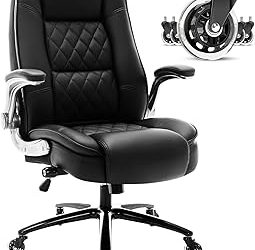
500lbs Big and Tall Executive Desk Chair with Pocket Spring Cushion
The pocket spring seat is the standout here, distributing weight the way a quality mattress does rather than compressing into a flat pancake after six months. It’s a genuinely large chair, so confirm you have wall clearance behind your desk before committing.
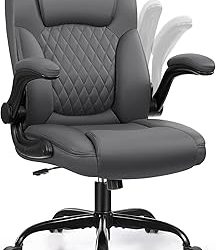
Ergonomic Office Chair for Long Hours, 330 lb Capacity
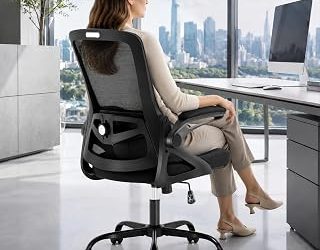
This is the most apartment-friendly pick on the list: a modest footprint, straightforward padded lumbar adjustment, and a profile that tucks in without a fight. For desks in bedrooms or shared living rooms, the smaller base diameter earns its keep daily.
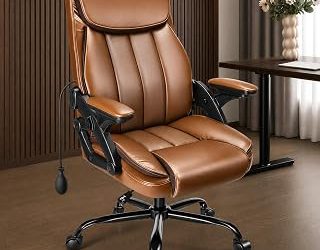
YFO Home Office Desk Chair, Brown Leather
A quieter aesthetic choice for rooms where the desk sits in plain view, and the brown leather reads more like furniture than office equipment. Rubber casters keep it silent on hard floors, though the fixed armrests limit how far it slides under a low desktop.
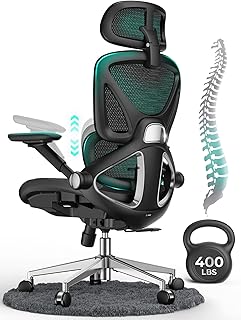
Ergonomic Mesh Office Chair, 400lbs, 4D Flip-up Arms
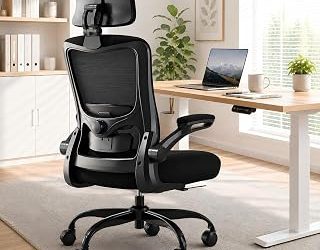
The flip-up arms and breathable mesh back make this the most versatile chair here for tight quarters, since it stows nearly flush against a desk. The three-level tilt and adjustable headrest give you real support without the visual bulk of a padded executive shell.
500lbs Big and Tall Extra Wide Seat Executive Chair
The extra-wide seat and thick armrest padding suit longer sessions and larger frames, backed by a heavy-duty base that feels planted rather than tippy. Plan on a dedicated corner for this one; it isn’t a chair you’ll be relocating between rooms.
Frequently Asked Questions
Will a big and tall chair fit a small home office?
Sometimes, but you need about 40 inches of depth behind the desk edge and a wall without baseboard heating or trim in the swing path. If your desk sits in an alcove, a mid-back mesh chair is the safer choice.
Is mesh or padded upholstery better for a bedroom office?
Mesh, generally. It reads visually lighter in a room that’s already full, breathes in spaces without dedicated cooling, and doesn’t hold odors the way foam and fabric can in a closed room.
Do massage and heat features actually hold up?
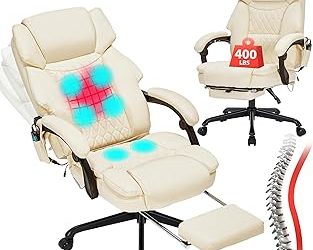
The vibration and heat functions on chairs like the massage model with foot rest are pleasant additions rather than therapeutic equipment. Buy that chair for its recline and footrest if you want a genuine work-and-rest hybrid in one piece of furniture.
Do I need a chair mat on apartment flooring?
If the chair ships with rubber or PU casters, usually no on hardwood or laminate. On low-pile carpet, a thin mat noticeably reduces rolling effort and prevents fiber wear in the small area you pivot over every day.
Final Thoughts
For most small offices, the Ergonomic Mesh Office Chair with 4D flip-up arms is the strongest all-around choice, combining real adjustability with a profile that disappears under a desk. If your room is genuinely tight, the 330 lb Capacity Ergonomic Office Chair is the easiest fit, while the 500lbs Big and Tall model with pocket spring cushion is the pick when you have the floor space and want seating built to last years rather than seasons.