
Key takeaways
- A floating TV console can be 47 1/4 inches wide or more than 70 inches wide, and depth and cabinet height change with the specific design. The most useful floating tv console dimensions are the full exterior width, depth, height,…
A floating TV console can be 47 1/4 inches wide or more than 70 inches wide, and depth and cabinet height change with the specific design. The most useful floating tv console dimensions are the full exterior width, depth, height, usable compartment openings, and the clearance you choose below the cabinet. Published sizes are examples, not universal standards.
As an Amazon Associate we earn from qualifying purchases.
By KK Home Furnishings Editorial Team
Floating TV Console Dimensions by Width, Depth, and Height
Published US listings provide a more reliable starting point than a single supposed standard size. IKEA describes wall-mountable BESTÅ TV units at both 47 1/4 and 70 7/8 inches wide, with a 15 3/4-inch depth and 15-inch body height. Prepac lists an Altus wall-hung console that is 58.25 inches wide, 16 inches deep, and 16.75 inches high [IKEA; Prepac via Lowe’s, October 2026].
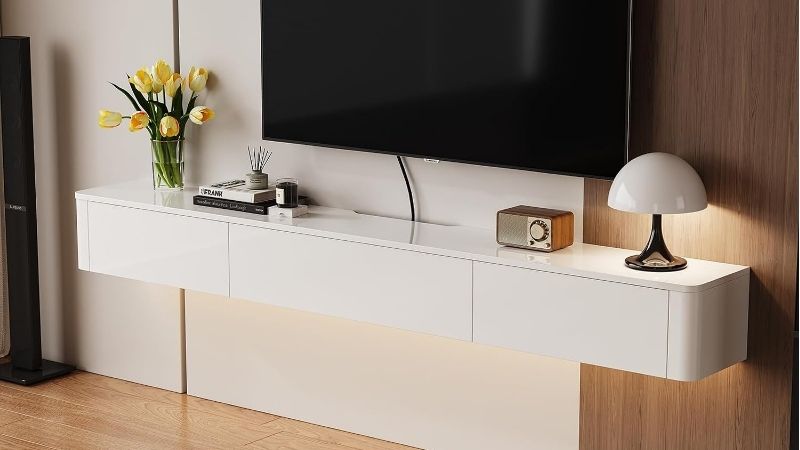
Use the cabinet dimensions to check wall fit, then check the instructions for installation permission, load limits, and mounting hardware. A tall cabinet with nearly identical width and depth can be unsuitable for hanging: the IKEA 70 7/8-inch BESTÅ unit with a 25 1/4-inch body is specifically marked not to be hung on a wall [IKEA, October 2026].
| Published example | Overall width | Depth | Body height | Wall mounting / limitation |
|---|---|---|---|---|
| IKEA BESTÅ 705.660.33 | 47 1/4 in | 15 3/4 in | 15 in | Wall-mount option; maximum TV top load 35 lb |
| Prepac Altus ECAW-0208-1 | 58.25 in | 16 in | 16.75 in | Wall-hung rail design; TV up to 75 lb per listing |
| IKEA BESTÅ 005.657.77 | 70 7/8 in | 15 3/4 in | 15 in | Wall-mount option; maximum TV top load 66 lb |
| IKEA BESTÅ 805.660.37 | 70 7/8 in | 15 3/4 in | 25 1/4 in | Floor-standing model; must not be hung |
Table values identify four exact configurations, not a recommended dimension range for every floating console. The TV limits are model-specific top-load claims, not a guarantee that a given wall can carry the complete installed cabinet. Do not substitute the tall floor unit for a wall-hung design merely because its width matches.
Width: Fit the Actual Wall and TV Footprint
A 47 1/4-inch cabinet uses much less wall area than a 70 7/8-inch one. IKEA publishes both sizes in its 15-inch-high BESTÅ TV-unit family, and it recommends choosing a bench slightly wider than the television placed on it [IKEA, October 2026]. Treat that as brand buying guidance, not a formula for every model.
Measure the visible television body and, if the screen will stand on the console, the real span of its feet or pedestal. The screen diagonal is not the width of its base. For a separately wall-mounted TV, furniture width is mainly about visual balance and the amount of equipment storage rather than support for the display.
Depth: Compare Outer Depth With Usable Shelf Space
The 47 1/4-inch IKEA BESTÅ listed here measures 15 3/4 inches from front to back, while Prepac lists 16 inches for its 58.25-inch Altus model [IKEA; Lowe’s, October 2026]. Those exterior numbers do not equal the clear depth inside each compartment. Back panels, doors, hinges, and cable bends reduce useful space.
Measure the deepest game console, receiver, router, or speaker that will go inside, including its power and HDMI plugs. If a product has doors, confirm that the equipment will fit with them closed. Device manufacturers may specify their own ventilation clearances; never use the cabinet’s external depth as proof a hot-running receiver will be safe in it.
Cabinet Height: Know Where the Measurement Starts
For the wall-mountable IKEA BESTÅ examples above, the body itself is 15 inches high. The Prepac Altus listing reports 16.75 inches [IKEA; Lowe’s, October 2026]. Neither height specifies the distance between the floor and the underside of a future installation, because installers can position the cabinet at different approved heights.
Separate three numbers in your plan: cabinet body height, desired underside clearance, and the top edge after mounting. Furniture listings normally supply the first, while the latter two depend on the selected placement. Also check whether opening a door or lowering a compartment lid needs additional unobstructed space above or below the unit.
Adjust for Your Situation
A useful sizing choice begins with where the TV is supported and what the console will hold. The six situations below turn catalog measurements into a room-specific decision. They are alternatives, not six different products to rank. In every case, the exact model instructions and the construction behind your wall override a generic design suggestion.
Choose a Narrow Console for a Compact Media Wall
If you have a short section of uninterrupted wall, start by marking the entire cabinet width with painter’s tape. The 47 1/4-inch BESTÅ example is an actual smaller format compared with its 70 7/8-inch sibling [IKEA, October 2026]. Check nearby door swings, radiators, switches, trim, and whether a person can pass without bumping the cabinet corners.
Avoid choosing purely by the available wall span. An open 47-inch unit can be long enough for a wall-mounted TV setup yet still be too shallow for a full-size receiver. Check interior measurements before paying for a narrow cabinet, and keep the screen supported independently when the furniture is not rated to hold the TV itself.
Choose a Long Cabinet for a Wide TV Wall
A 70 7/8-inch unit provides a different visual proportion and more total bay width than the 47 1/4-inch version. IKEA associates its 70 7/8-inch, 15-inch-high BESTÅ TV unit with televisions up to 72 inches and specifies a 66-pound maximum TV weight on the top panel [IKEA, October 2026]. Those limits belong to this exact frame.
The installed wall cabinet also imposes a structural loading question. IKEA says permissible load for a wall-hung TV bench varies with wall material, and its product page specifies the required wall fasteners. A long horizontal cabinet does not automatically distribute its full load safely across drywall; verify stud or masonry anchorage with the manual or a qualified installer.
Set the Cabinet Height Around the Seating Position
Begin with the viewer’s seated eye line and the actual planned screen location. A floating cabinet should not determine where the center of the TV must sit, especially when the television is independently attached to the wall. Mark the TV’s planned edges and the cabinet’s upper edge at full size before drilling.
The installation height is an adjustable design decision, not a fixed industry standard. If the cabinet’s top would crowd the screen, move the cabinet only within what the wall structure, hardware, and intended storage permit. Avoid raising the screen uncomfortably just to create an oversized decorative gap above a cabinet.
Allow Real Clearance for Cleaning and Floor Features
The distance from the floor to the bottom of a floating console is not included in the advertised body dimensions. Decide how much unobstructed access is needed for your vacuum, robot cleaner, floor vent, or baseboard heater. Then mark the complete silhouette so the cabinet does not block airflow or look visually crowded against nearby furniture.
A desired gap is only a layout preference, not permission to drill at that level. Confirm the fastening points, wall composition, available blocking, and utility locations first. If a robot vacuum needs access, verify its actual height rather than relying on an arbitrary online suggestion about how many inches should remain open.
Size the Storage for Consoles, Receivers, and Cables
A cabinet can be deep enough overall and still fail to hold an audio receiver once plugs and ventilation space are considered. The Prepac Altus product listing identifies a 58.25-inch outer width and reports separate compartments for AV gear [Lowe’s, October 2026]. The exterior dimensions alone cannot establish the usable opening size.
Measure the tallest device, then inspect each shelf opening, door clearance, and cable cutout. Reserve any ventilation clearance specified in the electronics manual. Putting a gaming system or receiver in a tightly enclosed bay can defeat the purpose of an attractive floating installation, so make airflow a functional sizing requirement.
Check the Wall-Mount Method Before Buying
Not every BESTÅ unit accepts the same mounting accessory. IKEA permits wall mounting the 15-inch-high BESTÅ TV units used above but explicitly says its BESTÅ suspension rail must not be used for the TV bench. The 25 1/4-inch-high BESTÅ frame in the table instead states that it must not be wall hung [IKEA, October 2026].
The Prepac Altus follows a different fastening design with a wall-hanging rail [Lowe’s, October 2026]. Do not interchange either company’s hardware or assume a drywall anchor can take the place of a required stud attachment. Follow the exact product instructions, account for all stored equipment, and hire a professional when the wall construction is uncertain.
For homes with children, mounting the display independently is especially important when the cabinet is not intended to support it. CPSC advises securing televisions and furniture and using stands designed for TVs [CPSC, Anchor It]. Hidden wiring and a floating appearance do not replace the manufacturer’s fastening requirements.
Frequently Asked Questions
These final checks cover details that shoppers often discover after they have chosen a cabinet width: what the advertised screen-size label means, whether the unit can actually hang, and how to verify a practical fit without inventing a universal number.
Does a floating console need to be wider than the television?
Not if the television is mounted separately and the console is used only for approved storage. In that setup, cabinet width chiefly affects proportion and device space. If the TV sits on top, however, the actual TV feet must fit fully on the supported surface and the model’s top-load rating must be respected.
IKEA recommends a TV bench slightly wider than the television sitting on it [IKEA, October 2026]. That is manufacturer guidance, not a universal rule for screens hung independently from the wall. Never substitute the advertised TV diagonal for the physical stand-foot span when checking fit.
Are floating TV consoles always about 16 inches deep?
No. The verified examples here happen to cluster near that depth: 15 3/4 inches for selected IKEA BESTÅ units and 16 inches for the Prepac Altus [IKEA; Lowe’s, October 2026]. That does not establish an industry standard, and it says nothing about a different brand’s interior storage.
If you are buying for a soundbar or compact streaming box, clear width may matter more than depth. For a deep AV receiver, measure to the rear of the attached cables and check that its own cooling instructions can still be followed. Choose the model from those real measurements.
Can a floor-standing TV console be converted to a floating one?
Only when the exact manufacturer instructions explicitly allow wall installation. Some BESTÅ units are dual-purpose, but IKEA states that its 70 7/8-inch-wide, 25 1/4-inch-high BESTÅ TV unit must not be hung from a wall [IKEA, October 2026]. Matching widths within a product family do not override that restriction.
Adding generic brackets or drilling an unapproved frame can create a falling hazard and compromise its structure. Buy a unit designed for the mounting method you want, with the specified fittings. Where the wall material or load path is unclear, obtain advice from a qualified installer.
Should the TV sit on the floating console or have its own mount?
Either arrangement requires confirmation from the exact product manuals. A TV resting on top must stay within the console’s permitted TV weight and fit its actual support footprint. A separately wall-mounted TV transfers screen weight to its own approved wall mount, leaving cabinet capacity for the cabinet and its stored contents.
A wall-hung console is not automatically a TV mounting bracket. CPSC recommends anchoring TVs and furniture to prevent tip-overs [CPSC, Anchor It]. For a clean installation, plan distinct support paths for the television, cabinet, and cables before choosing either arrangement.
Final Thoughts
The right floating tv console dimensions come from measured wall space, cabinet clearance, real device sizes, and a mounting method approved for that exact model. Compare manufacturer-listed width, depth, and body height, then verify interior openings and the wall load path. Do not treat a matching size or sleek product photo as proof that a cabinet is safe to hang.
