
Key takeaways
- A King air bed sounds simple until you find that King dimensions and pumps vary from one model to the next. The best king air beds publish their true inflated size and a maximum load, and say plainly whether a…
A King air bed sounds simple until you find that King dimensions and pumps vary from one model to the next. The best king air beds publish their true inflated size and a maximum load, and say plainly whether a pump is included, so you are not left measuring a guest room or buying a pump after the fact.
As an Amazon Associate we earn from qualifying purchases.
By KK Home Furnishings Editorial Team
How to Choose King Air Beds
An air bed is judged on its real inflated size, how much it holds, and what it takes to inflate it, not on the word King alone. The criteria below start with true dimensions and total load, then cover the pump and height, and the durability and storage details that decide whether an air bed survives more than a few guests.
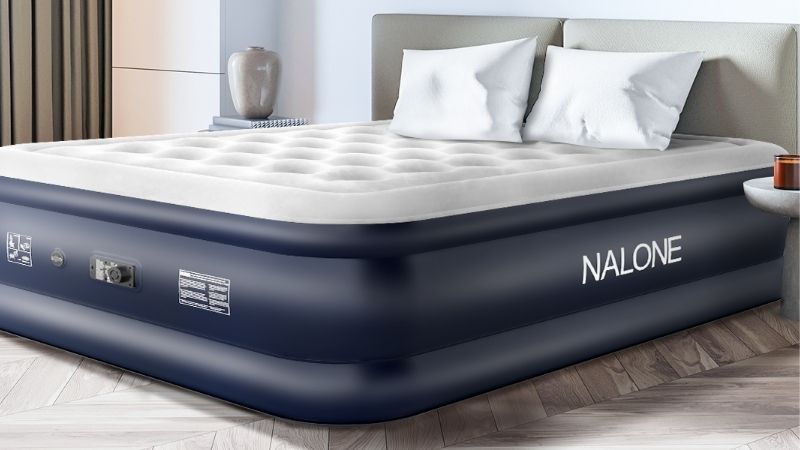
True Inflated Size, Not Just “King”
King is not a single dimension across air beds, so check the actual inflated size. The models here measure about 72 by 80 inches, narrower than a standard residential King, so confirm the figure rather than assuming it matches your King sheets or the floor space you measured for a traditional King mattress in a bedroom.
Measure the space where the bed will go, including walkways, since an inflated air bed takes its full footprint plus room to move around it. A guest room or living room that fits a frame may feel tight with an air bed on the floor, so map the 72-by-80-inch footprint before buying rather than after it is inflated.
Do not generalize one model’s dimensions to all King air beds, since sizes differ by brand and even by line. Check the exact inflated measurements for the specific model, and if you plan to use King sheets, confirm the fit, because a 72-by-80-inch bed may leave standard King bedding loose at the sides and corners.
Total Weight Limit
The weight rating is a total, not a per-person figure, so read it that way. These beds list a 600-pound maximum, which covers two sleepers plus bedding together, not 600 pounds each. Add up the people and the bedding that will sit on it, and leave margin, since an air bed near its limit stresses the seams and the base.
Height does not raise the rating. An 18-inch raised bed is easier to climb into than a 10-inch one, but the taller build does not mean it holds more weight, so judge capacity by the stated load rather than assuming a taller bed is sturdier. Both the 10-inch and 18-inch models here share the same 600-pound limit.
Match the capacity to real use. For a single guest the margin is generous; for two adults it is closer, so a heavier couple should stay well under the total. Overloading an air bed is the common cause of a slow leak or a blown seam, so treat the 600 pounds as a ceiling to stay under, not a target to hit.
Pump, Inflation and Height
Whether a pump is included changes the real cost and convenience, so check before buying. The Intex Downy and Pillow Rest models do not include a pump, so you must buy one separately, while the Elevated Comfort Plush has a built-in pump that inflates at the touch of a button, which is the easier, if pricier, setup.
Height affects access as much as inflation. The 18-inch Elevated Comfort sits at a near-bed height that is easy to get in and out of, suiting older guests, while the 10-inch models sit lower on the floor. Match the height to who sleeps on it, since a low bed is harder to rise from even if it packs smaller.
A built-in pump saves a purchase and a search for the right fitting, but an external pump can be shared across beds and replaced if it fails. Weigh the convenience of built-in against the flexibility of external, and confirm the valve type if you buy a separate pump, since a mismatched nozzle will not seal to inflate properly.
Durability, Leaks and Storage
Air beds fail at seams and the valve, so handle and store them with care. Inflate on a clear floor away from sharp objects, avoid overfilling, which stresses the seams, and keep pets off, since claws are a common cause of punctures. A slow overnight softening is usually a small leak or simply cooler air contracting, not a failure.
Keep a patch kit on hand, since most punctures are repairable if you can find the leak. Mark the install and any repair, and deflate and fold the bed loosely rather than cramming it, because sharp creases weaken the material over time and are where many beds eventually split after repeated storage in a tight bag.
Storage and portability are part of the value for an occasional-use bed. The flat 10-inch models pack smaller than the tall 18-inch one with its built-in pump, so if the bed lives in a closet between guests, weigh the packed size against the convenience of a built-in pump you will not have to dig out each time.
Top Picks
The strongest King air beds here all come from one maker, so treat this as a narrow, well-documented set rather than the whole market. Each pick leads with its true inflated size and 600-pound total load, plus whether a pump is included; the fourth row is a verification step for the details that vary between models.
| Product | Best For | Key Spec | Watch Out For |
|---|---|---|---|
| Intex Elevated Comfort Plush | Best overall | 72×80×18 in; 600 lb; built-in pump | Taller build packs larger for storage |
| Intex Downy 64755E | Best value | 72×80×10 in; 600 lb | Pump not included; buy one separately |
| Intex Pillow Rest 64144E | Best for a raised surface | 72×80×10 in; 600 lb | Pump not included; confirm valve fit |
| What to verify on any unit | Size and load you can plan | True inflated size; total weight limit | 72×80 is not a universal King size |
Intex Elevated Comfort Plush: Best Overall
The Intex Elevated Comfort Plush takes the top slot for convenience, at 72 by 80 by 18 inches with a 600-pound total load and a built-in pump. It suits a guest room where easy inflation and a near-bed height matter most. It sits in the mid tier for air beds, so confirm the current price before ordering.
Its advantage is the built-in pump and the 18-inch height, which inflates at the push of a button and sits high enough for older guests to rise from comfortably. Map the 72-by-80-inch footprint in the room, and remember the 600-pound rating is a total for two sleepers plus bedding, not a per-person figure to count against.
The honest caveat is storage: the taller build with its built-in pump packs larger than the flat 10-inch models, so it needs more closet space between uses. The extra height does not raise the weight limit, which stays at 600 pounds, so judge capacity by that figure and keep pets and sharp objects away to avoid punctures.
Intex Downy 64755E: Best Value
The Intex Downy 64755E is the value pick, a straightforward 72-by-80-by-10-inch bed with a 600-pound total load at the lowest entry here. It suits occasional guests on a budget who do not mind supplying a pump. It sits in the budget tier, so verify today’s price before choosing it over the built-in-pump model.
Its strength is simplicity and a small packed size, since the flat 10-inch build folds compactly for a closet. Budget for a separate pump, since one is not included, and confirm the valve type so the pump’s nozzle seals properly. Map the 72-by-80-inch footprint, and keep the total load under 600 pounds for two sleepers plus bedding.
The trade-off is the pump and the low height: you must buy and store a pump, and the 10-inch bed sits low on the floor, which is harder to rise from than a raised model. For a younger guest that is fine; for older visitors, the taller Elevated Comfort is the kinder choice despite the higher price.
Intex Pillow Rest 64144E: Best for a Raised Surface
The Intex Pillow Rest 64144E rounds out the picks with a 72-by-80-by-10-inch build, a 600-pound total load, and a raised pillow edge for comfort. It suits guests who want a built-in headrest without a tall bed. It sits in the budget-to-mid tier, so confirm the live price, and plan for a separate pump.
Its advantage is the integrated pillow top, which saves hunting for a spare pillow and keeps a sleeper from sliding off the head of the bed. As with the Downy, budget for a pump since none is included, and confirm the valve fitting so the nozzle seals, then map the 72-by-80-inch footprint in the room before guests arrive.
The caveat is the same pair as the Downy: no pump in the box and a low 10-inch height that is harder to climb out of than a raised model. The 600-pound rating is a total, not per person, so keep a heavier couple well under it, and store the bed folded loosely to avoid creasing the seams over time.
What to Verify on Any King Air Bed
Because King is not a fixed size for air beds, verify the true inflated dimensions before buying. These models run about 72 by 80 inches, narrower than a residential King, so confirm the exact figure for the model you want and check it against your room and any King sheets, which may fit loosely on a smaller air bed.
Read the weight rating as a total and the height as access, not capacity. A 600-pound limit covers two sleepers plus bedding together, not each person, and a taller bed is easier to enter but holds no more weight. Add up the real load and stay under the figure, and pick the height for who will sleep on it.
Finally, confirm the pump and valve before you are left stuck. Check whether a pump is included or must be bought separately, and match the valve type if you buy one, since a mismatched nozzle will not seal. Keep a patch kit ready, since most leaks are repairable if you can locate the puncture on the seam.
Frequently Asked Questions
Shoppers buying an occasional-use bed ask the same questions about size, weight, and pumps. Each answer below opens with the short version, then the detail that changes it, so you can match king air beds to your guest room and your guests rather than to the word King, which means different sizes across models.
Are all King air beds the same size?
No. King is not a fixed dimension for air beds, so sizes vary by brand and model. The ones here measure about 72 by 80 inches, narrower than a standard residential King, so confirm the inflated figure for the specific model rather than assuming it matches a traditional King mattress or your existing King bedding.
Measure your room and any sheets against the actual size. A 72-by-80-inch bed takes less width than a residential King, which can leave standard King sheets loose, and needs its footprint plus walkway space on the floor. Map the real dimensions before buying, since an air bed claims its full footprint the moment it is inflated.
Because sizes differ, do not carry one model’s measurements to another. Check each model’s exact inflated dimensions, especially if you are matching bedding or fitting a tight guest room, so the bed you picture is the bed you receive rather than one several inches off in width or length from what you expected.
Is the 600-pound limit per person?
No, it is a total. The 600-pound rating covers everyone and everything on the bed at once, two sleepers plus bedding, not 600 pounds each. Add up the real load and stay comfortably under it, since an air bed near its limit stresses the seams, which is the common cause of a slow leak or a blown seal.
The margin depends on use. For a single guest, 600 pounds is generous; for two adults it is closer, so a heavier couple should keep well below the total. Treat the figure as a ceiling to stay under rather than a target, and avoid sitting hard on the edge or letting children bounce, which concentrates force on the seams.
Height does not change the capacity. A taller 18-inch bed is easier to climb into but holds the same 600 pounds as a 10-inch model, so do not read the raised build as sturdier. Judge capacity by the stated load alone, and inflate the bed firm but not overfilled, since overfilling stresses the seams as much as overloading does.
Do King air beds come with a pump?
Not always, so check before buying. The Intex Elevated Comfort Plush has a built-in pump, while the Downy and Pillow Rest models do not include one, meaning you must buy a pump separately. A missing pump is the most common surprise, so read the listing and budget for one where it is not included.
If you buy a separate pump, match the valve type so the nozzle seals, since a mismatched fitting will not inflate the bed properly. An external pump can be shared across beds and replaced if it fails, while a built-in pump is more convenient but ties the inflation to that one bed if the pump ever stops working.
Weigh convenience against flexibility. A built-in pump inflates at a button for easy, frequent use, which suits a bed that comes out often; an external pump keeps the bed cheaper and lets you swap or share the pump, which suits an occasional bed you store flat. Either way, confirm what is in the box before you order.
How do I stop an air bed from going flat overnight?
First, tell a real leak from normal softening. Air contracts as a room cools at night, so a bed can feel softer by morning without any puncture; top it up and see if it holds. If it keeps deflating, you likely have a slow leak at a seam or the valve rather than simple temperature change.
Find and patch the leak. Inflate the bed, listen and feel for escaping air, or brush soapy water over the seams and valve to spot bubbles, then use a patch kit, since most punctures are repairable. Prevention helps most: inflate on a clear floor, avoid overfilling, and keep pets and sharp objects away from the bed.
Protect the seams for the long run. Deflate and fold the bed loosely rather than cramming it into a tight bag, since sharp creases weaken the material where many beds eventually split. Keep a patch kit with the bed, and check the valve is fully closed before sleeping, since a loose valve mimics a leak and is simple to fix.
Final Thoughts
The right king air beds are the ones whose true inflated size fits your room and bedding and whose 600-pound total load suits your guests, with a pump included or on your list. Before ordering, measure the 72-by-80-inch footprint and confirm whether a pump comes in the box, since King is not a fixed size and a missing pump is the usual surprise.
