Key takeaways
- The short answer is no. A king size mattress on queen frame rails leaves roughly eight inches hanging unsupported on each side, because a standard King is 76 inches wide against a Queen’s 60, and the two beds share nothing…
The short answer is no. A king size mattress on queen frame rails leaves roughly eight inches hanging unsupported on each side, because a standard King is 76 inches wide against a Queen’s 60, and the two beds share nothing but their 80-inch length. Width is the whole of the problem here.
As an Amazon Associate we earn from qualifying purchases.
By KK Home Furnishings Editorial Team
King Mattress on a Queen Frame by the Numbers
This is a width problem and nothing else, which makes it easy to settle with a tape measure. Compare the mattress width against the frame’s actual support surface rather than its outside dimensions, then divide the difference between the two sides to see how much mattress is genuinely hanging in the air.
| Input | Result | Note | Exception |
|---|---|---|---|
| Standard Queen mattress | 60 x 80 in | The common US nominal size | Specialty and short Queen sizes differ between brands |
| Standard King mattress | 76 x 80 in | Same length, 16 inches more width | A Cal King is a different size again at 72 x 84 in |
| Width difference | 16 in in total | About 8 in on each side when centred | Use your frame’s measured cavity, not the nominal figure |
| Article Lenia or Nera Queen cavity | 60.5 x 80 in | About 7.75 in of King overhang per side | One worked example, not a universal Queen-frame size |
A King Mattress Is 16 Inches Wider
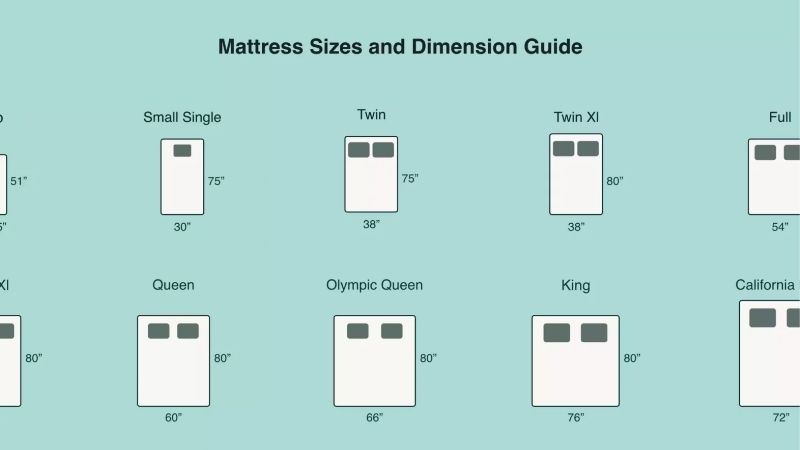
A standard US Queen measures 60 by 80 inches and a standard King measures 76 by 80. Length is identical between them, so nothing about this mismatch shows up at the head or the foot of the bed, and a glance down the length of the room will not reveal the problem at all once the bed is made up.
Casper’s current guidance states directly that a King mattress does not work properly on a Queen frame, because the additional width has nothing beneath it. In surface-area terms a King covers 6,080 square inches against a Queen’s 4,800, which is roughly 26.7 percent more mattress to support.
Calculate the Unsupported Width Per Side
Use one calculation throughout: the mattress width minus the frame’s actual support width, divided by two. Against a nominal 60-inch Queen support surface that gives about 8 inches of unsupported mattress on each side, assuming the King has been centred on the frame rather than pushed hard against one rail.
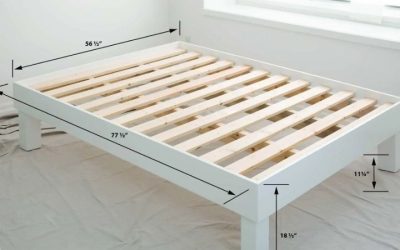
Run it on your own frame rather than on the nominal number. The Article Lenia and Nera Queens both have a 60.5-inch interior cavity, which works out at roughly 7.75 inches per side instead, and half an inch of difference in the cavity moves the result by a quarter inch on each edge.
Overall Frame Width Does Not Solve the Problem
The Lenia Queen measures 63 inches across the outside but only 60.5 inches inside, and the Nera Queen is 62 inches outside with the same 60.5-inch cavity. Those extra inches are side rails and upholstery, and a decorative rail is not a support surface for a mattress however solid it looks from the side.
That distinction is where the mistake usually happens, because a 63-inch outer measurement looks encouraging next to a 76-inch mattress. Measure from the inside face of one rail to the inside face of the other, at the level the mattress actually rests on, and use only that figure.
Mattress Warranty Requirements Still Apply
Support is not only a question of width across the bed. Purple’s warranty terms call for a centre support with five or six legs on Queen, King and Cal King sizes, and slats spaced no more than 3.5 inches apart wherever a slatted frame is used without an additional foundation beneath the mattress.
A King mattress perched on Queen rails fails that test twice over, since the edges have no slat beneath them and the centre support was positioned for a narrower bed. Read the foundation clause in your own mattress warranty before assuming that any improvised arrangement will still be covered by it.
Adjust for Your Situation
What to do next depends on whether the King mattress has already been bought, and on whether the bedroom itself can absorb the extra 16 inches of width at all. Three of the four situations below end with a different frame, and the fourth ends with keeping the Queen bed you already own.
If You Already Own the King Mattress
Measure the support surface first, not the headboard or the outside of the rails, and write down the width you get at mattress level before doing anything else. If that figure comes back near 60 inches, the honest conclusion is that this frame cannot carry the mattress regardless of how it looks once made up.
Seven to eight inches of unsupported mattress on each side is not a tolerance to live with, and it concentrates load on the slats that remain under the middle. Replacing the frame or the base with a King-size system is the only real fix, and nothing padded underneath the overhang substitutes for proper support.
If You Want to Keep the Queen Headboard
A headboard can often be retained separately from the support structure, using an adapter bracket that mounts it to a new King frame. That keeps the look you paid for, and a headboard is the one part of a bed carrying no mattress load at all, which is why it transfers between frames more easily than rails do.
What an adapter cannot do is widen anything at all. The rails, the slats, the legs and the centre support must all still be King-size items, so treat the headboard purely as a styling decision and verify the new support system against your mattress warranty entirely on its own terms.
If You Have a Universal Adjustable Metal Frame
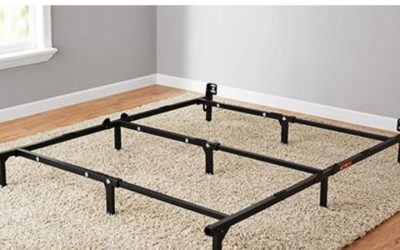
Some metal bed frames adjust across several sizes, and a few of them genuinely do include a King configuration among those settings. Expand one only where the maker lists King explicitly among its settings and supplies the centre support and additional legs that the wider configuration needs to work.
Adjustable width on its own is not sufficient evidence. A frame that stretches to King dimensions without adding centre rails simply leaves the middle of the mattress unsupported instead of the edges, which trades one problem for another and usually shows up as a dip within months.
If the Bedroom Is Tight
Sixteen inches of extra mattress width has to come out of the walkways somewhere, so measure the room before committing to the upgrade. Check the door swing, the clearance beside each nightstand and the path from the door to the wardrobe, ideally with the new footprint marked out on the floor in masking tape first.
Bedding is the cost people most often forget alongside the frame itself. Moving from Queen to King means new sheets, a new mattress protector and usually a new duvet as well, and none of that transfers across, so the frame is only one part of what the change actually costs to complete.
Frequently Asked Questions
The questions below separate the two things that routinely get conflated here: whether a mattress physically rests on a frame, and whether that frame supports it the way the mattress maker intended it to be supported. Only the second of those decides anything actually worth acting on.
Can You Put a King Mattress on a Queen Frame?
No, not as a permanent sleeping arrangement it cannot. A King is 76 by 80 inches against a Queen’s 60 by 80 inches, and Casper’s current guidance says plainly that a King does not work properly on a Queen frame, because the additional width has nothing supporting it underneath at all.
It will physically balance there, which is exactly why the question keeps being asked in the first place. The test is not whether a mattress stays on the frame overnight but whether its full width is carried, and on a Queen support surface close to a quarter of that width is not.
How Far Would a King Mattress Overhang a Queen Frame?
About 8 inches on each side against a nominal 60-inch Queen support surface, and roughly 7.75 inches per side on a measured 60.5-inch cavity such as the Article Lenia or Nera. Both of those figures assume the mattress has been centred on the frame rather than pushed hard to one edge.
Measure your own frame rather than taking either number, because Queen frames vary in cavity width even when the nominal size matches. Whichever figure you arrive at, it is a structural gap rather than a clearance, and it sits exactly where a sleeper’s weight lands when getting in and out of bed.
Are King and Queen Mattresses the Same Length?
Yes, both standard US sizes measure 80 inches long, which is precisely why this mismatch is entirely lateral. A King adds all of its extra space across the bed rather than down the length of it, so a frame that fits perfectly on length still falls 16 inches short across the width.
A Cal King is the exception worth knowing, at 72 by 84 inches, which is narrower and longer than a standard King. Those two are not interchangeable with each other either, so confirm which one a frame, a foundation or a set of sheets is actually built for before ordering anything.
Can a Foundation Fix the Queen-to-King Mismatch?
Only if the whole support system becomes King-size. A Queen foundation is still 60 inches wide, and Saatva lists its Queen foundation at 60 by 80 inches against 76 by 80 for the King, so adding one underneath the mattress changes the height of the finished bed rather than its width.
The same logic applies to a bunkie board or a platform insert laid across Queen rails. Width comes from the frame itself, so the component that has to change size is whichever one carries the mattress, and anything stacked on top of a 60-inch wide structure still measures 60 inches across.
Final Thoughts
If the King mattress has not been bought yet, that is the decision worth revisiting rather than the frame. Keeping a Queen avoids a new frame, a new foundation and a complete change of bedding, and a king size mattress on queen frame rails was never going to be the saving it looks like.