Key takeaways
- Shoppers searching for a milwaukee tools air compressor mostly want to know whether the M18 FUEL 2-gallon unit is worth it and how it compares. The answer turns on usable air delivery at 90 PSI, not maximum pressure, so the…
Shoppers searching for a milwaukee tools air compressor mostly want to know whether the M18 FUEL 2-gallon unit is worth it and how it compares. The answer turns on usable air delivery at 90 PSI, not maximum pressure, so the units below are compared on air delivery, tank size, noise and power type.
As an Amazon Associate we earn from qualifying purchases.
By KK Home Furnishings Editorial Team
How to Choose an Air Compressor Like the Milwaukee M18
Choosing an air compressor like the Milwaukee M18 works best when you read usable air delivery at 90 PSI first, then tank size, the cordless trade-off and noise for indoor work. Those four steps keep the focus on how much air a tool actually gets rather than on a headline maximum pressure that says little about real performance.
Compare SCFM At 90 PSI First
The number that decides whether a compressor keeps a tool running is air delivery at 90 PSI, stated in SCFM. The Milwaukee M18 FUEL 2840-20 delivers 1.2 SCFM at 90 PSI, while the corded Husky 3300241A delivers 2.4 and the Campbell Hausfeld delivers 2.2, so the gap in usable air is real across these units.
Match that figure to the tool you run: a brad or finish nailer sips air and suits a lower figure, while a framing nailer or any continuous tool wants more. Read SCFM at 90 PSI rather than maximum pressure, since a high maximum means little if the compressor cannot supply enough air to keep the tool working steadily.
The caution is that air delivery alone does not settle it, because the Milwaukee is cordless while the Husky and Campbell are corded, which is a different use case. A corded unit’s higher delivery suits a stationary shop, while the Milwaukee trades some flow for the freedom to work with no outlet at all nearby.
Tank Size Does Not Equal Air Delivery
A bigger tank stores more air between cycles, but it does not raise the rate the pump can deliver. The Milwaukee and Makita both use a 2-gallon tank, yet tank size tells you how long you can work before the motor restarts, not the air delivery at 90 PSI that governs whether a tool keeps running under load.
Match the tank to the job pattern: a small tank suits short bursts like trim work, where the stored air covers the gaps, while continuous tools draw on the pump’s delivery rate rather than the tank. A large tank with low air delivery still starves a hungry tool once the stored air runs down during steady use.
The practical point is to read both numbers rather than being swayed by tank size alone. For intermittent nailing a 2-gallon tank is plenty, but for anything continuous the air delivery at 90 PSI is what decides performance, so treat tank volume as convenience and the SCFM figure as the real capability.
Cordless Convenience Changes The Trade-Off
Going cordless changes what you are comparing, so weigh it deliberately rather than by numbers alone. The Milwaukee M18 and the Makita run on battery platforms, trading some air delivery for the freedom to work anywhere, while the Husky and Campbell Hausfeld are corded units that deliver more air but need an outlet to do it.
Match the choice to where you work: a cordless unit suits a job site, a roof or anywhere without power, and is a natural pick for someone already invested in M18 batteries. A corded compressor suits a garage or shop with an outlet, where its higher air delivery is more useful than the portability of a battery unit.
The trade-off is not that one is simply better, since they serve different needs, so ranking them on air delivery alone would misread the comparison. A cordless unit with lower flow can be the right tool for untethered work, while a corded one with higher flow wins for stationary jobs that run tools continuously.
Noise And Weight Matter On Indoor Jobs
For indoor or occupied spaces, noise and weight matter alongside air delivery. The Milwaukee and Makita are rated at 68 decibels, the Campbell Hausfeld at 65, and the Husky at under 65, figures close enough that none is dramatically quieter than another, though all are quieter than an old-style oil-lubricated compressor.
Match the noise level to the setting: finish work inside a home, or a workshop near living space, benefits from a quieter unit, while an open garage is more forgiving. Weight matters too for a cordless unit you carry, with the Milwaukee at about 31 pounds as a bare tool, which is manageable but not exactly light.
Read the noise figures as close rather than decisive, since the quietest here is only stated as under 65 decibels rather than an exact number. For regular indoor use, favor the lower-noise units and wear hearing protection anyway, and factor the carry weight into a cordless unit you plan to move between jobs often.
Top Picks
These picks lead with the Milwaukee M18 FUEL 2840-20, the unit most shoppers are really asking about, then set it against a value corded option, a higher-delivery quiet unit and a cordless alternative, with specs verified as of October 2026. They are matched to use cases rather than ranked on air delivery alone.
| Product | Best For | Key Spec | Watch Out For |
|---|---|---|---|
| Milwaukee M18 FUEL 2840-20 | M18 Battery Users | 2 gal; 1.2 SCFM at 90 PSI; 68 dBA; ~$399 | Bare tool; lower air delivery |
| Husky 3300241A | Corded Shop Use | 2.4 SCFM at 90 PSI; 135 PSI; ~$179 | Corded; needs an outlet |
| Campbell Hausfeld DC020500 | Higher Air At Low Noise | 2.2 SCFM at 90 PSI; 65 dBA | Corded; confirm current price |
| Makita AC001GZ | Cordless Alternative | 2 gal; 135 PSI; 68 dB; ~$499 | Highest price; bare tool |
Milwaukee M18 FUEL 2840-20 – Best Overall For M18 Battery Users
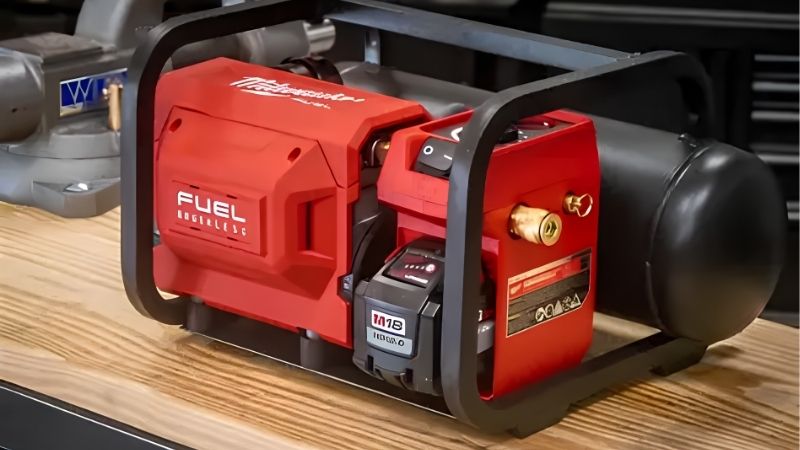
The Milwaukee M18 FUEL 2840-20 is the pick for anyone on the M18 platform, a cordless 2-gallon unit delivering 1.2 SCFM at 90 PSI with a 135 PSI maximum, rated at 68 decibels and weighing about 31.25 pounds as a bare tool, listed around $399 tool-only at Home Depot as of October 2026 for the unit alone.
Its appeal is cordless freedom on the M18 battery system, letting you run a nailer on a roof or a site with no outlet, which is exactly what the search for this compressor is usually about. For trim and intermittent nailing, the 1.2 SCFM delivery and 2-gallon tank are a sensible match to the kind of work.
The caveats are air delivery and cost: at 1.2 SCFM it supplies less than the corded units here, so it suits intermittent tools rather than continuous ones, and at about $399 it is a bare tool with the battery extra. For M18 owners that math works; for others, a corded unit delivers more air for less money.
Husky 3300241A – Best Value For Corded Shop Use
The Husky 3300241A is the value pick for a shop with an outlet, a corded unit delivering 2.4 SCFM at 90 PSI with a 135 PSI maximum and a noise rating under 65 decibels, listed around $179 at Home Depot as of October 2026. Its air delivery is the highest here, at twice the Milwaukee’s SCFM figure.
That higher flow suits continuous tools and general shop work, and the corded design means no battery to charge or replace over time. At about $179 it is also comfortably the cheapest here, which makes it the obvious choice for stationary use where portability is not needed and an outlet is always to hand nearby.
The trade-off is the cord: it needs power at the point of use, so it does not suit untethered work the way the Milwaukee does. Its higher SCFM does not make it simply better, since it serves a different, stationary role, but for a garage or workshop it delivers more air for far less money than the cordless picks.
Campbell Hausfeld DC020500 – Best For Higher Air Delivery At Low Noise
The Campbell Hausfeld DC020500 pairs strong air delivery with low noise, a corded unit delivering 2.2 SCFM at 90 PSI with a 125 PSI maximum, rated at 65 decibels for outdoor use. It sits just behind the Husky on air and among the quieter options, which suits work near living space or in an occupied shop.
The combination of 2.2 SCFM and a 65-decibel rating makes it a sensible choice where both air and quiet matter, such as a home workshop. As a corded unit it keeps up with continuous tools better than the cordless picks, trading portability for a steady supply of air drawn straight from the wall outlet.
The caveats are its corded design and that its current price was not confirmed at the time of writing, so check it before buying. Its 125 PSI maximum is a touch below the others, which matters little for most air tools, but as always read the SCFM at 90 PSI rather than the maximum as the real figure.
Makita AC001GZ – Best Cordless Alternative
The Makita AC001GZ is the cordless alternative to the Milwaukee for those on the Makita XGT platform, a 2-gallon 40V unit with a 135 PSI maximum rated at 68 decibels, listed around $499 tool-only at Home Depot as of October 2026. It offers the same untethered freedom on a different battery system entirely.
For a workshop already running Makita XGT tools it is the natural pick, matching the cordless convenience of the Milwaukee without switching platforms. The 2-gallon tank and 135 PSI maximum suit the same intermittent, portable work, so the choice between it and the Milwaukee often comes down to which batteries you already own.
The caveats are price and an unresolved air-delivery figure: at about $499 it is the most expensive here as a bare tool, and a comparable SCFM at 90 PSI was not available from the current source. Confirm the air delivery against the tools you run, since that figure, not the tank or maximum, decides performance.
Frequently Asked Questions
Shoppers researching this compressor tend to ask the same practical questions, and most come back to air delivery and noise rather than brand loyalty. These answers keep the numbers tied to the picks above while being clear that cordless and corded units serve different jobs and should not be ranked on SCFM alone.
Is The Milwaukee M18 Compressor Good For Framing Nailers?
It depends on the nailer’s air demand, since framing nailers draw more air than trim guns. The Milwaukee M18 2840-20 delivers 1.2 SCFM at 90 PSI, which comfortably suits brad and finish nailers but is modest for a framing nailer used continuously rather than for the occasional single shot here and there.
The reason is air delivery: a framing nailer fires larger fasteners and, in steady use, draws more air than a 1.2 SCFM supply can sustain for long. For occasional framing shots the stored tank air helps, but for continuous framing a higher-SCFM compressor, often a corded one, keeps up with the tool far better.
Check the nailer’s own air requirement against the compressor’s 1.2 SCFM before relying on it for framing work. For intermittent work it can manage, but if framing is the main job, the corded units here with higher SCFM, or a larger compressor, are the safer match than the cordless M18 unit on its own.
How Many PSI Does The Milwaukee 2840-20 Produce?
The Milwaukee M18 FUEL 2840-20 produces a maximum of 135 PSI, per the maker. That figure is the top pressure the tank reaches, which is ample for common air tools, though the number that matters more for keeping a tool running is its 1.2 SCFM air delivery measured at 90 PSI rather than at the peak.
Maximum PSI and working air delivery answer different questions: 135 PSI is the stored pressure, while SCFM at 90 PSI is the flow the pump can sustain under load. Most air tools operate well below the maximum, so the delivery figure, not the peak pressure, is what decides whether the compressor keeps up in real use.
Use the 135 PSI maximum to confirm the unit exceeds your tools’ operating pressure, which it readily does for typical nailers. Then weigh the 1.2 SCFM delivery against the tools you run, since that is the figure that determines real performance rather than the headline maximum pressure printed on the spec sheet.
How Loud Is The Milwaukee M18 Air Compressor?
The Milwaukee M18 2840-20 is rated at 68 decibels running, per the maker. That is in the same range as the Makita at 68 and only slightly above the Campbell Hausfeld at 65 and the Husky at under 65, so none of these units is dramatically quieter than the others on paper, whatever the marketing suggests.
The reason the figures sit close is that all four are designed as quieter, modern compressors compared with older oil-lubricated models. A few decibels is a modest difference in practice, though the quietest here is only stated as under 65 decibels rather than an exact number, so treat the ranking as close rather than decisive.
For indoor or occupied spaces, favor the lower-noise units and wear hearing protection regardless, since even 65 to 68 decibels over time is worth guarding against. For an open garage the difference matters less, so weigh noise alongside air delivery and power type rather than choosing on decibels alone.
Is SCFM More Important Than Tank Size?
For keeping a tool running, yes: SCFM at 90 PSI is the figure that matters most, while tank size is secondary. The Milwaukee’s 1.2 SCFM and the Husky’s 2.4 SCFM tell you how much air each can sustain, whereas their tank volumes only tell you how long before the motor restarts to refill the tank.
The reason is how tools draw air: a continuous tool depends on the pump’s delivery rate, so a large tank with low SCFM still starves it once the stored air runs down. A small tank with adequate SCFM keeps a tool going, which is why delivery, not volume, is the real capability figure to compare between units.
Read both numbers, but weight SCFM at 90 PSI more heavily when the tool runs continuously. Tank size earns its keep for short, bursty jobs like trim nailing, where stored air covers the gaps, so match both to your work rather than being swayed by a bigger tank on its own as a sign of more power.
Final Thoughts
The right milwaukee tools air compressor choice turns on usable air delivery at 90 PSI and how you work, not on maximum pressure: the cordless Milwaukee M18 FUEL 2840-20 for M18 owners who need portability, the corded Husky for the most air per dollar, the quiet Campbell Hausfeld for air and low noise, or the Makita on the XGT platform.