Key takeaways
- A mid-size fan lives or dies on how much air it moves for the power it draws, yet listings bury that behind a single headline figure. A well-chosen 42 in ceiling fan without light is judged on CFM per watt…
A mid-size fan lives or dies on how much air it moves for the power it draws, yet listings bury that behind a single headline figure. A well-chosen 42 in ceiling fan without light is judged on CFM per watt at its rated speed, so a cooler room does not arrive with a surprise on the electric bill.
As an Amazon Associate we earn from qualifying purchases.
By KK Home Furnishings Editorial Team
How to Choose a 42 in Ceiling Fan Without Light
Airflow efficiency, not raw size, separates these fans, so the criteria below are built around CFM per watt measured the same way for each model. From there they cover ceiling height and mount type, airflow for the room, and the motor and finish details that decide how quietly the fan runs over years.
CFM per Watt at Rated Speed
The single number worth comparing is airflow divided by power, CFM per watt. Among these, the Minka-Aire Mesa derives to about 104 CFM per watt, while the Hunter models land near 68 to 70. Confirm every figure is measured at the same speed, since a high-speed reading compared to another fan’s average is not a fair comparison.
Use efficiency to plan running cost, not just comfort. A fan left on for hours rewards a higher rating with a lower draw, and the Minka-Aire’s larger airflow also cools a slightly bigger space. Energy cost, though, depends on your hours of use and local rates, so treat any dollar figure as an illustration rather than a firm promise.
Efficiency figures are manufacturer-stated and shift with blade pitch, motor type, and the speed tested, with no independent airflow test published for most fans. A DC motor is often quieter and more efficient than an AC one, though not always, so weigh the rating alongside the mount and noise rather than ranking on airflow alone.
Ceiling Height and Mount Type
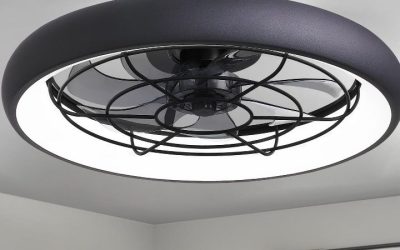
Mount type follows ceiling height, not preference. A low-profile or hugger fan like the Hunter Low Profile IV sits close to the ceiling for rooms under about eight feet, while a downrod model drops the blades into the airflow zone in taller rooms. Installation guidance commonly asks for at least seven feet of blade-to-floor clearance.
Measure before choosing. From the ceiling, subtract the fan’s drop and confirm the blades still clear heads and doors with the recommended margin. In a low room a standard downrod fan can sit too low, which is why hugger mounts exist; in a vaulted room a flush mount leaves the blades too high to feel any breeze below.
Mount also shapes the airflow you actually feel. A fan too close to the ceiling moves air but circulates it less effectively, while one hung at the right height pushes a stronger column downward. Match the mount to the room first, then compare efficiency within that group, since a mismatch undoes an otherwise good CFM-per-watt number.
Airflow for the Room Size
Airflow should suit the room, and a 42-inch span fits small to mid-size spaces: bedrooms, offices, and compact living rooms. The models here move roughly 2,900 to 4,700 CFM; more airflow suits a larger or warmer room, while a lower figure is plenty for a tight space where a constant gale would feel unwelcome.
Treat advertised room-size coverage as secondary to airflow and layout. A rule of thumb pairs blade span with square footage, but ceiling height, furniture, and whether the fan is your main or supplemental cooling all shift it. Use the CFM figure and your room’s real dimensions, not a marketing coverage claim, as the deciding input.
Direction matters year-round. Most fans reverse to pull air upward in winter, redistributing warm air without a chilling draft, which stretches the value of a light-free fan past summer. Confirm the model reverses and that the switch or remote is reachable, since a wall toggle on a high ceiling is awkward to flip often.
Motor, Noise and Finish
The motor sets noise and longevity. DC motors generally run quieter and draw less power than AC ones, which shows in the Minka-Aire’s efficiency, though a quality AC motor can still be quiet. Where the maker publishes a decibel figure it is usually measured on one speed, so read the condition before trusting the number outright.
Finish and blade material affect looks and upkeep on a light-free fan meant to disappear into the ceiling. Sealed or coated blades resist dust and warping, and a low-profile housing hides the motor in tight rooms. Confirm the fan is dry-rated for an indoor room, or damp-rated if it is heading to a covered porch instead.
Common faults are a wobble from an unbalanced blade or a loose downrod, plus remote or capacitor issues over time. Use the included balancing kit at install, and keep the model and date for warranty claims. Replacement remotes and capacitors are usually available, so a noise or speed fault rarely means a whole new fan at all.
Top Picks
With three current models publishing clean airflow-per-watt figures at this size, the fourth row below is a verification step rather than filler. Each 42 in ceiling fan without light leads with its CFM and watts; compare them at the same speed, and pick the mount that suits your ceiling before ranking on efficiency.
| Product | Best For | Key Spec | Watch Out For |
|---|---|---|---|
| Minka-Aire Mesa F566 | Best overall efficiency | 4,700 CFM; 45 W (~104 CFM/W) | Efficiency is derived; confirm the tested speed |
| Hunter Builder Elite 42 | Best value | 3,005 CFM; 30 W (70 CFM/W) | Needs a downrod for airflow in taller rooms |
| Hunter Low Profile IV 42 | Best for low ceilings | 2,926 CFM; 29 W (68 CFM/W) | Hugger mount circulates less in big rooms |
| What to verify on any unit | Same-speed CFM | Dry vs damp rating; blade clearance | High-speed vs average CFM must not be mixed |
Minka-Aire Mesa F566: Best Overall Efficiency
The Minka-Aire Mesa F566 leads on the defining spec: roughly 4,700 CFM for about 45 watts, which derives to around 104 CFM per watt, well ahead of the field. It suits a mid-size room that needs strong, efficient airflow. It sits in the premium tier, so confirm the current price before you place an order.
Its advantage is moving far more air per watt, so it cools a slightly larger space while sipping power over long runs. That efficiency typically points to a DC motor, which also tends to run quieter in use. Confirm your ceiling height suits the mount and that the remote or control reaches comfortably from the room below.
The caveat is that the per-watt figure is derived and manufacturer-stated, with no independent airflow test, and airflow numbers must be read at the same tested speed to compare fairly. As the priciest pick, its efficiency has to earn the premium over the Hunter models, so weigh your running hours against the gap first.
Hunter Builder Elite 42: Best Value
The Hunter Builder Elite 42 is the value pick, moving about 3,005 CFM on 30 watts for roughly 70 CFM per watt. It fits a standard bedroom or office that wants solid airflow without the premium outlay. It lands in the budget-to-mid tier, so check the current price, which shifts with finish and retailer at any given time.
Its strength is a dependable airflow-to-power balance at a lower cost, which makes it an easy whole-room choice. As a downrod-style fan it performs best in rooms with enough height to drop the blades into the airflow zone. Measure your ceiling and confirm at least the recommended blade-to-floor clearance before choosing this over a hugger.
The trade-off is the mount: in a low room a downrod fan can hang too close to heads, so this is not the pick for ceilings under about eight feet. Efficiency sits below the Minka-Aire, which only matters if you run the fan for long stretches, so keep the balancing kit handy for the occasional blade wobble.
Hunter Low Profile IV 42: Best for Low Ceilings
The Hunter Low Profile IV 42 is built for low ceilings, hugging the mount while still moving about 2,926 CFM on 29 watts, near 68 CFM per watt. It suits rooms under eight feet where a dropped fan would sit in the way of people below. It is a mid-tier option, so confirm the live price before buying it.
Its advantage is clearance: the flush housing keeps blades safely overhead in tight rooms where a downrod model cannot go, and airflow and efficiency stay close to the Builder Elite. Confirm the fan is dry-rated for an indoor room, or damp-rated if it is destined for a covered porch, before you settle on this mount.
The compromise is reach. A hugger mount circulates air a little less effectively than a well-hung downrod fan, so in a large or tall room it underperforms its airflow number. Keep it to the small, low rooms it is designed for, and use the balancing kit at install to head off the wobble these compact fans can develop.
How to Verify Airflow Before You Buy
Because airflow numbers are only comparable at matching conditions, verify them yourself before ranking fans. Confirm each CFM figure is stated at the same speed, usually the highest, since a high-speed reading set against another fan’s average overstates the difference. Where a listing is vague, ask the seller which speed the number reflects.
Then translate airflow into efficiency. Divide CFM by watts to get CFM per watt, the figure that reveals how much cooling each fan buys for its power draw. Use that to compare models on equal footing, and remember these are manufacturer-stated figures with no independent airflow test, so treat the ranking as a guide, not a guarantee.
Finally, check the rating and mount against your room. Confirm the fan is dry-, damp-, or wet-rated for where it will hang, and measure floor-to-ceiling to be sure the mount leaves the recommended blade clearance. A number that looks great on paper is wasted if the fan sits at the wrong height or in the wrong environment.
Frequently Asked Questions
The questions buyers ask about a light-free mid-size fan come down to airflow, fit, and running cost. Each answer below leads with the short version, then adds the variable, whether ceiling height, room size, or usage hours, that changes it, so the 42 in ceiling fan without light you pick matches the room it has to cool.
Is a 42-inch fan big enough for my room?
For a small to mid-size room, usually yes. A 42-inch span suits bedrooms, offices, and compact living spaces, moving the 2,900 to 4,700 CFM these models publish. For a large or open room, a wider fan or a second unit moves air more evenly across the floor than one mid-size blade ever can.
Blade span pairs loosely with floor area, but the better inputs are the fan’s CFM and your ceiling height. A tall ceiling needs a downrod to bring the blades into reach, while a crowded or L-shaped room may need airflow aimed where people actually sit rather than simply a bigger blade spinning overhead.
If the room doubles as your only cooling, lean toward the higher-airflow model and run it alongside an air conditioner to spread the cool. For gentle circulation in a tight space, the lower-CFM fans are plenty, and a smaller, quieter fan is usually the better and less intrusive fit there anyway.
What does CFM per watt actually tell me?
It tells you how efficiently the fan turns power into airflow, and higher is better. A fan near 104 CFM per watt moves far more air for the same draw than one near 68, which matters most if you leave it running for hours at a time rather than switching it on only briefly in the evening to take the edge off.
Compare the figures at the same speed, since a high-speed CFM set against another fan’s average reading overstates the gap. These numbers are manufacturer-stated with no independent airflow test, so use them to rank efficiency, not as a precise guarantee of how the fan performs in your particular room and layout.
Any electricity-cost estimate depends on your running hours and local rate, so treat a dollar figure as an illustration rather than a fixed saving. Over long daily use the efficient model pays back, while for occasional use the difference in the bill is small enough to decide on mount and noise instead.
Low-profile or downrod, which do I need?
It depends on ceiling height. A low-profile or hugger mount suits ceilings under about eight feet, keeping blades safely overhead, while a downrod drops the fan into the airflow zone in taller rooms. Installation guidance commonly asks for at least seven feet of blade-to-floor clearance underneath the spinning blades.
Measure from the floor to the ceiling, subtract the fan’s drop, and confirm the blades still clear heads and the recommended margin. Too low and a downrod fan becomes a hazard; too high and a flush mount leaves the breeze stranded near the ceiling where you simply cannot feel it down below.
In standard eight-to-nine-foot rooms either can work, so decide on airflow and noise instead. For very high or sloped ceilings, check that the model accepts a longer downrod and an angled mount, since not every compact fan offers them, and a mismatch leaves the blades hanging at the wrong height.
Can a no-light ceiling fan go on a covered porch?
Only if it is rated for it. An indoor fan is dry-rated; a covered porch needs at least a damp rating, and an open, weather-exposed spot needs a wet rating. Check the listing before buying, since a dry-rated fan used outdoors can corrode and fail well before the end of its expected life.
Damp and wet ratings reflect sealed motors and weather-resistant finishes, which most of these indoor-focused models do not carry at all. If outdoor use is the goal, filter for a damp- or wet-rated fan first, then compare airflow and efficiency within that smaller, more suitable group of models rather than this one.
For a sheltered indoor room, a dry rating is all you need, and these fans are built for exactly that. Keep moisture and dust off the blades to protect the motor, and confirm the finish suits the room, since a light-free fan is meant to blend quietly into the ceiling above rather than stand out.
Final Thoughts
The right 42 in ceiling fan without light is the one whose airflow-per-watt holds up at the same tested speed as its rivals and whose mount fits your ceiling. Before ordering, measure floor to ceiling and subtract the fan’s drop to confirm the blade clearance, since a downrod in a low room, or a hugger in a tall one, wastes the efficiency.