Key takeaways
- These fans are not truly bladeless; the blades are hidden inside an enclosed housing, and almost none publish an airflow figure. A bladeless ceiling fan with light is best judged on its light output, size, and mount, with airflow verified…
These fans are not truly bladeless; the blades are hidden inside an enclosed housing, and almost none publish an airflow figure. A bladeless ceiling fan with light is best judged on its light output, size, and mount, with airflow verified separately, since lumens and watts tell you nothing about how much air it moves.
As an Amazon Associate we earn from qualifying purchases.
By KK Home Furnishings Editorial Team
How to Choose a Bladeless Ceiling Fan With Light
Because makers rarely publish airflow for these enclosed fans, you cannot rank them on it the way you would a standard fan. These criteria start with what bladeless really means and how to check airflow yourself, then cover light output, size and mount, and the cleaning and safety traits of an enclosed design.
What Bladeless Really Means
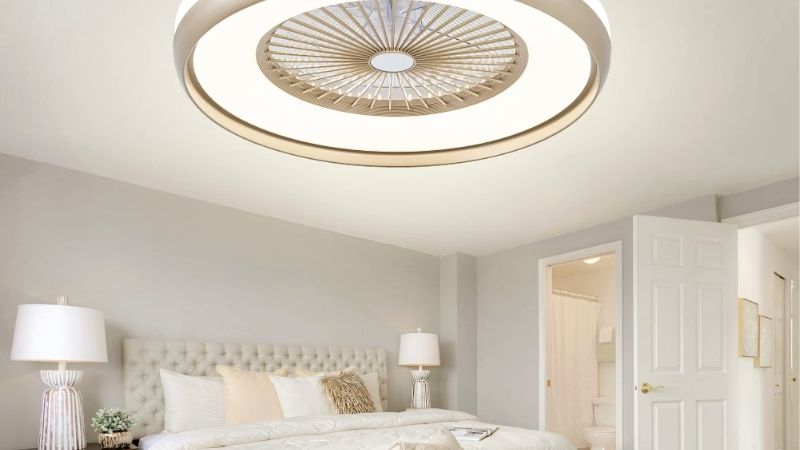
A bladeless ceiling fan still has blades; they are simply hidden inside an enclosed housing, so avoid any claim that there are no moving parts inside. The sealed look is the appeal, keeping fingers and dust away from the blades, but it does not change the basic physics of how the fan pushes air downward into the room.
The catch is data: among current enclosed models with a light, airflow in cubic feet per minute is almost never published, so there is no verified figure to rank them by. That makes this category different from a standard fan, where you compare CFM directly, and it is why these picks are judged on other verified specs.
Treat the enclosed design as a style and safety choice rather than a performance upgrade. It will not automatically move more air than a bladed fan of the same size; if anything, the housing can restrict flow. Judge the fan on the specs that are published, and verify airflow yourself before assuming it cools a large room.
Light Output and Color
With airflow unpublished, light output becomes a leading spec, and here it is well documented. The HUMHOLD model lists up to 5,000 lumens, bright enough to light a room on its own, while others publish wattage instead, like the Dazuma at 45 watts. Judge brightness by lumens where given, not by watts, which only measure power draw.
Match the output to the room. A bedroom needs far fewer lumens than a kitchen or open living space, so a 5,000-lumen fan may be more light than you want over a bed unless it dims. Confirm the fan offers dimming and a color-temperature choice if it is your main light source, since a fixed, bright white can feel harsh.
Because the light and fan are combined, a failure in one can mean replacing both, so check that the LED is rated for a long life and whether the module is replaceable. An integrated LED that cannot be swapped turns a dead light into a dead fan, which is a real cost to weigh against the clean enclosed look.
Size and Mount for the Room
Size still matters even without a CFM figure, so match the fan’s diameter to the room. These run from about 19.7 inches on the compact Lexoka to 24 inches on the HUMHOLD, suiting small to mid-size rooms. A larger housing generally serves a bigger space, but confirm the mount suits your ceiling before assuming it will fit.
Check the mounting style and ceiling height. Enclosed fans are often flush or low-profile, which suits lower ceilings, but confirm the drop and that blades, hidden or not, clear the recommended height above the floor. Measure from the floor to the ceiling and subtract the fixture’s depth before choosing a model for a low room.
Weight affects installation on an enclosed fan, since the housing adds mass; the Dazuma, for instance, is listed at about six kilograms. Confirm your ceiling box is rated for a fan, not just a light fixture, because a combined fan-and-light unit is heavier than a bare light and needs a fan-rated support to stay safely mounted.
Cleaning, Safety and Durability
The enclosed design is easier to keep clean on the outside and safer around curious hands, since the blades are shielded. That is a genuine advantage in a child’s room or a low-ceiling space. Dust still collects on and inside the housing, though, so check how the unit opens for cleaning before you buy, as some seal tighter than others.
Look for safety certification such as a UL or ETL listing on the fan and its light, especially since the two are combined in one powered fixture. A listed unit has been tested for electrical safety, which matters more when a single device carries both the motor and a bright LED drawing meaningful power at the ceiling.
Durability comes down to the motor and the LED, the two parts most likely to fail. A DC motor tends to run quieter and cooler, which can extend life, though that is not guaranteed. Confirm whether the maker sells replacement parts or a remote, since an enclosed fan is harder to service than an open one if something fails.
Top Picks
Because no maker here publishes airflow for an enclosed bladeless ceiling fan with light, there is no outright winner on how much air these move; each pick leads instead with a verified spec like brightness or size. The fourth row shows how to check airflow yourself, using a fan that does publish a figure as a yardstick.
| Product | Best For | Key Spec | Watch Out For |
|---|---|---|---|
| HUMHOLD enclosed fan light | Best for brightness | 24 in; up to 5,000 lm | Very bright; confirm it dims for a bedroom |
| Dazuma enclosed fan light | Best for a sturdier build | 45 W; ~6 kg | Heavier; needs a fan-rated ceiling box |
| Lexoka enclosed fan light | Best for small rooms | 19.7 in compact housing | Compact size suits only a small space |
| How to verify airflow | Airflow you can check | Ask for CFM; compare to a rated fan | CFM is not published on these models |
HUMHOLD Enclosed Fan Light: Best for Brightness
The HUMHOLD enclosed fan is the pick when light matters most, listing up to 5,000 lumens in a 24-inch housing, bright enough to be a room’s main light. It suits a kitchen or living space that needs real illumination. It sits in the mid tier, so confirm the current price before you place an order.
Its advantage is output: 5,000 lumens is a lot of light from a ceiling fixture, and the 24-inch size suits a mid-size room. Confirm it dims and offers a color-temperature choice, since that much light over a bed or a quiet corner can feel harsh if it only runs at full, cool brightness all evening.
The honest caveat is airflow: like the others, HUMHOLD does not publish a CFM figure, so you cannot know how much air it moves without asking. Judge it on the verified brightness, confirm the LED is replaceable or long-rated since light and fan are combined, and verify airflow separately before counting on it to cool a room.
Dazuma Enclosed Fan Light: Best for a Sturdier Build
The Dazuma enclosed fan is the pick where build matters, listing about 45 watts and roughly six kilograms, a more substantial fixture than the lightest options. It suits a room where a solid, well-made unit is worth the extra weight. It sits in the mid tier, so verify today’s price before ordering it.
Its advantage is a heavier, more solid construction, which can mean a steadier fixture and a sturdier motor housing. Because it weighs around six kilograms, confirm your ceiling box is rated for a fan rather than just a light, since a combined fan-and-light unit this heavy needs fan-rated support to mount safely overhead.
The caveat is that wattage is not airflow: 45 watts tells you power draw, not how much air the fan moves, which Dazuma does not publish. Judge it on the build and verified wattage, check for a UL or ETL listing given the combined motor and light, and confirm airflow with the seller before relying on it for cooling.
Lexoka Enclosed Fan Light: Best for Small Rooms
The Lexoka enclosed fan is the compact pick at about 19.7 inches, sized for a small bedroom, office, or nursery where a larger housing would overwhelm the ceiling. It suits tight rooms and lower ceilings. It sits in the budget-to-mid tier, so confirm the live price before you commit to it.
Its advantage is the small footprint: a 19.7-inch enclosed fan fits a compact room and a low ceiling where a 24-inch unit feels heavy overhead. The shielded blades are a real plus in a child’s room. Measure your ceiling height and confirm the mount suits a low room before choosing this over a larger model.
The caveat is coverage and data: a compact fan suits only a small space, and like the others Lexoka does not publish airflow, so do not expect it to cool a large room. Judge it on the verified size and the enclosed-safety benefit, and verify the airflow figure with the seller before assuming it moves much air.
How to Verify Airflow on a Bladeless Fan
Since none of these enclosed models publish a CFM figure, verify airflow yourself before buying. Ask the seller directly for the airflow in cubic feet per minute and the speed it was measured at; a maker confident in the fan’s performance can usually provide it, and a refusal to answer is itself useful information.
Use a fan that does publish airflow as a yardstick. A comparable 20-inch enclosed fan on the market lists around 2,000 CFM at about 36 watts, which works out near 56 CFM per watt; that gives you a rough benchmark to judge any quoted figure against rather than accepting a vague cooling claim at face value.
Do not substitute lumens or watts for airflow, since neither measures how much air a fan moves. If you cannot get a real CFM figure, treat the fan primarily as a light fixture with gentle air movement, and size your cooling expectations accordingly rather than assuming the enclosed design performs like a full bladed fan.
Frequently Asked Questions
Buyers drawn to the sleek look of these fans ask the same questions about blades, airflow, and brightness. Each answer below leads with the short version, then adds the detail that changes it, so you can judge a bladeless ceiling fan with light on what makers actually publish rather than on the marketing around it.
Are bladeless ceiling fans really bladeless?
No. A bladeless ceiling fan hides its blades inside an enclosed housing rather than doing away with them, so there are still moving parts inside. The sealed design keeps fingers and dust off the blades, which is genuinely safer, but it is a styling and safety choice, not a fan that moves air without any blades at all.
The enclosed look is the appeal, especially in a child’s room or a low-ceiling space where shielded blades reduce risk. Just do not read bladeless as meaning no blades or inherently better airflow, since the housing can actually restrict flow compared with an open fan of the same diameter and motor.
Think of it as a design category rather than a performance upgrade. Judge the fan on its published specs and verify airflow separately, since the enclosed shell changes how it looks and how safe it is around hands, but not the basic way blades inside push air down into the room below.
Do they move as much air as a regular fan?
It is hard to say, because most enclosed models with a light do not publish an airflow figure. Without a CFM number, you cannot compare them directly to a standard fan, and the housing may restrict flow, so do not assume a bladeless fan matches an open one of the same size on air movement.
Lumens and watts do not answer this, since neither measures airflow; a very bright or high-wattage fan can still move modest air. The only honest way to compare is a CFM figure measured at a stated speed, which you usually have to request from the seller rather than read off the listing itself.
If airflow is a priority, favor a fan that publishes CFM, even a conventional one, or ask for the figure before buying an enclosed model. If you mainly want the look and a bright light with gentle air movement, a bladeless fan can suit you, as long as your cooling expectations match that reality.
How bright are bladeless fan lights?
They can be very bright: the HUMHOLD model lists up to 5,000 lumens, enough to light a room on its own, while others publish wattage instead. Judge brightness by lumens where given, since watts measure power draw rather than light output, and a higher-wattage LED is not automatically brighter than a lower one.
Match the output to the room and confirm it dims. Five thousand lumens suits a kitchen or living space but can feel harsh over a bed unless you can dim it or shift the color temperature. For a bedroom or nursery, a lower-output or adjustable model is usually the more comfortable choice in the evening.
Because the light and fan are combined, consider what happens if the LED fails. An integrated, non-replaceable LED means a dead light becomes a dead fan, so check the LED’s rated life and whether the module can be swapped, which protects the investment in a fixture that does two jobs at once.
How do you clean an enclosed ceiling fan?
Carefully, and according to the maker’s instructions, since the blades sit inside a housing. The outside wipes down easily, which is part of the appeal, but dust still reaches the interior through the vents. Check before buying how the unit opens for cleaning, because some seal tighter and are harder to access than others.
Wipe the exterior and vents regularly to keep dust from building up and from reaching the motor and LED. For the interior, follow the manual rather than forcing the housing open, and always cut power at the switch before cleaning, since you are working on a combined fan-and-light fixture wired into the ceiling.
If a model cannot be opened for interior cleaning at all, factor that into your choice, as trapped dust can affect airflow and the light over time. A fan whose housing opens for maintenance will stay cleaner and last longer than one sealed shut, so weigh serviceability alongside the look before you decide.
Final Thoughts
The right bladeless ceiling fan with light is the one whose published specs, brightness, size, and a safety listing, match your room, with airflow confirmed rather than assumed, since no maker here prints a CFM figure. Before ordering, ask for airflow at a stated speed and confirm the LED is replaceable, since the light and fan fail as a pair.